
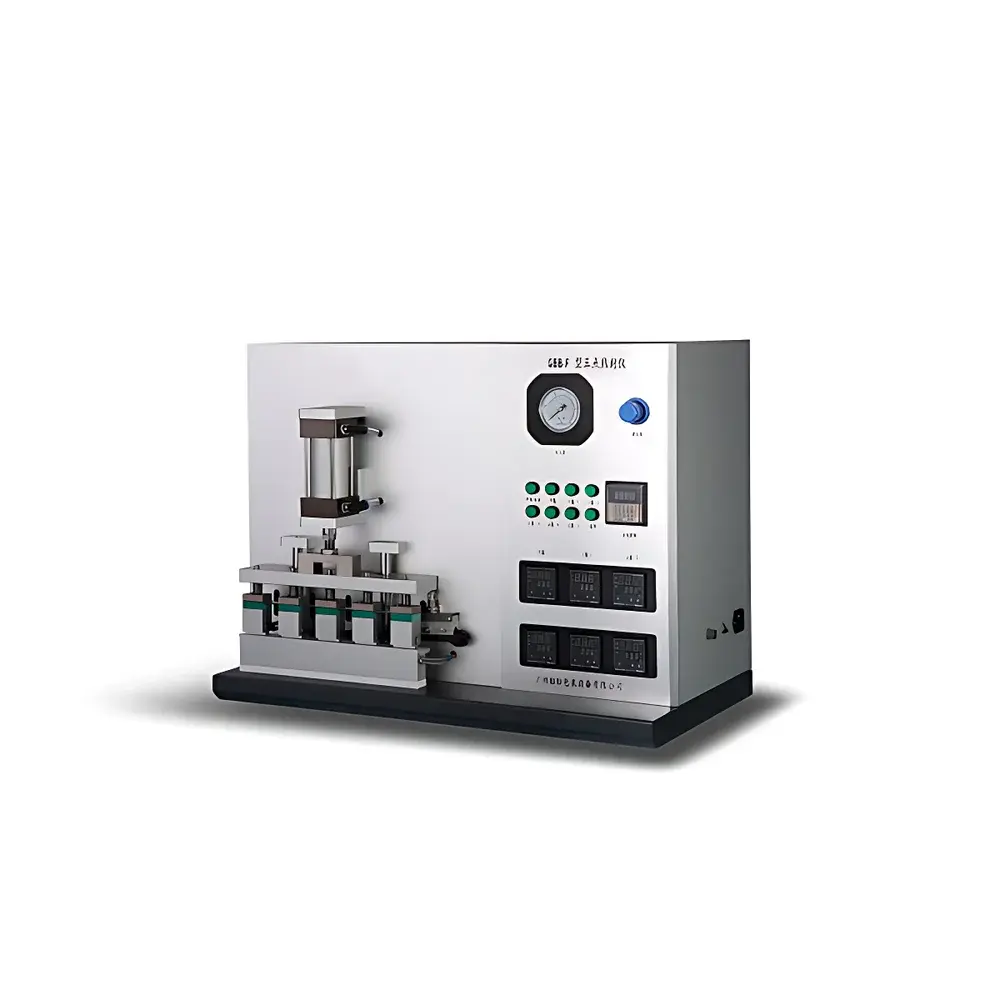
GBPI GBB-F13 Five-Point Heat Sealing Tester
| Brand | GBPI |
|---|---|
| Origin | Guangdong, China |
| Manufacturer | GBPI Packaging Instruments Co., Ltd. |
| Model | GBB-F13 |
| Temperature Range | Ambient to 300 °C |
| Temperature Control Accuracy | ±1 °C |
| Sealing Time | 0.1–999.9 s |
| Sealing Pressure | 0.05–0.8 MPa |
| Sealing Surface | Upper knife — five independent 35 × 10 mm segments |
| Heating Mode | Electric resistance heating |
| Actuation | Pneumatic (compressed air) |
| Power Supply | AC 220 V, 50 Hz |
| Rated Power | 2000 W |
| Dimensions (W×D×H) | 700 × 400 × 540 mm |
| Weight | 55 kg |
Overview
The GBPI GBB-F13 Five-Point Heat Sealing Tester is an engineered solution for quantitative evaluation of heat seal integrity in flexible packaging materials. Designed in strict accordance with international and national packaging test standards—including ASTM F2029-2016 (Standard Test Method for Measuring Heat Seal Strength of Thermoplastic Films and Laminates), QB/T 2358-1998 (Plastic Film—Heat Seal Strength Test Method), and YBB 00122003-2015 (Technical Requirements for Heat-Sealable Packaging Materials for Pharmaceutical Use)—this instrument enables precise, repeatable determination of the critical process parameters governing seal formation: temperature, dwell time, and pressure. Unlike single-point seal testers, the GBB-F13 implements a segmented five-zone upper sealing knife, each thermally isolated and independently controllable, allowing simultaneous assessment of seal performance across multiple thermal profiles on a single specimen. This architecture supports both comparative process window studies and validation of sealing equipment operating conditions under GLP- and GMP-aligned laboratory environments.
Key Features
- Five independently controlled heating zones (35 × 10 mm each) on the upper sealing knife, enabling multi-parameter thermal mapping on one sample strip
- Independent temperature control for upper knife segments and lower silicone-padded sealing bar—supports asymmetric thermal profiling
- Pneumatic actuation via regulated compressed air (recommended supply: ≥8 bar, 2.5 HP compressor), ensuring consistent force delivery and minimal mechanical hysteresis
- Dual operational modes: fully automated sequence control (programmable time/temperature/pressure) and manual foot-switch activation for rapid prototyping or troubleshooting
- Modular sealing surface design—knife geometry, contact area, surface finish (e.g., polished, matte, or anti-adhesive coated), and silicone pad hardness can be customized per application requirements
- Integrated Pt100 RTD sensors with accessible calibration ports—traceable temperature verification without disassembly
- Robust industrial-grade frame with vibration-dampened base and precision linear guide rails for uniform pressure distribution across all five zones
Sample Compatibility & Compliance
The GBB-F13 accommodates standard film specimens up to 100 mm wide and 300 mm long, including mono-layer polyolefins (LDPE, PP), coextrusions, metallized laminates, aluminum foil composites, and pharmaceutical-grade cold-forming foils. Its five-point configuration is especially suited for evaluating seal initiation thresholds, hot-tack development, and seal degradation onset across thermal gradients—key for optimizing form-fill-seal (FFS) machine settings. The instrument meets essential regulatory expectations for packaging validation: data acquisition supports audit-ready records aligned with FDA 21 CFR Part 11 (when paired with compliant software), and its mechanical design conforms to ISO/IEC 17025 metrological traceability principles for testing laboratories. All electrical components comply with IEC 61000-6-3 (EMC) and IEC 61000-6-2 (immunity) standards.
Software & Data Management
While the GBB-F13 operates as a standalone benchtop instrument with intuitive front-panel controls, it features RS-232 and optional USB interfaces for integration into laboratory information management systems (LIMS). When used with GBPI’s optional SealMaster™ PC software (v3.2+), users gain full protocol scripting, real-time parameter logging (time-stamped temperature, pressure, and actuation status), automatic pass/fail flagging against user-defined limits, and PDF report generation compliant with ISO 15142-1 (Packaging—Test Methods for Heat Seal Strength). Audit trails include operator ID, method version, calibration date, and environmental ambient log—supporting 21 CFR Part 11 electronic signature readiness when deployed with validated system configurations.
Applications
- Establishing thermal process windows for packaging line qualification (IQ/OQ/PQ)
- Comparative evaluation of sealant layer performance across resin grades and suppliers
- Hot-tack strength profiling during cooling phase (0.1–5 s dwell intervals)
- Accelerated aging studies correlating seal integrity loss with storage conditions
- Root cause analysis of package leaks, delamination, or seal creep in stability testing
- Development of child-resistant or senior-friendly peel seals requiring precise force modulation
- Validation of sterilization-compatible seals for medical device pouches (per ISO 11607-1)
FAQ
What standards does the GBB-F13 directly support?
ASTM F2029-2016, QB/T 2358-1998, and YBB 00122003-2015 are natively implemented in its test method templates and reporting structure.
Is compressed air supply included with the instrument?
No—the GBB-F13 requires an external clean, dry, oil-free compressed air source (minimum 8 bar, 2.5 HP recommended); air filtration (particulate, moisture, and oil removal) is mandatory for pneumatic longevity.
Can the sealing surfaces be modified for non-standard geometries?
Yes—GBPI offers custom tooling services for specialized knife profiles (e.g., rounded edges, stepped widths, embossed patterns) and alternative elastomer pads (Shore A 30–70, FDA-compliant silicones or fluorosilicones).
How is temperature calibration verified?
Each zone includes a dedicated Pt100 RTD sensor with direct access via terminal block; NIST-traceable calibration certificates are available upon request for individual zones.
What safety certifications apply to the electrical system?
The unit carries CE marking per Machinery Directive 2006/42/EC and Low Voltage Directive 2014/35/EU, with internal fusing, thermal cut-off protection, and grounded chassis design per IEC 61000-6-2.






