
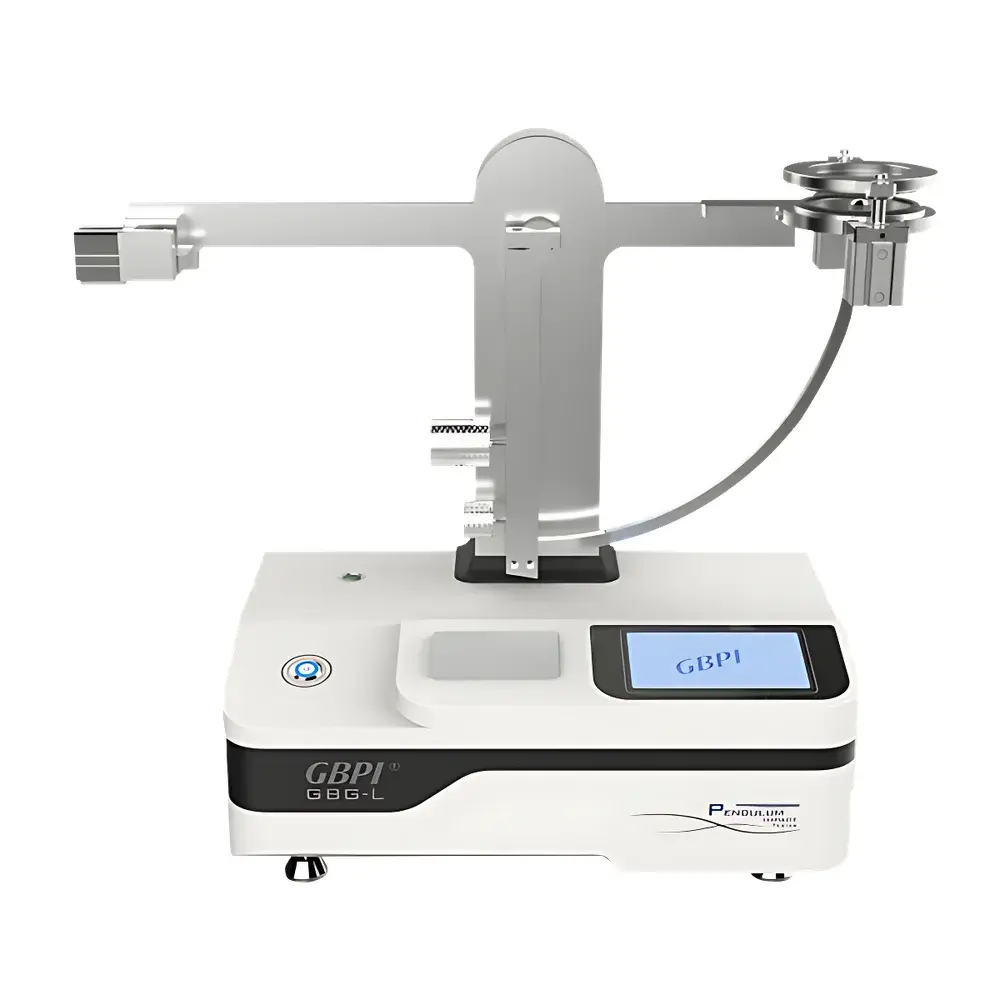
GBPI GBG-L2A Pendulum Impact Tester
| Brand | GBPI |
|---|---|
| Origin | Guangdong, China |
| Manufacturer Type | Direct Manufacturer |
| Instrument Type | Pendulum Impact Tester |
| Nominal Impact Energy | 5 J (8 J optional) |
| Resolution | 0.001 J |
| Pendulum Lift Angle | 90° |
| Pendulum Radius | 285 mm |
| Impact Tip Diameter | Φ19 mm / Φ25.4 mm |
| Clamp Aperture | Φ60 mm / Φ89 mm |
| Specimen Size | 100 mm × 100 mm |
| Dimensions (L×W×H) | 773 mm × 378 mm × 606 mm |
| Power Consumption | 75 W |
| Supply Voltage | AC 220 V, 50 Hz |
Overview
The GBPI GBG-L2A Pendulum Impact Tester is a precision-engineered instrument designed for quantitative evaluation of the pendulum impact resistance of thin, flexible sheet materials—primarily plastic films, laminates, foils, and paper-based substrates. It operates on the classical principle of gravitational potential energy conversion: a calibrated pendulum arm, raised to a fixed angular displacement (90°), releases a hemispherical impact tip that strikes a horizontally clamped specimen. The energy absorbed during specimen fracture—or deformation beyond critical failure—is calculated from the residual swing height of the pendulum, measured electronically with ±0.001 J resolution. This method conforms rigorously to standardized mechanical testing protocols including GB/T 8809–2015 (Determination of impact resistance of plastic films and sheets), ASTM D3420–2020 (Standard Test Method for Impact Resistance of Plastic Film by the Pendulum Method), and GB/T 21189–2007 (General requirements for impact testing machines). Its architecture integrates mechanical robustness with digital metrology, ensuring high reproducibility across laboratory, QC, and R&D environments.
Key Features
- High-resolution electronic energy measurement system with 0.001 J resolution, traceable to national metrological standards.
- Motorized pneumatic specimen clamping and pendulum release mechanism—eliminates manual handling variability and ensures consistent impact initiation timing.
- Dual-diameter impact tips (Φ19 mm and Φ25.4 mm) and interchangeable clamp inserts (Φ60 mm and Φ89 mm) enable method flexibility per material thickness and standard requirements.
- Integrated 7-inch color TFT touchscreen interface with intuitive icon-driven navigation, real-time test status feedback, and on-device data review.
- Automatic test sequence execution: single-button initiation triggers clamp pressurization, pendulum lifting, release, energy capture, and result logging.
- Onboard statistical engine computes mean, standard deviation, coefficient of variation, and pass/fail compliance against user-defined thresholds.
- Leveling assistance system with dual-axis bubble indicators and adjustable leveling feet ensures precise horizontal alignment of the impact plane—critical for minimizing torque-induced measurement drift.
Sample Compatibility & Compliance
The GBG-L2A is validated for use with specimens up to 100 mm × 100 mm in planar dimension and thicknesses ranging from 12 µm (e.g., metallized PET film) to 1.0 mm (e.g., rigid PVC sheet or laminated board). It supports common industrial packaging substrates including PE/PP coextruded films, aluminum foil laminates, nylon-based barrier structures, metallized paperboard, and Tetra Pak®-type composite cartons. All operational parameters—including energy calibration, pendulum inertia, and tip geometry—adhere to the geometric and dynamic tolerances specified in ISO 179-1:2019 (Plastics — Determination of Charpy impact properties) Annex B for pendulum-type instruments. The system supports audit-ready documentation workflows compatible with GLP and GMP-regulated environments; raw energy values, timestamps, operator IDs, and environmental metadata (if integrated with external hygrothermal sensors) are stored in non-volatile memory with immutable timestamping.
Software & Data Management
Data acquisition and reporting are managed via embedded firmware compliant with FDA 21 CFR Part 11 principles: electronic signatures, role-based access control (administrator/operator modes), and full audit trail functionality—including record creation, modification, and deletion events. Test results export in CSV and PDF formats; PDF reports include instrument ID, calibration certificate expiry date, test standard reference, specimen ID, operator name, ambient temperature/humidity (when interfaced), and graphical energy distribution plots. Optional USB host interface enables direct transfer to LIMS or enterprise QA databases. Firmware updates are delivered via secure signed packages and require administrative authentication—ensuring integrity and version traceability across multi-site deployments.
Applications
- Quality assurance of food and pharmaceutical flexible packaging—verifying seal integrity and puncture resistance of pouches and blister lidding.
- R&D screening of new polymer blends, nanocomposite films, and bio-based substrates under controlled impact loading conditions.
- Comparative analysis of aging effects (e.g., UV exposure, thermal cycling) on impact toughness retention in multilayer laminates.
- Supplier qualification testing per contractual specifications referencing ASTM D3420 or GB/T 8809 performance thresholds.
- Educational laboratories conducting fundamental mechanics-of-materials experiments on viscoelastic thin films.
- Regulatory submission support: generating GLP-compliant datasets for packaging validation dossiers submitted to NMPA, FDA, or EMA.
FAQ
What standards does the GBG-L2A comply with?
It fully implements GB/T 8809–2015, ASTM D3420–2020, and GB/T 21189–2007, with mechanical design aligned to ISO 179-1:2019 Annex B requirements.
Is an external air supply required?
Yes—a clean, oil-free compressed air source (0.5–0.7 MPa) must be provided by the user; the unit includes pneumatic fittings and regulators.
Can the instrument be calibrated internally?
No—energy calibration requires certified reference pendulums and traceable mass/moment-of-inertia verification; GBPI recommends annual third-party calibration with certificate issued per ISO/IEC 17025.
Does the system support network connectivity?
Not natively; however, exported CSV files are compatible with common lab informatics platforms, and optional RS-232/USB-to-Ethernet adapters may be deployed for integration into centralized test management systems.
What maintenance is required for long-term accuracy?
Monthly verification of pendulum bearing friction, annual inspection of pneumatic seals and impact tip wear (measured via micrometer), and biannual recalibration of the optical encoder and load cell signal chain.



