
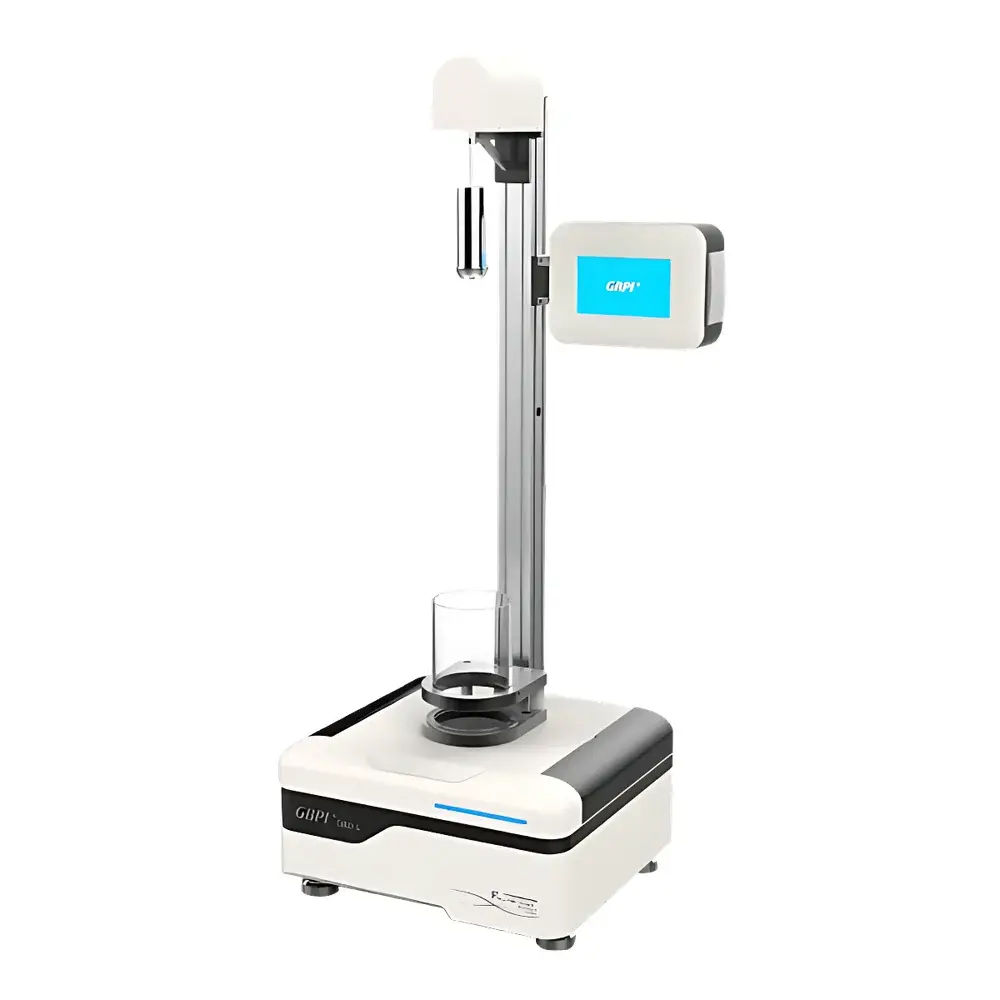
GBPI GBG-L2R Dart Impact Tester
| Brand | GBPI |
|---|---|
| Origin | Guangdong, China |
| Manufacturer Type | Manufacturer |
| Country of Origin | China |
| Model | GBG-L2R |
| Quotation | Upon Request |
| Measurement Methods | Method A, Method B, Single-Specimen Test |
| Impact Height | 1500 mm / 660 mm |
| Mass Range (Method A) | 50–2000 g |
| Mass Range (Method B) | 300–2000 g |
| Single-Specimen Mass Options | 20 g, 25 g, 40 g, 60 g, 80 g |
| Resolution | 0.1 g |
| Dart Tip Diameter (Method A) | Φ38 mm ±1 mm |
| Dart Tip Diameter (Method B) | Φ50 mm ±1 mm |
| Weight Disc Diameter (Method A) | Φ30 mm |
| Weight Disc Diameter (Method B) | Φ45 mm |
| Method A Weights | 5 g, 15 g, 30 g, 80 g (8 pcs each), 120 g (16 pcs) |
| Method B Weights | 15 g, 45 g, 90 g (8 pcs each), 180 g (9 pcs) |
| Clamp Outer Diameter | 150 mm |
| Clamp Inner Diameter | 125 mm |
| Pneumatic Supply | Compressed air, 0.6–0.8 MPa |
| Air Hose Connector | Φ6 mm |
| Dimensions (W×D×H) | 510 mm × 440 mm × 1300 mm |
| Weight | 50 kg |
| Power Supply | AC 220 V, 50 Hz |
| Power Consumption | 75 W |
Overview
The GBPI GBG-L2R Dart Impact Tester is an electromechanically controlled instrument engineered for precise determination of the impact resistance of thin, flexible sheet materials—primarily plastic films, laminates, coated foils, and lightweight paperboard—under standardized free-fall conditions. It operates on the principle of gravitational kinetic energy transfer: a calibrated dart (with defined geometry per ISO 7765-1 or ASTM D1709) is released from a fixed height onto a horizontally clamped specimen. The mass required to produce 50% failure probability across a statistically sufficient sample set is calculated using the up-and-down method (staircase procedure), delivering a robust, reproducible measure of material toughness under dynamic loading. This test method directly correlates with real-world performance during handling, stacking, palletizing, and drop events in packaging supply chains.
Key Features
- Triple-test-mode architecture supporting Method A (lighter mass range, smaller dart), Method B (heavier mass range, larger dart), and single-specimen testing—enabling compliance with diverse international standards without hardware reconfiguration.
- Electromagnetic release mechanism ensures zero operator-induced timing or positional variability; dart detachment is triggered digitally with sub-millisecond repeatability.
- Pneumatically actuated clamping system (150 mm outer diameter, 125 mm inner aperture) applies uniform, consistent pressure across the specimen perimeter—eliminating slippage, wrinkling, or edge deformation that compromise impact energy localization.
- Integrated 7-inch color touchscreen interface provides guided workflow navigation, real-time parameter validation, and on-device result visualization—including cumulative pass/fail tally and intermediate N-value tracking per ASTM D1709 Annex A2.
- Onboard thermal printer outputs fully traceable test reports containing date/time stamp, operator ID (if configured), method selection, initial mass (m₀), increment/decrement value (Δm), individual trial outcomes, final calculated impact mass, and compliance statement referencing applicable standards.
- Internal data storage retains up to 30 complete test sessions with full audit trail—each record includes raw trial sequence, mass adjustments, pass/fail status per specimen, and final statistical derivation.
Sample Compatibility & Compliance
The GBG-L2R accommodates specimens ≤1 mm thick, including mono- and multilayer polyolefin films (e.g., LDPE, PP), metallized PET, aluminum-laminated structures, nylon-based barrier films, and coated paperboard substrates used in pharmaceutical blister packaging and food cartons. Its mechanical design and operational parameters conform strictly to the dimensional, mass, and procedural requirements of ISO 7765-1:1998, GB/T 9639.1–2008, GB/T 15267–1994, ASTM D1709–22 (Methods A and B), and JIS K7124–2011. For regulated environments—including GLP-compliant laboratories and GMP-aligned QC labs—the instrument supports manual user log-in protocols and timestamped digital records suitable for FDA 21 CFR Part 11–aligned documentation workflows when integrated with validated LIMS or ELN platforms.
Software & Data Management
No proprietary PC software is required for core operation; all test logic, statistical calculation (including the standard staircase algorithm per ISO 7765-1 Clause 8.3), and result derivation occur autonomously within the embedded controller. The system computes the median impact mass (M50) using the formula M50 = m₀ + Δm × (Nf − Np) / Nt, where Nf = number of failures, Np = number of passes, and Nt = total trials (minimum 20, extended as needed to achieve exactly 10 failures or 10 passes). Data export is supported via USB flash drive (CSV format) for external analysis. Audit-ready logs include operator-entered batch IDs, environmental notes (optional), and firmware version metadata—facilitating internal quality audits and regulatory inspections.
Applications
- Quality assurance of rollstock and finished pouches in food, pharmaceutical, and medical device packaging lines.
- R&D evaluation of new polymer blends, nanocomposite films, and bio-based barrier coatings.
- Supplier qualification testing against contractual impact performance thresholds (e.g., “≥850 g @ 1500 mm, Method A”).
- Educational laboratories demonstrating fundamental polymer mechanics and failure mode analysis.
- Regulatory submission support for packaging validation dossiers under ICH Q5C and USP .
FAQ
What standards does the GBG-L2R comply with?
The instrument meets the mechanical, dimensional, and procedural specifications of ISO 7765-1, ASTM D1709 (Methods A and B), GB/T 9639.1, GB/T 15267, and JIS K7124.
Is compressed air supply included with the instrument?
No—the unit requires an externally supplied clean, dry compressed air source at 0.6–0.8 MPa, delivered via a standard Φ6 mm pneumatic hose (included). Users must provide an appropriately rated air compressor and filtration system.
Can test results be exported for external analysis?
Yes—results are exportable in CSV format via USB interface for integration into Excel, statistical software (e.g., Minitab), or enterprise quality management systems.
How is calibration verified?
Mass calibration is performed using NIST-traceable weights (supplied with instrument); dart tip geometry and drop height are verified using calibrated calipers and laser distance meter per ISO 7765-1 Annex B. Routine verification checks are documented in the onboard log.
Does the system support multi-user access control?
The current firmware supports manual operator identification entry per test session; role-based authentication and electronic signatures require integration with third-party LIMS/ELN systems compliant with 21 CFR Part 11.




