
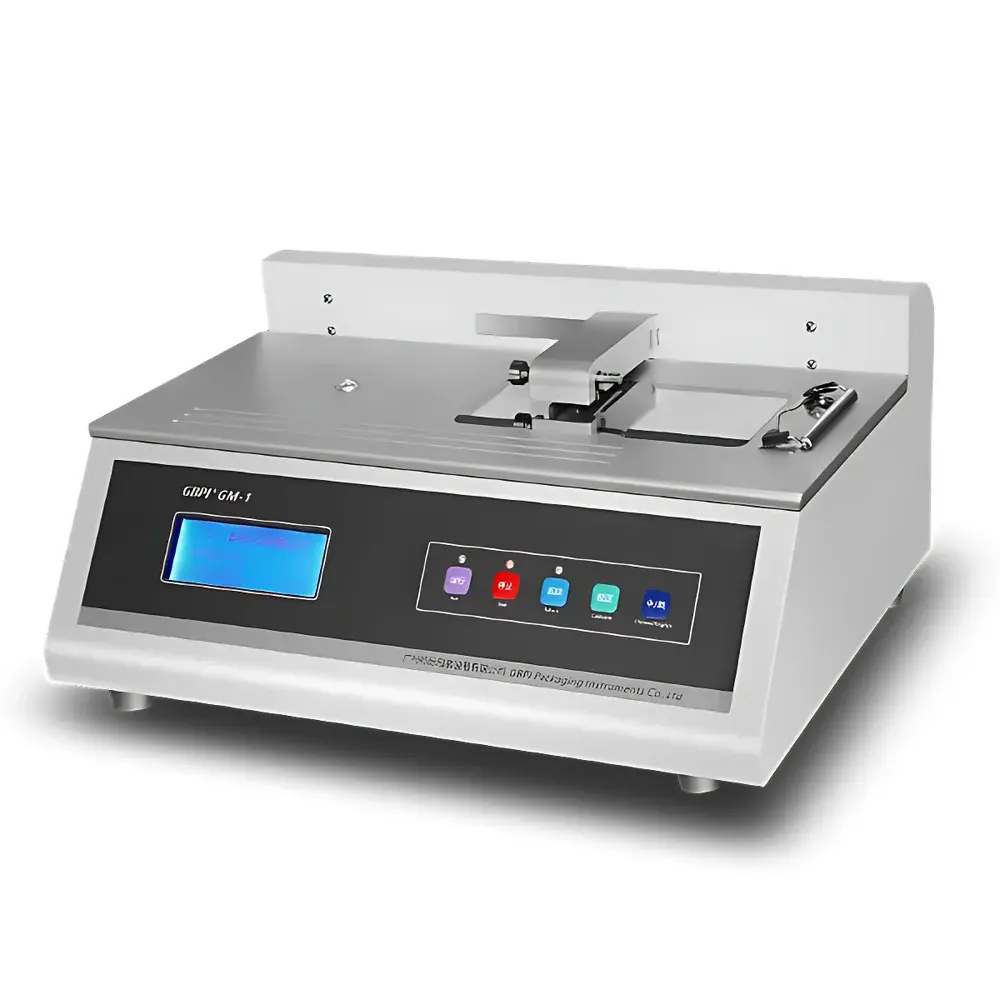
GBPI GM-1G Coefficient of Friction Tester for Thin Films and Packaging Materials
| Brand | GBPI |
|---|---|
| Origin | Guangdong, China |
| Manufacturer Type | Direct Manufacturer |
| Country of Origin | China |
| Model | GM-1G |
| Pricing | Available Upon Request |
| Test Standards | GB 10006, ISO 8295, TAPPI T816 |
| Friction Coefficient Range | 0.001–0.999 |
| Resolution | 0.001 |
| Force Measurement Range | 0–9.8 N |
| Slider Velocity | 100 ± 10 mm/min |
| Travel Distance | 100 ± 5 mm |
| Max Sample Thickness | ≤2 mm |
| Slider Dimensions | 63 mm × 63 mm |
| Slider Mass | 200 g ± 2 g |
| Test Platform Size | 200 mm × 470 mm |
| Overall Dimensions | 470 mm × 350 mm × 220 mm |
| Power Consumption | 100 W |
| Power Supply | AC 220 V, 50 Hz |
| Weight | 12.5 kg |
Overview
The GBPI GM-1G Coefficient of Friction Tester is a precision-engineered instrument designed specifically for static and kinetic coefficient of friction (COF) measurement in thin-film and flexible packaging materials. It operates on the fundamental principle of horizontal sliding resistance quantification under controlled normal load and relative motion—complying strictly with the tribological test methodology defined in ASTM D1894 (equivalent to ISO 8295 and GB 10006). The system employs a calibrated slider assembly mounted on a high-stability force transducer, which measures tangential resistance as the sample surface moves across a standardized substrate at a regulated velocity of 100 mm/min. This enables traceable, repeatable determination of both static COF (the peak force required to initiate motion) and kinetic COF (the sustained force during steady-state sliding), critical parameters for evaluating slip performance, opening behavior, and surface uniformity in roll-to-roll manufacturing processes.
Key Features
- High-resolution force sensing with 0.001 resolution and full-scale range of 0–9.8 N, ensuring accurate detection of low-friction surfaces such as silicone-coated films or fluorinated liners.
- Modular hardware architecture with plug-in functional units—including motor drive, sensor signal conditioning, and real-time data acquisition—facilitating rapid diagnostics and field maintenance.
- Integrated 5-inch LCD display with dual-channel real-time COF visualization, enabling immediate verification of static/kinetic transitions without external software dependency.
- Comprehensive software suite compliant with Annex 11 and FDA 21 CFR Part 11 requirements: featuring role-based user access control, electronic signatures, audit trail logging (including parameter changes, test initiation, and result export events), and immutable data storage.
- Automated overload protection circuitry safeguards the load cell against mechanical shock or calibration drift beyond ±10% of full scale.
- Standardized 200 g slider (63 mm × 63 mm) meets ISO 8295 dimensional specifications; optional mass configurations available for specialized compliance testing (e.g., ASTM D3330).
Sample Compatibility & Compliance
The GM-1G supports a broad spectrum of planar substrates up to 2 mm thickness, including polyolefin films (LDPE, PP), metallized laminates, aluminum foil, paperboard, nonwovens, woven sacks, printed flexographic substrates, and ceramic-coated sheets. Its mechanical design accommodates specimens cut to standard dimensions per GB 10006 (63 mm × 100 mm) and ISO 8295 (63 mm × 100 mm), with clamping fixtures engineered to minimize edge deformation and ensure uniform contact pressure distribution. All test procedures align with internationally recognized quality frameworks: GLP-compliant data handling, GMP Annex 11–validated software modules, and full traceability to national metrology institutes via optional NIST-traceable calibration certificates.
Software & Data Management
The proprietary GBPI TestSuite v4.2 provides intuitive workflow navigation, customizable test templates, and statistical post-processing tools—including mean, standard deviation, confidence intervals (95%), and outlier identification using Grubbs’ test. Raw force-time curves are stored in HDF5 format with embedded metadata (operator ID, timestamp, environmental conditions, calibration status). Export options include CSV, PDF (with embedded signature fields), and XML for LIMS integration (ASTM E1482, ISO/IEC 17025). Remote access is enabled via secure TLS 1.2–encrypted web interface, allowing authorized users to monitor live tests, retrieve historical datasets, trigger automated report generation, and submit service requests—all within a single authenticated session.
Applications
- Packaging R&D: Optimizing anti-block additive concentrations in BOPP films by correlating COF trends with haze and seal integrity metrics.
- QC/QA Labs: Routine release testing of incoming PET/ALU laminates against internal specification limits (e.g., μs ≤ 0.35, μk ≥ 0.28).
- Regulatory Submissions: Generating auditable COF dossiers for FDA food-contact notifications (21 CFR 177) and EU Plastics Regulation (EU No. 10/2011) compliance dossiers.
- Process Troubleshooting: Diagnosing intermittent jamming in high-speed form-fill-seal lines by mapping COF variability across film width and machine direction.
- Material Benchmarking: Cross-comparing frictional behavior of bio-based PLA films versus conventional PE under controlled RH (23°C/50% RH per ISO 291).
FAQ
What standards does the GM-1G comply with?
It is fully aligned with GB 10006, ISO 8295, and TAPPI T816 for static and kinetic COF measurement on planar materials.
Can the instrument be integrated into an existing LIMS environment?
Yes—via standardized RESTful API and HL7-compatible data export protocols, supporting bidirectional synchronization with major LIMS platforms including LabWare, Thermo Fisher SampleManager, and STARLIMS.
Is calibration traceable to international standards?
Optional factory calibration includes a certificate traceable to CNAS-accredited reference standards, with uncertainty budgets reported per ISO/IEC 17025 Annex A.
How is data integrity ensured during remote operation?
All remote sessions enforce multi-factor authentication, session timeouts, encrypted data streams, and write-once-read-many (WORM) archival of raw datasets to prevent tampering.
Does the system support variable test speeds?
The base configuration operates at 100 ± 10 mm/min per ISO 8295; variable-speed upgrade kits (50–500 mm/min) are available under model variant GM-1G-VS, subject to additional validation documentation.




