
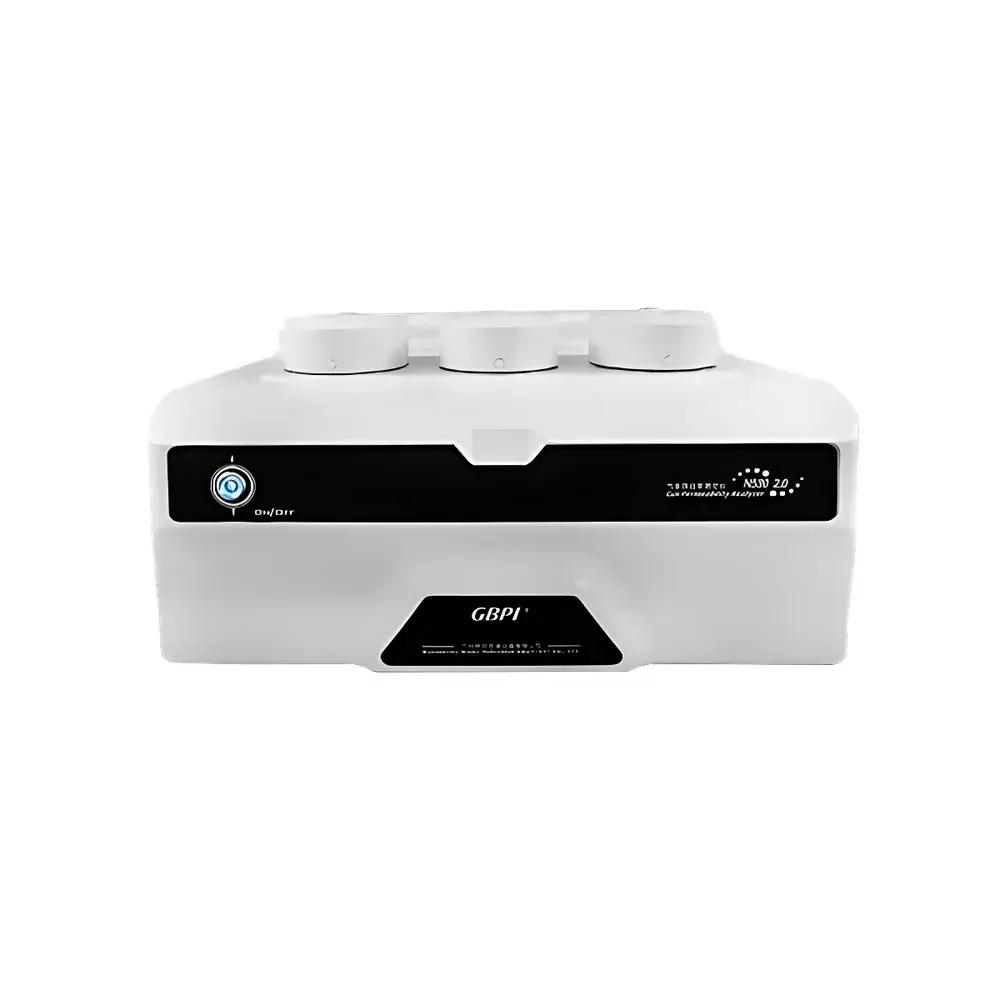
GBPI N530 2.0 Gas Permeability Tester for Food Packaging Films
| Brand | GBPI |
|---|---|
| Origin | Guangdong, China |
| Manufacturer Type | Direct Manufacturer |
| Model | GBPI N530 2.0 |
| Test Principle | Differential Pressure Method (Manometric) |
| Standards Compliance | GB/T 1038, ISO 2556, ISO 15105-1, ASTM D1434, JIS K7126-1, YBB 00082003 |
| Measurement Range | 0.01–50000 cm³/(m²·24 h·0.1 MPa), extendable to 600000 cm³/(m²·24 h·0.1 MPa) |
| Resolution | 0.0001 cm³/(m²·24 h·0.1 MPa) |
| Temperature Control Range | 15–60 °C |
| Temperature Accuracy | ±0.1 °C |
| Vacuum Level | <10 Pa |
| Vacuum Resolution | 0.01 Pa |
| Test Pressure | 0.1 MPa |
| Test Gases | O₂, CO₂, N₂, air, He |
| Permeation Area | 50.24 cm² |
| Specimen Diameter | Φ110 mm |
| Max Specimen Thickness | ≤2 mm |
| Specimen Capacity | 3 independent test chambers |
| Dimensions | 690 × 620 × 390 mm |
| Weight | 55 kg |
| Power | 750 W |
| Supply | AC 220 V, 50 Hz |
Overview
The GBPI N530 2.0 Gas Permeability Tester is an engineered differential pressure (manometric) instrument designed for precise, traceable, and standards-compliant measurement of gas transmission rates (GTR) through flexible barrier materials. It operates on the fundamental principle of Fick’s first law of diffusion under a controlled transmembrane pressure gradient: a specimen is sealed between two isolated chambers; the upstream chamber is pressurized with test gas (e.g., O₂ or CO₂) at 0.1 MPa while the downstream chamber is maintained under high vacuum (<10 Pa). The accumulation of permeated gas in the downstream chamber is monitored in real time using a high-stability, 0.01 Pa-resolution capacitive pressure sensor. From the linear slope of downstream pressure vs. time, the instrument calculates gas permeability (in cm³/(m²·24 h·0.1 MPa)), permeance, and related barrier metrics—without requiring carrier gas flow calibration or external mass spectrometry. This method delivers intrinsic material-level data critical for shelf-life modeling, packaging integrity validation, and regulatory submissions in food, pharmaceutical, and medical device manufacturing.
Key Features
- Triple independent test chambers enable concurrent analysis of three identical or dissimilar specimens—each with fully autonomous pressure control, data acquisition, and pass/fail logic—increasing throughput without cross-contamination or signal interference.
- Patented auto-pressure-balance technology dynamically maintains a constant differential pressure across the specimen surface, adjustable from 0.01 to 0.1 MPa, ensuring consistent driving force throughout the test duration.
- Integrated semiconductor-based dual-direction temperature control system achieves ±0.1 °C uniformity over the full 15–60 °C operating range, minimizing thermal drift-induced measurement uncertainty.
- Oil-free, imported vacuum pump delivers ultimate vacuum <0.1 Pa with low acoustic emission (<55 dB(A)) and extended service intervals—critical for long-duration low-permeability tests (e.g., metallized PET or SiOₓ-coated films).
- Pneumatic clamping mechanism ensures repeatable, leak-tight sealing (verified per ASTM D3078 bubble test protocol) with single-button actuation and visual torque feedback—eliminating operator-dependent variability in specimen loading.
- Real-time five-channel plotting interface displays permeation rate vs. time, chamber temperature vs. time, upstream/downstream pressure trajectories, and differential pressure stability—supporting on-the-fly deviation detection and endpoint confirmation.
Sample Compatibility & Compliance
The N530 2.0 accommodates flat, flexible specimens up to 2 mm thick and 110 mm in diameter—including monolayer polymers (PE, PP, PET, PVC), coextrusions, aluminum-laminates, metallized films, biodegradable substrates (PLA, PBAT), coated papers, pharmaceutical blisters (PVC/PVDC, cold-form aluminum), and medical-grade nonwovens. Optional fixtures extend capability to rigid and semi-rigid packaging forms: pouches (stand-up, vacuum-sealed), bottles (PET, HDPE), trays (PS, APET), and composite cans—enabling whole-package permeation assessment per ASTM F1140/F1140M burst-and-leak protocols. All hardware and firmware comply with ISO/IEC 17025:2017 general requirements for testing laboratories, and software architecture conforms to FDA 21 CFR Part 11 for electronic records and signatures, including full audit trail logging, role-based user permissions (admin/operator/analyst), and immutable data archiving.
Software & Data Management
The embedded Windows-based control software features modular graphical workflow configuration: users define test parameters (gas type, temperature setpoint, target vacuum level, duration), assign calibration references (NIST-traceable GBW(E) 130541/130542 certified reference materials), and configure report templates prior to run initiation. All raw sensor outputs are timestamped, stored in encrypted SQLite databases, and exportable in CSV, PDF, XML, or ASTM E1482-compliant formats. Electronic signature integration supports 21 CFR Part 11-compliant review/approval workflows. Remote diagnostics and firmware updates are enabled via secure TLS-encrypted connection to GBPI’s ISO 27001-certified IoT platform—allowing authorized personnel to monitor instrument status, retrieve historical datasets, download SOPs and training videos, and initiate predictive maintenance alerts.
Applications
This instrument serves as a primary metrology tool in R&D labs evaluating novel barrier coatings, production QC environments verifying lot-to-lot consistency of rollstock, and regulatory affairs departments generating data for FDA IND/NDA dossiers or EU MDR technical files. Typical use cases include: quantifying O₂ transmission through modified-atmosphere packaging (MAP) films for fresh-cut produce; validating CO₂ retention in carbonated beverage containers; assessing moisture vapor transmission in pharmaceutical desiccant pouches; benchmarking He permeation for leak-rate correlation studies; and supporting ISO 11607-1 validation of sterile barrier systems. Its wide dynamic range (0.01–600,000 cm³/(m²·24 h·0.1 MPa)) permits characterization of ultra-high-barrier electronics encapsulants alongside highly permeable hygiene films—eliminating need for multiple dedicated instruments.
FAQ
What gases can be tested on the N530 2.0?
O₂, CO₂, N₂, air, and He are supported natively; other gases may be used provided compatibility with stainless-steel wetted parts and validated sensor linearity.
Is calibration traceable to national standards?
Yes—GBPI holds CNAS-accredited calibration capability (Certificate No. L8185) and supplies instruments pre-calibrated using GBW(E) 130541 and GBW(E) 130542 certified reference materials issued by the National Institute of Metrology (China).
Can the system validate compliance with pharmaceutical GMP requirements?
Yes—the software includes 21 CFR Part 11-compliant audit trails, electronic signatures, and configurable user access levels aligned with Annex 11 and EU GMP Chapter 4 computerized system guidance.
What sample preparation is required before testing?
Specimens must be conditioned at standard ambient conditions (23 °C ±2 °C, 50% RH ±5%) for ≥48 h and degassed in a desiccator for 24 h to eliminate trapped volatiles that could bias low-permeability measurements.
Does the instrument support IQ/OQ/PQ documentation packages?
Yes—GBPI provides vendor-qualified installation qualification (IQ), operational qualification (OQ), and performance qualification (PQ) protocols compliant with ISO 13485 and ICH Q5C, including acceptance criteria, test methods, and blank execution records.






