
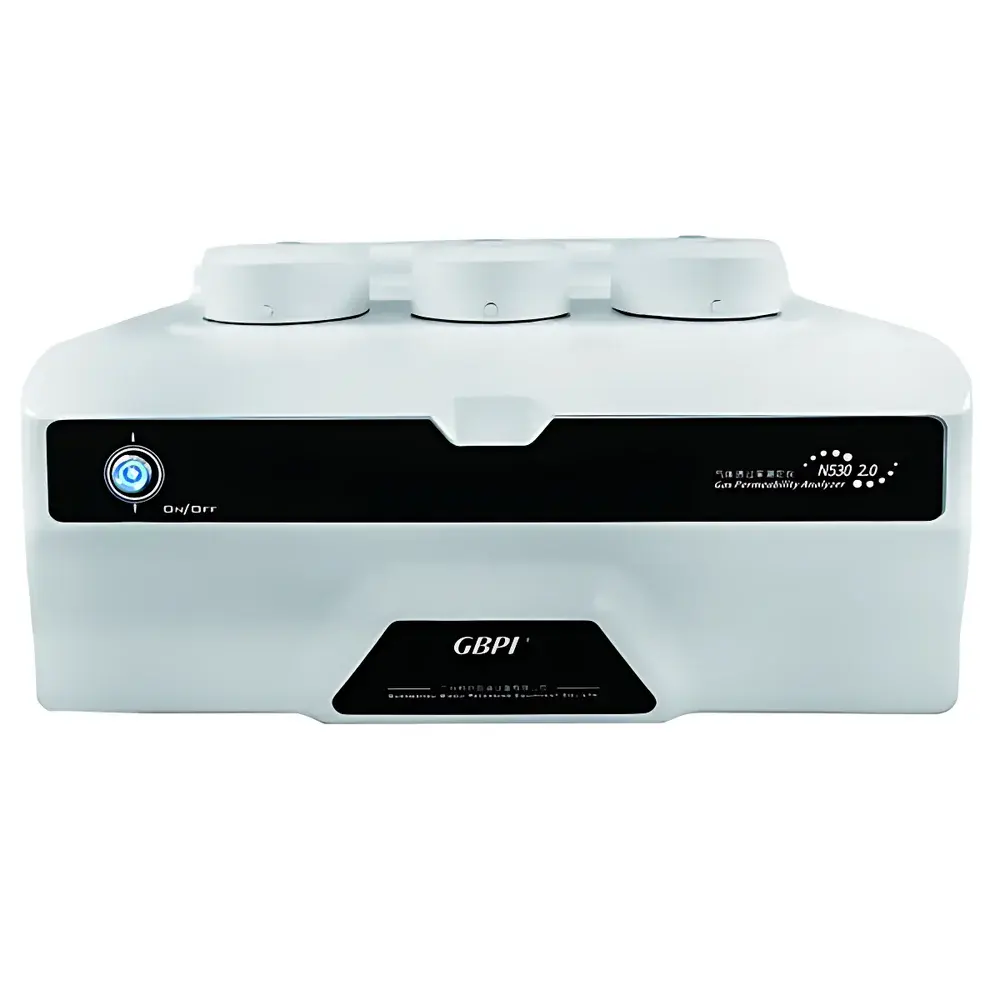
GBPI N530 2.0B Gas Permeability Tester (Differential Pressure Method)
| Brand | GBPI |
|---|---|
| Origin | Guangdong, China |
| Manufacturer Type | Direct Manufacturer |
| Model | N530 2.0B |
| Testing Principle | Differential Pressure Method (ASTM D1434 / ISO 2556 / GB/T 1038 compliant) |
| Measurement Range | 0.02–50,000 cm³/(m²·24 h·0.1 MPa) |
| Resolution | 0.001 cm³/(m²·24 h·0.1 MPa) |
| Temperature Control Range | 15–60 °C |
| Temperature Accuracy | ±0.1 °C |
| Vacuum Level | <20 Pa |
| Vacuum Resolution | 0.01 Pa |
| Test Gas | O₂, CO₂, N₂, air, He |
| Test Area | 50.24 cm² |
| Specimen Size | Ø110 mm |
| Max Specimen Thickness | 2 mm |
| Chamber Capacity | 3 independent test cells |
| Power Supply | AC 220 V, 50 Hz, 450 W |
Overview
The GBPI N530 2.0B Gas Permeability Tester is an industrial-grade differential pressure method instrument engineered for precise, reproducible measurement of gas transmission rates (GTR) through flexible packaging materials and rigid packaging components. It operates on the fundamental principle of Fick’s first law of diffusion under a controlled, constant pressure gradient—where a defined partial pressure difference is maintained across a conditioned specimen, and the rate of gas permeation into a downstream detection chamber is quantified via high-resolution pressure transduction. This method conforms rigorously to internationally recognized standards including ASTM D1434, ISO 2556, ISO 15105-1, JIS K7126-1, YBB 00082003, and GB/T 1038, ensuring regulatory acceptability in pharmaceutical, food, medical device, and electronics packaging quality control laboratories. The system is designed for deterministic traceability, with all critical parameters—including temperature, vacuum integrity, pressure differential, and elapsed time—continuously monitored and logged at sub-second intervals.
Key Features
- Triple independent test chambers enable concurrent, statistically independent measurements—increasing throughput without compromising data integrity or inter-chamber cross-contamination risk.
- Patented automatic pressure-difference maintenance system dynamically adjusts upstream gas supply to sustain user-defined ΔP (0.01–0.1 MPa), eliminating manual intervention and drift-induced error.
- High-stability thermal management employs imported platinum resistance temperature sensors (PT100 class A) and water-cooled jacketing, delivering ±0.1 °C uniformity across the full 15–60 °C operating range.
- Ultra-high vacuum capability (<20 Pa base pressure, 0.01 Pa resolution) is achieved using a certified oil-free vacuum pump with ≤0.1 Pa ultimate vacuum rating, ensuring rapid degassing and low background interference.
- Real-time multi-parameter visualization displays five synchronized time-series curves: permeation rate vs. time, temperature vs. time, upstream pressure vs. time, downstream pressure vs. time, and ΔP vs. time—with on-screen toggle, zoom, and export functionality.
- Fully modular embedded OS complies with GMP Annex 11 requirements for computerized systems: role-based access control (admin/operator/auditor), electronic signatures, full audit trail (user actions, parameter changes, test events), and configurable data retention policies.
Sample Compatibility & Compliance
The N530 2.0B accommodates flat specimens up to Ø110 mm and 2 mm thick—including monolayer and multilayer polymer films (e.g., PET, PE, PP, BOPP, CPP, PVC), metallized and coated substrates (AlOx, SiOx, Al foil laminates), biodegradable films (PLA, PBAT, PBS), pharmaceutical blister foils (PVC/PVDC, cold-forming aluminum), paperboard composites, and technical nonwovens. With optional fixtures, it extends to 3D packaging forms: pouches, bottles (PET, HDPE), cups (PS, PP), trays, tubes, and composite cans. All gas channels are chemically inert (SS316L, EPDM-free sealing), supporting O₂, CO₂, N₂, air, and He testing per ISO 15105-2. Instrument validation includes certified reference materials traceable to NIM (National Institute of Metrology, China): GBW(E)130541 and GBW(E)130542 gas permeability standards, enabling calibration verification per ISO/IEC 17025 Clause 6.5.
Software & Data Management
The proprietary GBPI LabSuite™ software provides ISO 17025-aligned data governance. Each test generates a structured XML metadata package containing raw sensor logs, environmental conditions, operator ID, instrument configuration, and calculation parameters. Statistical modules compute mean GTR, standard deviation, CV%, and confidence intervals (95%) across replicates. Reports are exportable in PDF/A-2, CSV, and Excel formats; support digital signatures compliant with FDA 21 CFR Part 11 and EU Annex 11. Integration with enterprise LIMS is enabled via HL7 or RESTful API—supporting automated result ingestion, sample tracking, and workflow triggering. All data reside in encrypted local storage with optional network backup; no cloud dependency or vendor-hosted servers.
Applications
This instrument serves as a primary QC tool in packaging R&D and release testing for barrier performance validation. Key use cases include: evaluating oxygen transmission rate (OTR) of snack food wrappers to prevent lipid oxidation; verifying CO₂ transmission in carbonated beverage containers; assessing moisture vapor transmission (via dry air proxy) in pharmaceutical blister packaging; qualifying nitrogen purge efficiency in medical device pouches; validating shelf-life models for active pharmaceutical ingredients sensitive to ambient O₂; and benchmarking sustainable film alternatives against legacy petrochemical structures. Regulatory submissions to USP , EP 2.6.23, and China’s YBB standards routinely cite differential pressure method data generated by instruments of this class.
FAQ
What gas types can be tested on the N530 2.0B?
O₂, CO₂, N₂, air, and He are fully supported; additional gases require compatibility verification with wetted materials and sensor linearity validation.
Is the instrument suitable for testing pre-formed packages like bottles or pouches?
Yes—using optional custom fixtures (sold separately), the system accommodates rigid and semi-rigid containers per ASTM F2622 and ISO 15105-2 Annex B protocols.
How is temperature uniformity verified across the test chamber?
GBPI supplies a factory-verified temperature mapping report (per ISO 13485 Annex C) demonstrating ≤0.2 °C spatial variation at three load points within the thermal zone.
Does the system meet FDA 21 CFR Part 11 requirements?
Yes—the embedded OS implements electronic signatures, audit trails, and role-based security aligned with Part 11 Subpart B, confirmed in the delivered Validation Protocol (IQ/OQ/PQ-ready).
Can raw pressure-time data be exported for third-party analysis?
Yes—full-resolution sensor logs (10 Hz sampling) are exportable in CSV format with UTC timestamps, sensor IDs, and engineering units embedded.
Related Products






