
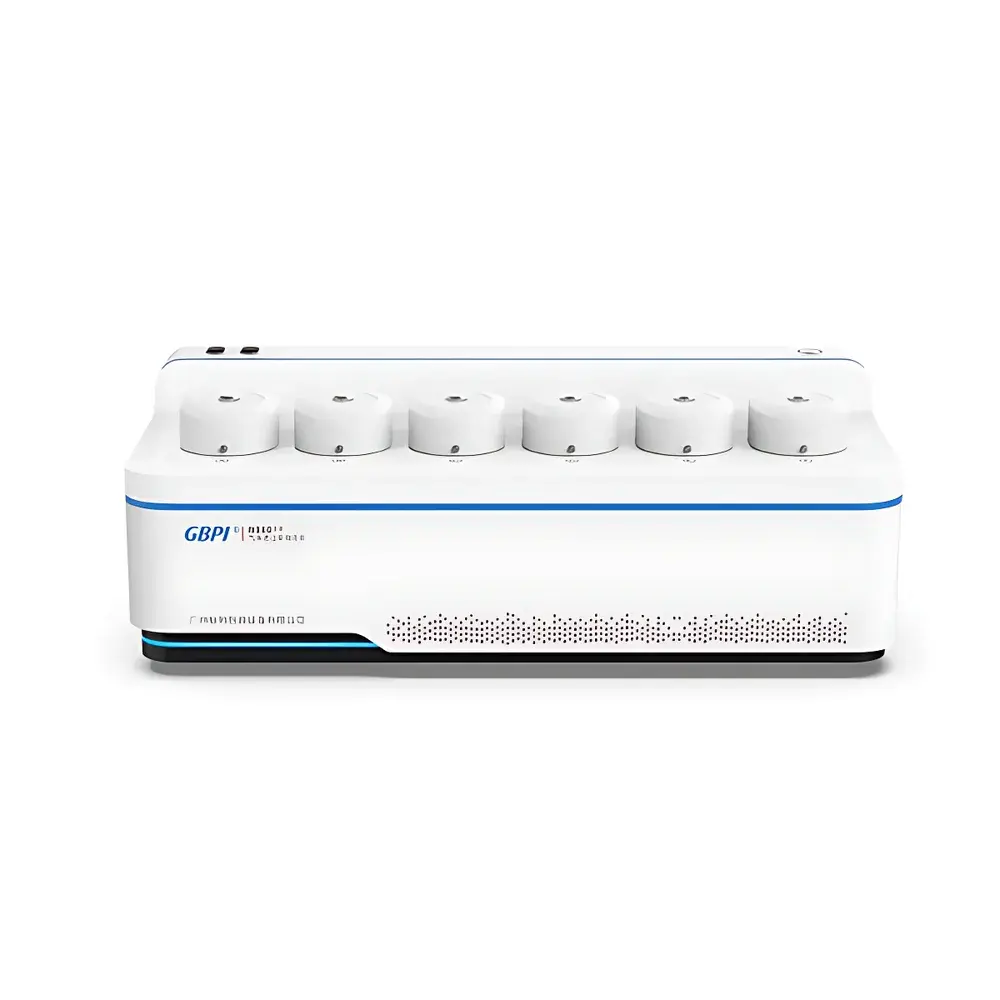
GBPI N560 2.0 Gas Permeability Tester (Differential Pressure Method)
| Brand | GBPI |
|---|---|
| Origin | Guangdong, China |
| Manufacturer Type | Direct Manufacturer |
| Model | N560 2.0 |
| Test Range | 0.01–25,000 cm³/(m²·24 h·0.1 MPa) |
| Resolution | 0.0001 cm³/(m²·24 h·0.1 MPa) |
| Temperature Control Range | 15–60 °C |
| Temperature Accuracy | ±0.1 °C |
| Vacuum Accuracy | ±0.2% of reading |
| Ultimate Vacuum | <10 Pa |
| Vacuum Resolution | 0.01 Pa |
| Test Pressure | 0.1 MPa |
| Permeation Area | 50.24 cm² |
| Specimen Diameter | Φ110 mm |
| Max Specimen Thickness | ≤2 mm |
| Specimen Capacity | 6 units |
| Pneumatic Pressure | ≥0.3 MPa |
| Power | 1500 W |
| Supply | AC 220 V, 50 Hz |
| Dimensions | 1140 × 600 × 440 mm |
| Compatible Gases | O₂, CO₂, N₂, air, He |
Overview
The GBPI N560 2.0 Gas Permeability Tester is a precision-engineered differential pressure method instrument designed for quantitative determination of gas transmission rates (GTR) through polymeric, metallic, and composite packaging materials. It operates on the fundamental principle of Fick’s first law of diffusion under a controlled transmembrane pressure gradient: a test specimen is sealed between two chambers; the upstream chamber is pressurized with a defined test gas (e.g., O₂, CO₂, or N₂) at 0.1 MPa, while the downstream chamber is maintained under high vacuum (<10 Pa). The resulting steady-state gas flux—measured via ultra-high-resolution pressure rise in the downstream chamber—is used to calculate gas permeability, permeance, diffusion coefficient, and solubility coefficient. This methodology conforms rigorously to internationally recognized standards including ISO 2556, ISO 15105-1, ASTM D1434, JIS K7126-1, GB/T 1038.1, and the Chinese Pharmacopoeia 2025 Edition Chapter 4007 “Gas Permeation Testing of Pharmaceutical Packaging Materials.” Its architecture integrates vacuum metrology, thermal regulation, and pneumatic actuation into a single robust platform suitable for QC laboratories, R&D departments, and regulatory-compliant packaging development environments.
Key Features
- High-precision vacuum measurement system featuring silicon piezoresistive sensors with integrated temperature compensation—full-scale drift ≤0.01% reading/°C, enabling continuous, gap-free vacuum monitoring without pressure jump artifacts during pump-down.
- Patented automatic pressure-difference maintenance technology: dynamically regulates and stabilizes the transmembrane ΔP (adjustable from 0.01 to 0.1 MPa) using a built-in 0.01 Pa resolution pressure transducer and closed-loop feedback control.
- Dual-directional thermoelectric (Peltier) temperature control with ±0.1 °C stability across 15–60 °C, minimizing thermal drift and ensuring reproducible permeation kinetics.
- Ultra-low ultimate vacuum capability (<0.05 Pa) delivered by a certified oil-free vacuum pump—low noise, high reliability, and extended service life.
- Six independent test chambers permit concurrent evaluation of up to six specimens (identical or heterogeneous), each with autonomous parameter logging and real-time data acquisition.
- Integrated pneumatic clamping system enables one-touch specimen sealing with >99.99% leak integrity verified per ASTM E493 leak rate specifications.
- Full-spectrum real-time visualization: five synchronized time-series plots—permeation rate vs. time, temperature vs. time, upstream pressure vs. time, downstream pressure vs. time, and ΔP vs. time—with toggleable preview and export functionality.
Sample Compatibility & Compliance
The N560 2.0 accommodates flat-sheet specimens (films, foils, laminates, paperboards, rubber sheets) up to Φ110 mm and 2 mm thick, as well as rigid and semi-rigid packaging containers—including bottles, pouches, cups, tubes, and cans—via optional fixture kits. It supports testing of biodegradable films (e.g., PLA, PBAT, PBS), pharmaceutical blister foils (PVC, PP, PTP), medical transdermal patches, hygiene products (sanitary napkins, panty liners), and multilayer barrier structures used in food, pharma, and electronics packaging. All hardware and firmware comply with ISO/IEC 17025 calibration traceability requirements. The system is validated for GLP and GMP environments per Annex 11 (EU) and FDA 21 CFR Part 11, featuring role-based user access, full audit trail (including parameter changes, start/stop events, and calibration logs), electronic signatures, and immutable data storage.
Software & Data Management
The proprietary GBPI PermeaSoft™ v4.x software provides modular, icon-driven workflow configuration—from test setup and environmental conditioning to kinetic modeling and statistical reporting. Its permeation analysis module computes not only gas transmission rate (GTR) but also intrinsic material properties: permeability coefficient (P), diffusion coefficient (D), and solubility coefficient (S), derived from time-lag analysis and Arrhenius temperature dependence modeling. Users may perform multi-temperature curve fitting to extrapolate performance across storage conditions (e.g., 25 °C/60% RH, 40 °C/75% RH). Reports are customizable in PDF, Excel, and CSV formats; support digital signing, version-controlled templates, and direct submission to LIMS or QMS platforms. Raw data files adhere to ASTM E2500-21 metadata standards and include embedded instrument ID, calibration certificate numbers (GBW(E)130541 / GBW(E)130542), and environmental timestamps.
Applications
- Pharmaceutical packaging validation per USP , EP 3.2.1, and CP 2025 Chapter 4007—critical for shelf-life prediction of sterile injectables, lyophilized products, and moisture-sensitive tablets.
- Food packaging barrier optimization: evaluating O₂ ingress in modified-atmosphere packaging (MAP), CO₂ loss in carbonated beverage containers, and aroma retention in coffee pouches.
- Development of sustainable packaging: quantifying permeability trade-offs in bio-based polymers, nanocomposite films, and metallized cellulose substrates.
- Regulatory dossier preparation for FDA 510(k), CE marking, and PMDA submissions—data generated meets ICH Q5C stability protocol requirements.
- Accelerated aging studies: correlating permeation data with real-time stability under elevated temperature/humidity to establish accelerated test conditions.
- Supplier qualification and incoming inspection: batch-level verification of film supplier specifications against contractual GTR limits.
FAQ
What gases can be tested on the N560 2.0?
O₂, CO₂, N₂, air, and He are fully supported; additional gases may be qualified upon request with appropriate calibration standards and safety review.
Does the system meet FDA 21 CFR Part 11 requirements?
Yes—audit trail, electronic signature, user authentication, and data integrity safeguards are implemented per GAMP5 and Annex 11 guidelines.
Can I test irregularly shaped packages like squeeze tubes or stand-up pouches?
Yes, using optional custom fixtures designed for container-type specimens; each fixture undergoes helium leak testing prior to delivery.
Is calibration traceable to national standards?
Absolutely—the instrument is factory-calibrated using GBW(E)130541 and GBW(E)130542 certified reference materials issued by the National Institute of Metrology (NIM), China.
What is the minimum detectable GTR value?
The lower limit of quantification is 0.01 cm³/(m²·24 h·0.1 MPa) under standard test conditions (23 °C, 0.1 MPa O₂), verified per ISO 5725 repeatability protocols.
How is temperature uniformity ensured across all six test chambers?
Each chamber has an individual Peltier element and PT100 sensor; active thermal balancing algorithms maintain inter-chamber deviation ≤±0.15 °C during steady-state operation.





