
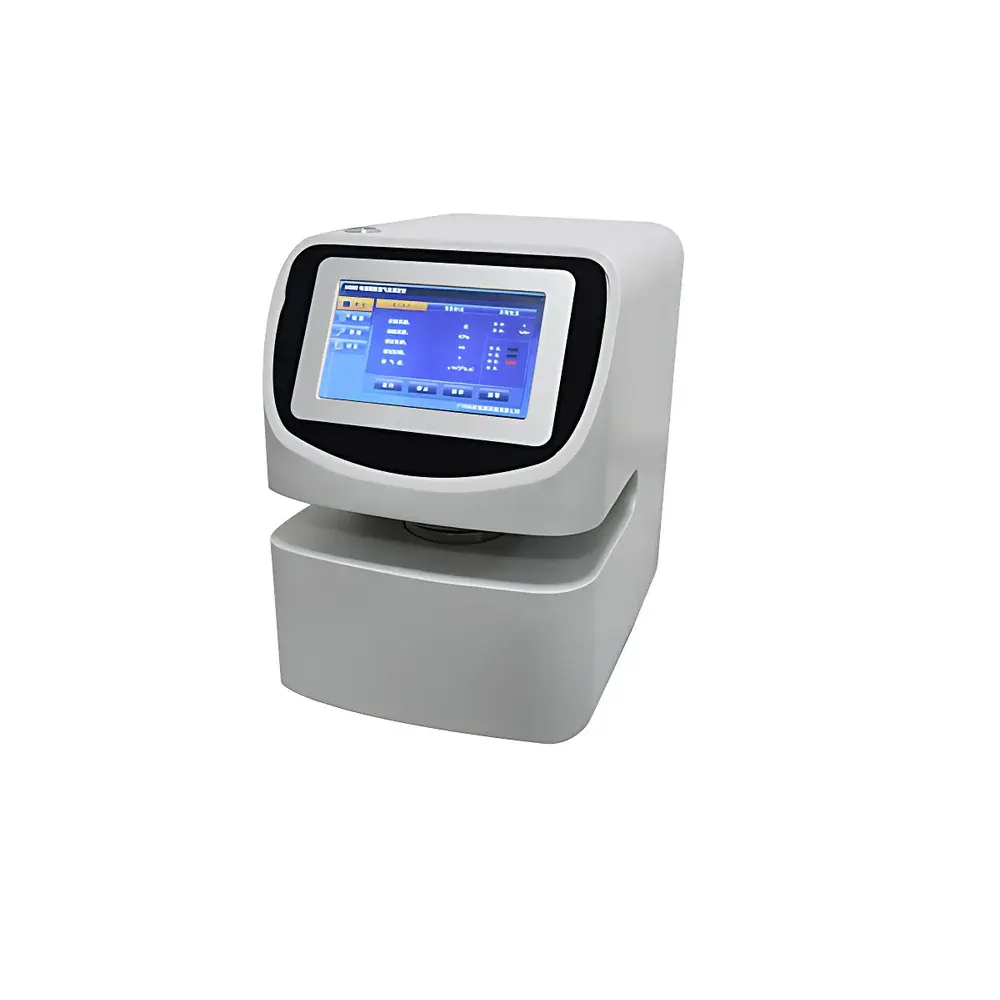
GBPI N600-4 Lithium-Ion Battery Polyolefin Separator Air Permeability Tester
| Brand | GBPI |
|---|---|
| Origin | Guangdong, China |
| Manufacturer Type | Direct Manufacturer |
| Country of Origin | China |
| Model | N600-4 |
| Price Range | USD 14,000 – 72,000 |
| Testing Methods | Gurley, Schopper, Bentzen |
| Standard Compliance | SJ/T 10171–2016, GB/T 458–2008, GB/T 36363–2018 |
| Measurement Range (Gurley) | 0.01–2.5 µm/(Pa·s) |
| Air Flow Rate Range | 0.01–120 mL/min |
| Resolution | 0.001 µm/(Pa·s) |
| Differential Pressure Range | 0–3 kPa |
| Pressure Accuracy | ±0.01 kPa |
| Test Area Options | 6.42 cm² or 10.0 ± 0.2 cm² |
| Sample Size | 50 mm × 50 mm or 60 mm × 100 mm |
| Conditioning | 24 h at <40 °C, 10–35 %RH |
| Temperature & Humidity Monitoring | Integrated sensor |
| Chamber Leak Rate | ≤1.0 mL/h |
| Power | 100 W |
| Voltage/Frequency | 220 V, 50 Hz |
| Dimensions (L×W×H) | 500 mm × 400 mm × 300 mm |
Overview
The GBPI N600-4 Lithium-Ion Battery Polyolefin Separator Air Permeability Tester is a precision-engineered instrument designed specifically for the quantitative evaluation of gas permeability in microporous polyolefin separators used in lithium-ion batteries. It operates on three internationally recognized physical principles—Gurley, Schopper, and Bentzen methods—each defining air flow resistance under controlled differential pressure conditions. The Gurley method measures the time required for 100 mL of air to pass through a sample under a fixed pressure differential of 1.23 kPa; the Schopper method determines volumetric flow rate at either 1.00 kPa or 2.50 kPa (±0.01 kPa), with selection dependent on expected permeability range; the Bentzen method quantifies instantaneous air volume passing through the specimen after 5 s of clamping at 1.47 kPa (±0.02 kPa). All three methods are grounded in Darcy’s law for laminar gas flow through porous media and provide complementary insights into pore structure integrity, tortuosity, and effective open area—critical parameters influencing ionic conductivity, dendrite suppression, and thermal shutdown behavior in battery cells.
Key Features
- Triple-method integration: Seamless switching between Gurley, Schopper, and Bentzen test protocols via intuitive interface—no hardware reconfiguration required.
- High-precision pressure control: Digital servo-regulated differential pressure system with 0–3 kPa adjustability and ±0.01 kPa accuracy, meeting strict tolerances mandated by SJ/T 10171–2016 and GB/T 36363–2018.
- Modular test area configuration: Interchangeable masks enable rapid transition between 6.42 cm² (50 mm × 50 mm) and 10.0 ± 0.2 cm² (60 mm × 100 mm) effective areas—ensuring compatibility with both standard separator sheets and R&D-scale laminates.
- Integrated environmental monitoring: Real-time temperature and relative humidity sensing within the test chamber supports GLP-compliant conditioning per ISO 186 and ASTM D646.
- Leak-tight architecture: Sealed pneumatic path with verified leak rate ≤1.0 mL/h, eliminating drift during extended low-flow measurements (<0.1 mL/min).
- Dual-mode operation: Standalone testing via built-in 7-inch capacitive touchscreen or synchronized acquisition via USB-connected PC using GBPI’s proprietary software suite.
- Large-volume measurement chamber (1 L): Ensures stable laminar flow profiles and minimizes compressibility effects across the full 0.01–120 mL/min dynamic range.
Sample Compatibility & Compliance
The N600-4 is validated for use with dry, non-woven, and biaxially oriented polypropylene (PP) or polyethylene (PE) monolayer/multilayer separators—commonly employed in cylindrical, prismatic, and pouch-type Li-ion cells. Sample thickness up to 50 µm is accommodated without compression artifacts, thanks to pneumatically balanced clamping force. Instrument compliance extends across multiple regulatory and industrial standards: SJ/T 10171–2016 (Chinese industry specification for alkaline and lithium battery separator permeability), GB/T 458–2008 (adapted from ISO 5636-3 for paper-based materials), and GB/T 36363–2018 (the definitive national standard governing technical requirements for lithium-ion battery polyolefin separators). While not certified for FDA 21 CFR Part 11 out-of-the-box, audit-ready data logs—including user ID, timestamp, method parameters, raw flow/time values, and environmental metadata—are exportable in CSV and PDF formats to support internal GMP/GLP documentation workflows.
Software & Data Management
The included Windows-based software provides full method setup, real-time graphing of pressure vs. flow curves, automatic calculation of Gurley seconds, Schopper permeance (mL/min·cm²·kPa⁻¹), and Bentzen volumetric throughput (mL/5s), all traceable to NIST-traceable pressure transducers. Each test record stores full parameter history, operator ID, and calibration status flags. Audit trails capture all modifications—including manual overrides—to satisfy ISO/IEC 17025 clause 7.7 requirements for result integrity. Data exports comply with LIMS interoperability standards (ASTM E1469), and optional OPC UA integration enables direct linkage to MES platforms in automated cell manufacturing environments.
Applications
- Quality control of incoming separator rolls prior to electrode lamination.
- R&D evaluation of surface-modified or ceramic-coated separators for improved wettability and thermal stability.
- Process validation of stretching and quenching parameters during dry/wet process manufacturing.
- Comparative analysis of aging-induced pore collapse after high-temperature storage or overcharge cycling.
- Supporting DOE submissions requiring documented permeability consistency per UL 1642 Annex B and IEC 62619 Annex C.
FAQ
Does the N600-4 meet international battery material certification requirements?
Yes—it complies with SJ/T 10171–2016, GB/T 36363–2018, and GB/T 458–2008, which align closely with ISO 5636-3 and JIS P 8117 for permeability methodology. While not CE-marked for EU battery directive (2006/66/EC), its measurement uncertainty profile supports third-party verification against EN 62620.
Can the instrument be calibrated in-house?
Yes—users may perform routine zero and span checks using certified reference pressure modules (e.g., Fluke 754). Full factory recalibration is recommended annually or after 500 test cycles, with certificate of calibration traceable to CNAS-accredited labs.
Is humidity control active or passive during testing?
Passive conditioning only—the instrument monitors ambient RH but does not regulate it. Pre-conditioning per SJ/T 10171–2016 (24 h at <40 °C, 10–35 %RH) must be performed externally in a climate-controlled chamber before loading.
What maintenance is required for long-term stability?
Monthly inspection of O-rings and filter elements in the air supply line; quarterly verification of pressure transducer linearity using dead-weight testers; annual replacement of desiccant in the integrated moisture trap (if optional air dryer is installed).





