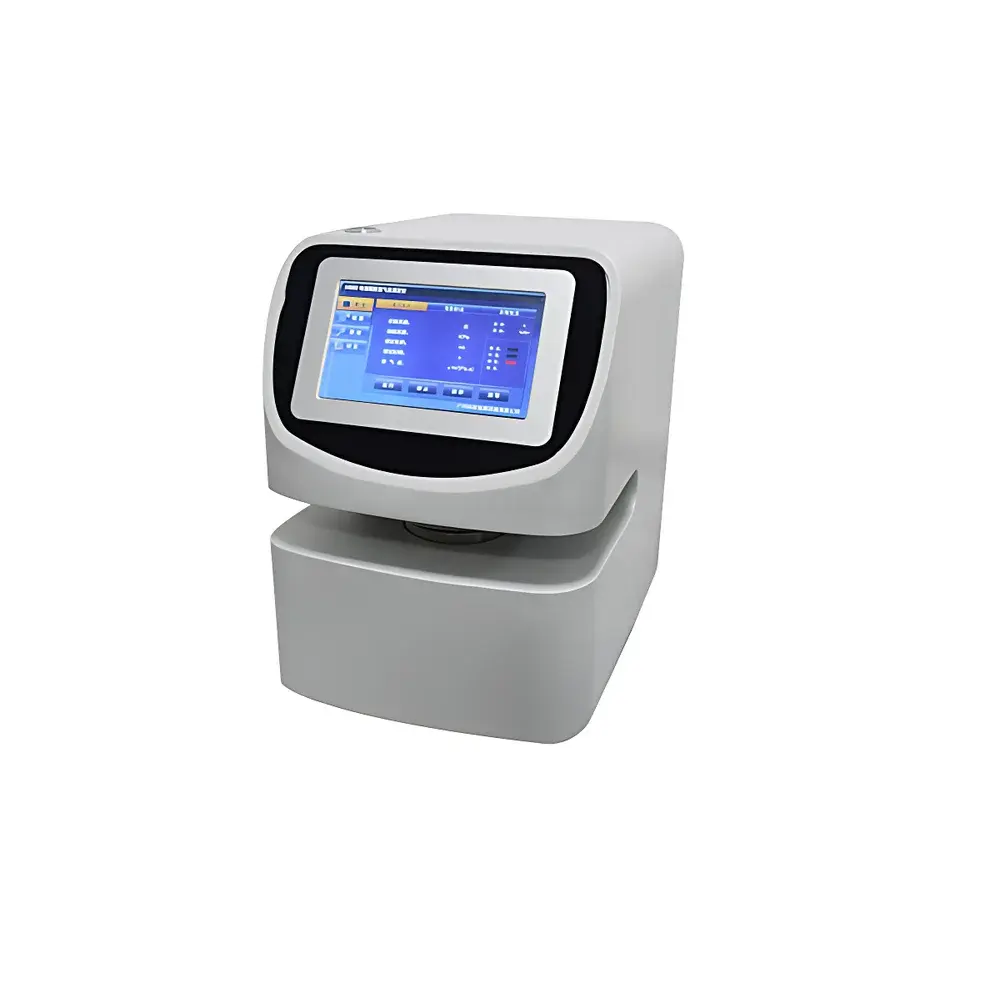
GBPI N600-5 Lithium-Ion Battery Separator Gas Permeability Tester (Compliant with GB/T 36363-2018, SJ/T 10171-2016, and GB/T 458-2008)
| Brand | GBPI |
|---|---|
| Origin | Guangdong, China |
| Manufacturer Type | Direct Manufacturer |
| Region Category | Domestic (China) |
| Model | N600-5 |
| Price Range | USD 7,000 – 14,000 |
| Test Methods | Gurley, Schopper, and Bentzen |
| Measurement Range | 0.01–2.5 µm/(Pa·s) |
| Air Flow Rate | 0.01–120 mL/min (custom ranges available) |
| Resolution | 0.001 µm/(Pa·s) |
| Differential Pressure Range | 0–3 kPa |
| Pressure Accuracy | ±0.01 kPa |
| Standard Test Pressures | 1.23 kPa ±0.01 kPa (Gurley), 1.00 kPa ±0.01 kPa or 2.50 kPa ±0.01 kPa (Schopper), 1.47 kPa ±0.02 kPa (Bentzen) |
| Test Duration | 10–6000.0 s |
| Sample Dimensions | 50 mm × 50 mm (effective area: 6.42 cm²) or 60 mm × 100 mm / 50 mm × 50 mm (effective area: 10.0 ±0.2 cm²) |
| Conditioning Requirements | ≤40 °C, 10–35 %RH, 24 h equilibration |
| Chamber Environmental Monitoring | Integrated temperature & humidity sensors |
| Seal Integrity | ≤1.0 mL/h leakage rate |
| Enclosure Dimensions | 500 mm × 400 mm × 300 mm (L×W×H) |
| Power Consumption | 100 W |
| Supply | 220 V, 50 Hz |
Overview
The GBPI N600-5 Lithium-Ion Battery Separator Gas Permeability Tester is a precision-engineered instrument designed specifically for quantitative evaluation of gas permeability in microporous polyolefin separators used in lithium-ion batteries. It operates on three internationally recognized physical principles—Gurley, Schopper, and Bentzen methods—each defined by controlled differential pressure conditions and volumetric flow measurement under standardized test geometries. The instrument implements constant-pressure gas transmission physics to determine air permeance (µm/(Pa·s)) and volumetric flow rate (mL/min), parameters directly correlated with separator tortuosity, pore size distribution, and interfacial resistance in electrochemical cells. Its design complies fully with GB/T 36363-2018 (Technical Specifications for Polyolefin Separators for Lithium-Ion Batteries), SJ/T 10171-2016 (General Test Methods for Alkaline Battery Separators, Permeability Section), and GB/T 458-2008 (Determination of Air Permeability of Paper and Paperboard), ensuring metrological traceability and regulatory alignment for QC/QA laboratories in battery material manufacturing and R&D facilities.
Key Features
- Triple-method integration: Simultaneous support for Gurley (1.23 kPa ±0.01 kPa), Schopper (1.00 kPa or 2.50 kPa ±0.01 kPa), and Bentzen (1.47 kPa ±0.02 kPa) protocols—enabling method-specific validation per material grade and application requirement.
- High-precision pressure control: Digital proportional solenoid regulation with real-time feedback ensures stable differential pressure across the full 0–3 kPa range, achieving ±0.01 kPa accuracy—critical for repeatability in low-flow regimes (<0.13 mL/L).
- Modular sample area configuration: Interchangeable masks allow rapid switching between 6.42 cm² (50 mm × 50 mm) and 10.0 ±0.2 cm² (60 mm × 100 mm or 50 mm × 50 mm) effective test areas without recalibration.
- Integrated environmental monitoring: On-board temperature and relative humidity sensors continuously log chamber conditions during testing, supporting ISO 18893-compliant environmental reporting and enabling correlation of permeability data with ambient moisture content.
- Hermetic test chamber: Leak rate ≤1.0 mL/h verified per ASTM E493, minimizing measurement drift and eliminating need for frequent zero-point revalidation.
- Dual-mode operation: Standalone touchscreen interface supports immediate testing with local data storage; USB/RS232 connectivity enables synchronized acquisition, remote parameter adjustment, and GLP-compliant audit trail generation via PC-based software.
Sample Compatibility & Compliance
The N600-5 accommodates standard separator formats including dry-process and wet-process polyethylene (PE) and polypropylene (PP) membranes, ceramic-coated variants, and multilayer laminates. Sample conditioning follows strict preconditioning protocols: specimens are equilibrated at ≤40 °C and 10–35 %RH for ≥24 h, followed by mass stabilization checks (≤0.25 % variation over 1 h intervals) per ISO 187. All test procedures adhere to the mechanical and procedural requirements of GB/T 36363-2018 Annex B, ensuring data integrity for supplier qualification, incoming inspection, and process capability studies. Instrument calibration is traceable to national standards through factory-certified pressure transducers and volumetric flow meters, supporting ISO/IEC 17025 documentation workflows.
Software & Data Management
The accompanying Windows-based software provides full test sequence automation, real-time curve visualization (flow vs. time), and automated calculation of permeance, Gurley number equivalents, and normalized flow rates. Raw data export is supported in CSV and Excel-compatible formats. Audit trails include operator ID, timestamp, method selection, pressure setpoint, environmental readings, and pass/fail flags per test cycle. Software architecture conforms to FDA 21 CFR Part 11 requirements for electronic records and signatures when configured with user access controls and digital signature modules—facilitating GMP-aligned documentation in battery cell production environments.
Applications
- Quality control of commercial Li-ion separator batches against GB/T 36363-2018 acceptance limits.
- Development of next-generation high-safety separators (e.g., ceramic-coated, thermally stable composites) requiring comparative permeability profiling under multiple pressure regimes.
- Root cause analysis of cell swelling or impedance rise linked to separator pore closure or contamination-induced flow restriction.
- Validation of coating uniformity and calendering effects on gas transport kinetics.
- Supporting IEC 62660-1 and UL 1642 safety certification testing protocols where permeability correlates with thermal shutdown behavior.
FAQ
What standards does the N600-5 explicitly support?
GB/T 36363-2018, SJ/T 10171-2016, and GB/T 458-2008—covering lithium-ion battery separators, alkaline battery separators, and general paper/paperboard permeability testing.
Can the instrument be calibrated for non-standard pressure ranges?
Yes; the differential pressure system is field-adjustable from 0–3 kPa, and custom calibration certificates can be issued for extended ranges upon request.
Is environmental conditioning mandatory before testing?
Per GB/T 36363-2018 Clause 6.2, yes—specimens must undergo 24-hour conditioning at ≤40 °C and 10–35 %RH, with mass stabilization confirmed prior to insertion.
Does the system meet regulatory requirements for pharmaceutical or medical device labs?
When deployed with optional 21 CFR Part 11-compliant software modules and validated SOPs, it supports GLP/GMP audit readiness for battery components supplied to regulated industries.
What maintenance is required for long-term pressure accuracy?
Annual verification of pressure transducer linearity and seal integrity is recommended; GBPI provides certified recalibration services with NIST-traceable documentation.