
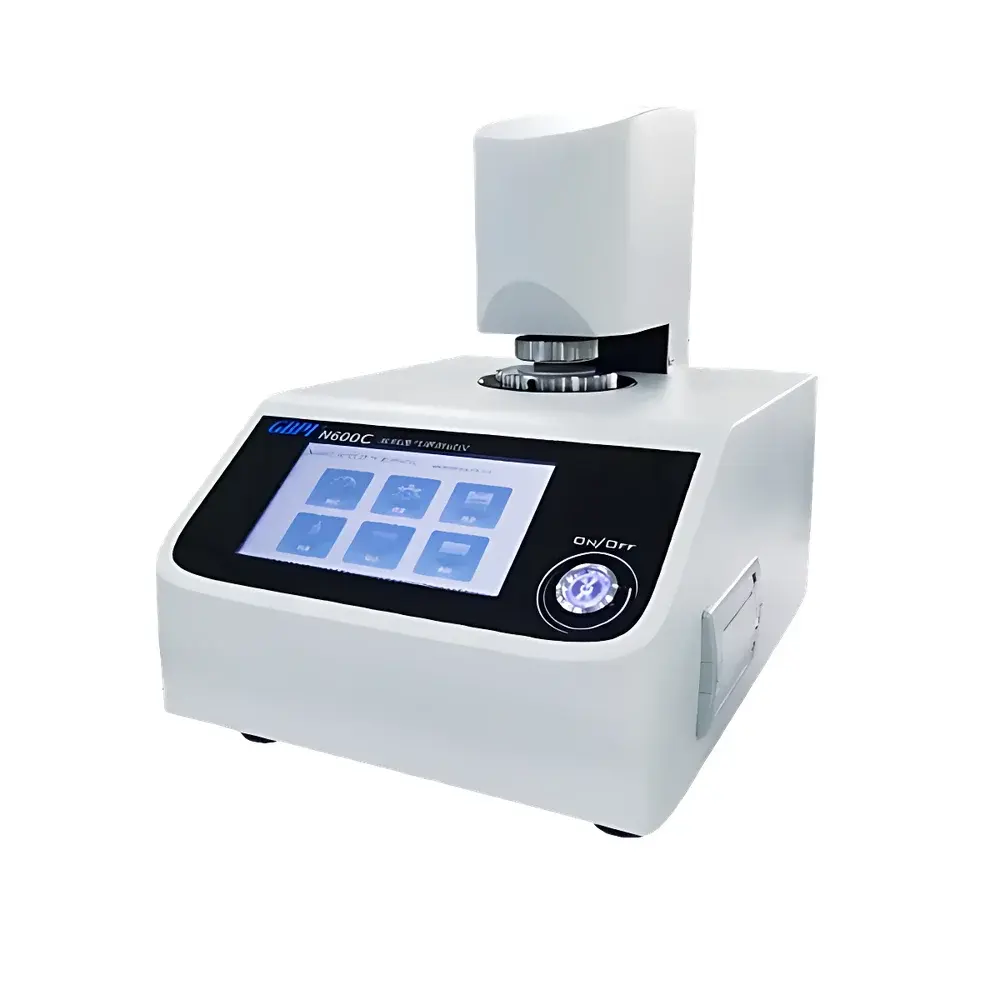
GBPI N600C-1 Proton Exchange Membrane Gas Permeability Tester
| Brand | GBPI |
|---|---|
| Origin | Guangdong, China |
| Manufacturer Type | Direct Manufacturer |
| Country of Origin | China |
| Model | N600C-1 |
| Pricing | Upon Request |
| Test Principle | Differential Pressure (Manometric) Method |
| Standard Compliance | GB/T 20042.7–2014 |
| Test Range | 0–200,000 mL·mm/(cm²·h·mmHg) |
| Resolution | 0.1 mL·mm/(cm²·h·mmHg) |
| Pressure Range | 0–500 Pa (customizable) |
| Pressure Resolution | 0.1 Pa |
| Pressure Accuracy | ±0.1% FS |
| Flow Range | 0–50 L/min (customizable) |
| Flow Resolution | 1 mL/min |
| Flow Accuracy | ±1% FS |
| Test Area | 16 cm² |
| Dimensions | 410 × 295 × 365 mm |
| Power Consumption | 100 W |
| Input Voltage | 110–250 VAC, 50–60 Hz |
Overview
The GBPI N600C-1 Proton Exchange Membrane Gas Permeability Tester is an engineered solution for precise, repeatable measurement of gas permeability in carbon paper substrates used in proton exchange membrane fuel cells (PEMFCs). Designed in strict accordance with GB/T 20042.7–2014, this instrument implements the differential pressure (manometric) method—where a controlled pressure gradient is applied across a standardized test specimen, and the resulting gas flux is quantified under steady-state conditions. The system calculates permeability using the fundamental relationship: K = (Q × d) / (A × ΔP), where K is the permeability coefficient (mL·mm/(cm²·h·mmHg)), Q is volumetric flow rate, d is sample thickness, A is effective test area (16 cm²), and ΔP is the applied pressure differential. This principle ensures traceable, physics-based characterization aligned with international metrological practice and widely accepted in PEMFC materials qualification workflows.
Key Features
- High-precision differential pressure control: Adjustable range from 0 to 500 Pa with resolution of 0.1 Pa and accuracy of ±0.1% full scale (FS), enabling reproducible low-pressure testing critical for thin, low-resistance carbon papers.
- Wide dynamic measurement range: Covers 0–200,000 mL·mm/(cm²·h·mmHg), supporting both ultra-low-permeability backing layers and highly porous diffusion media.
- Integrated human-machine interface: 7-inch color capacitive touchscreen with embedded real-time data visualization, parameter configuration, and on-device result calculation—no external PC required for routine operation.
- Onboard thermal printer: Generates immediate hard-copy reports including test date, operator ID, sample ID, pressure/flow readings, calculated permeability, and pass/fail status against user-defined limits.
- Modular hardware architecture: Supports optional custom test areas (e.g., 5 cm² or 25 cm² fixtures), auxiliary compressed air supply integration, and calibrated flow sensor upgrades for extended range applications.
Sample Compatibility & Compliance
The N600C-1 is optimized for rigid and semi-rigid planar specimens up to 3 mm thick, including carbon fiber paper, graphite-coated substrates, microporous layers (MPL), and catalyst-coated membranes (CCM) used in PEMFC stack assembly. Its clamping mechanism ensures uniform sealing without edge leakage or compression-induced porosity collapse. All measurements comply with GB/T 20042.7–2014, which specifies methodology, calibration protocols, and uncertainty evaluation procedures for carbon paper permeability in fuel cell contexts. While not certified to ISO 15105-1 or ASTM D1434, the instrument’s physical operating principles and metrological traceability align with the underlying science of those standards. For regulated environments, optional software modules support 21 CFR Part 11 compliance—including role-based access control, electronic signatures, and immutable audit trails—enabling use in GLP/GMP-aligned R&D and QC laboratories.
Software & Data Management
The optional PC-based upper-level software is architected per Annex 11 (Computerized Systems) of the EU GMP Guidelines and FDA’s 21 CFR Part 11 requirements. It provides multi-tiered user permissions (Administrator, Supervisor, Operator), time-stamped audit logs for all parameter changes and report generation events, and cryptographic electronic signature capture. Raw sensor data (pressure, flow, temperature) are stored in encrypted SQLite databases with checksum validation. Export formats include CSV (for statistical analysis in JMP or Minitab), PDF (with embedded digital signature), and XML (compatible with LIMS integration via HL7 or RESTful API adapters). Calibration records—including certificate numbers, due dates, and technician IDs—are maintained within the same database schema to support internal audits and regulatory inspections.
Applications
- Quality control of carbon paper batches prior to MEA fabrication, ensuring consistency in gas transport resistance across production lots.
- Development of next-generation porous transport layers (PTLs) with graded porosity or hydrophobic/hydrophilic patterning—quantifying directional permeability anisotropy.
- Accelerated degradation studies: Monitoring permeability drift after thermal cycling, humidity exposure, or electrochemical aging protocols.
- Comparative evaluation of alternative substrate materials (e.g., metal foams, titanium felts) against industry-standard carbon papers.
- Supporting DOE targets for PEMFC system efficiency by correlating measured permeability with polarization curve performance metrics.
FAQ
What standards does the N600C-1 directly reference?
It is fully compliant with GB/T 20042.7–2014, the Chinese national standard for permeability testing of carbon paper in proton exchange membrane fuel cells.
Can the instrument be used for non-fuel-cell materials such as packaging films or battery separators?
While physically capable of measuring gas flow through other flat sheet materials, its calibration, pressure range, and test area are specifically optimized for carbon paper; deviations require method validation per ISO/IEC 17025.
Is third-party calibration certification included with purchase?
A factory-issued calibration certificate is provided; optional accredited calibration (CNAS or A2LA traceable) is available upon request with documented uncertainty budgets.
How is temperature controlled during testing?
The base model operates at ambient laboratory temperature (23 ± 2°C recommended); environmental chamber integration for controlled-temperature testing is supported via analog I/O interface.
What maintenance is required for long-term accuracy?
Annual verification of pressure transducers and mass flow sensors is recommended; filter replacement every 6 months ensures particulate-free gas path integrity.





