
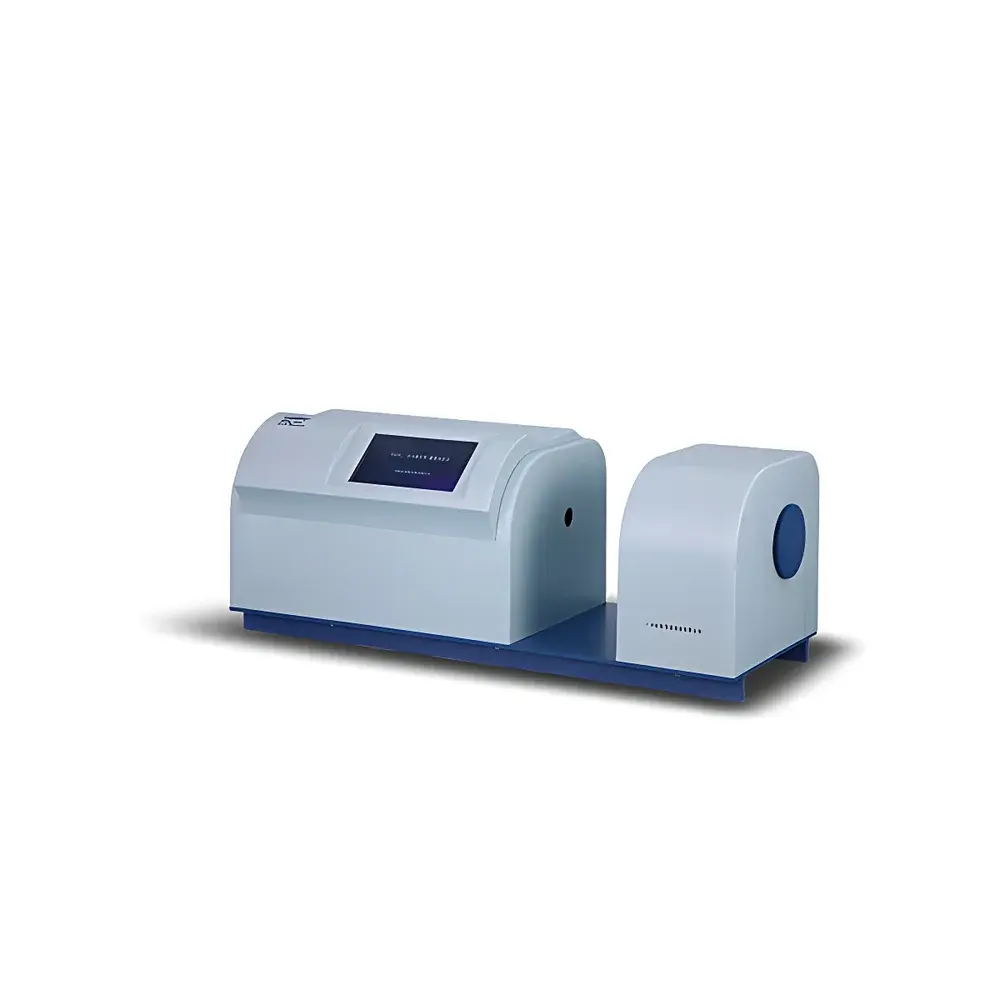
GBPI SGW810-G Automatic Haze and Luminous Transmittance Meter
| Brand | GBPI |
|---|---|
| Origin | Guangdong, China |
| Manufacturer Type | Direct Manufacturer |
| Product Category | Domestic |
| Model | SGW810-G |
| Pricing Range | USD 4,200 – 7,000 (FOB) |
| Type | Fully Automated |
| Haze Range | 0–30.0% |
| Transmittance Range | 0–100.0% |
| Haze Repeatability | ≤0.05% (for haze ≤0.5%) |
| Transmittance Repeatability | ±0.5% |
| Preheat Time | 30 min |
| Transmittance Accuracy | ±1.0% |
| Haze Accuracy | ±0.1% (≤0.5%), ±0.3% (>0.5%) |
| Minimum Resolution | 0.01% (both haze and transmittance) |
| Light Source | C-illuminant (6774 K) |
| Detector | Silicon photodiode |
| Optical Configuration | Collimated illumination, diffuse viewing geometry, integrating sphere detection |
| Sample Port Aperture | Input Ø25 mm, Output Ø21 mm |
| Solid Sample Size | 50 mm × 50 mm |
| Liquid Cell Dimensions | 50 mm × 50 mm × 10 mm |
| Film Sample Size | 50 mm × 50 mm |
| Power Supply | 220 V AC, 50 Hz |
| Net Weight | 21 kg |
| Compliance | GB/T 2410–2008, ASTM D1003–2007, JIS K7105–1981 |
Overview
The GBPI SGW810-G Automatic Haze and Luminous Transmittance Meter is a precision optical instrument engineered for quantitative assessment of light transmission and scattering behavior in transparent and semi-transparent planar materials. It operates on the principle of standardized integrating sphere photometry, conforming to the fundamental measurement geometry defined in ASTM D1003–2007: total transmittance (Tt) is determined as the ratio of total transmitted radiant flux to incident flux, while haze (H) is calculated as the percentage of transmitted light that deviates from the incident beam by more than 2.5°, relative to total transmitted light. This dual-parameter methodology enables rigorous characterization of optical clarity—critical for quality control in polymer sheet manufacturing, pharmaceutical packaging validation, beverage container certification, and optical film development. The instrument employs a stable C-illuminant (6774 K) source and calibrated silicon photodiode detectors housed within a high-reflectance BaSO4-coated integrating sphere, ensuring spectral consistency and long-term photometric stability.
Key Features
- Fully automated measurement cycle with integrated touchscreen interface—no manual calibration or path-length adjustment required between solid, liquid, or film samples.
- Dual-axis high-stability optical alignment system minimizes beam drift during extended operation; preheat stabilization time strictly controlled at 30 minutes to meet ASTM D1003 thermal equilibrium requirements.
- Optimized integrating sphere geometry (input port Ø25 mm, output port Ø21 mm) ensures uniform spatial response across the full 0–100.0% transmittance and 0–30.0% haze dynamic range.
- Traceable photometric calibration performed against NIST-traceable reference standards; factory calibration certificates include uncertainty budgets per ISO/IEC 17025 guidelines.
- Robust mechanical architecture with vibration-damped base and EMI-shielded electronics—designed for continuous operation in QC laboratories compliant with ISO 9001 and GMP Annex 11 environments.
Sample Compatibility & Compliance
The SGW810-G accommodates three primary sample formats without hardware modification: rigid flat specimens (50 mm × 50 mm), thin flexible films (same footprint), and liquid solutions in standardized 10-mm-pathlength cuvettes (50 mm × 50 mm × 10 mm). Its optical design satisfies all geometric and spectral constraints specified in GB/T 2410–2008 (Chinese national standard), ASTM D1003–2007 (Standard Test Method for Haze and Luminous Transmittance of Transparent Plastics), and JIS K7105–1981 (Japanese Industrial Standard for Transmittance and Haze of Plastics). Instrument validation protocols support IQ/OQ documentation for regulated industries, including pharmaceutical primary packaging qualification per USP and food-contact material testing under FDA 21 CFR Part 177.
Software & Data Management
Embedded firmware supports GLP-compliant data handling: each measurement record stores operator ID, timestamp, environmental temperature/humidity (via optional external sensor input), sample ID, and full audit trail of parameter changes. Export formats include CSV and PDF reports compliant with 21 CFR Part 11 requirements (electronic signatures, audit logs, and data integrity controls available via optional software license). Raw photodiode voltage traces and sphere reflectance decay profiles are accessible for metrological review. No cloud dependency—data remains on-device or exports directly to networked drives via USB or Ethernet.
Applications
- Quality assurance of PET, PC, and acrylic sheets used in automotive glazing and display enclosures—monitoring haze growth due to UV degradation or surface micro-scratching.
- Pharmaceutical packaging validation: quantifying haze increase in blister foil lidding after accelerated aging (ICH Q1A), or verifying clarity of IV bag films per USP .
- Food & beverage R&D: turbidity profiling of clarified juices, dairy alternatives, and functional waters using liquid-cell mode—correlating measured haze values with particle size distribution (PSD) from orthogonal DLS analysis.
- Coating development: evaluating anti-fog performance of hydrophilic polymer coatings on polycarbonate substrates via time-resolved haze kinetics under controlled humidity ramping.
- Academic research in optical polymer physics: correlating haze anisotropy with extrusion-induced molecular orientation using sequential angular scans (optional add-on module).
FAQ
Does the SGW810-G comply with FDA 21 CFR Part 11 for electronic records in regulated labs?
Yes—when configured with the validated software package, it provides role-based access control, electronic signatures, immutable audit trails, and secure data export meeting Part 11 technical requirements.
Can it measure samples thicker than 10 mm?
No—the optical path is fixed; samples exceeding 10 mm thickness require sectioning or use of alternative collimated-beam instruments per ASTM E284 definitions.
Is calibration traceable to international standards?
All factory calibrations are performed using NIST-traceable reference standards certified by CNAS-accredited laboratories; calibration certificates include expanded uncertainties (k=2) and compliance statements per ISO/IEC 17025.
What maintenance is required beyond routine cleaning?
Annual verification of sphere coating reflectance (≥97% @ 400–700 nm) and photodiode linearity is recommended; GBPI offers certified service contracts with on-site verification and recalibration.
How does it handle highly scattering samples near the 30% haze upper limit?
The integrating sphere’s optimized baffle geometry and dual-detector signal processing minimize stray-light artifacts, maintaining ≤±0.3% absolute accuracy even at 28–30% haze—validated per ASTM D1003 Annex A3.




