
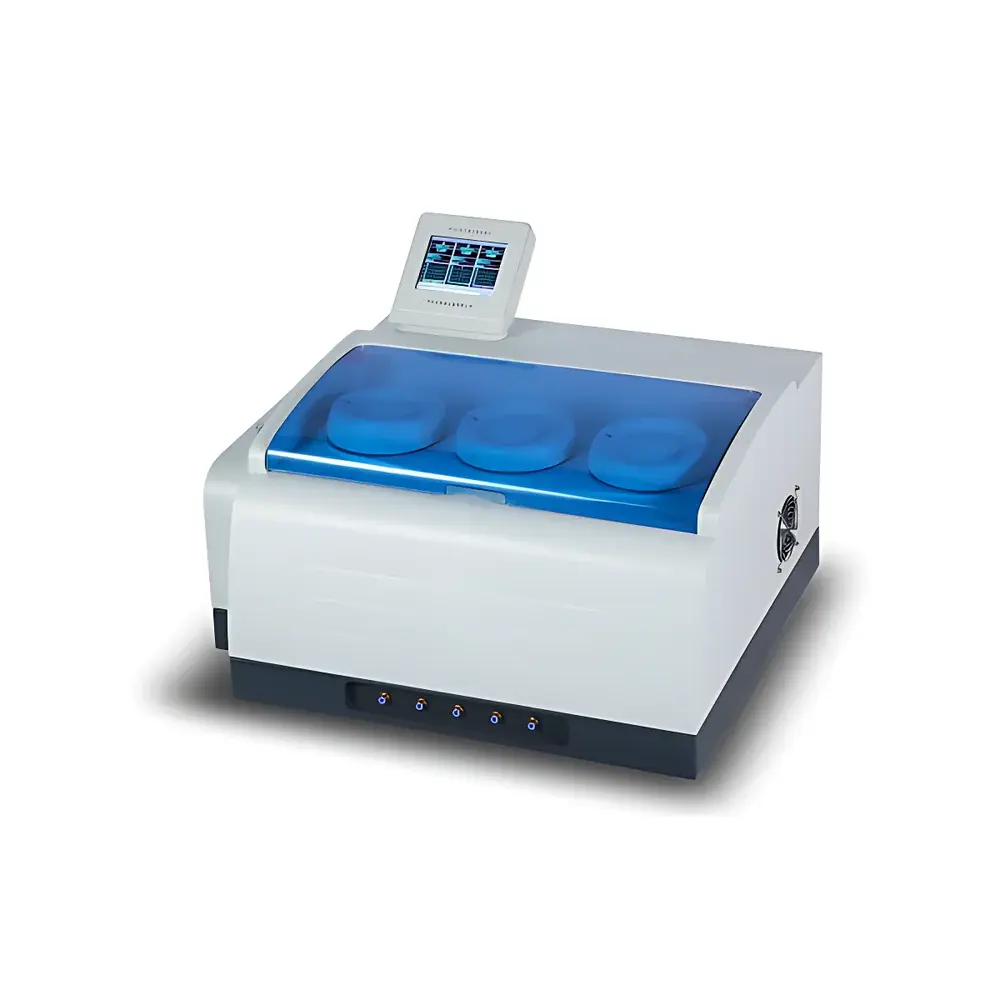
GBPI W203J Water Vapor Transmission Rate (WVTR) Tester
| Brand | GBPI |
|---|---|
| Origin | Guangdong, China |
| Manufacturer Type | Direct Manufacturer |
| Model | W203J |
| Test Range | 0.001–50 g/(m²·24h) (film & sheet), optional up to 1000 g/(m²·24h) |
| Accuracy | 0.001 g/(m²·24h) |
| Temperature Control Range | 15–45 °C |
| Temp. Stability | ±0.1 °C |
| Humidity Control Range | 30–90 %RH |
| RH Stability | ±1 %RH |
| Test Area | 50.24 cm² |
| Specimen Size | Ø100 mm |
| Max. Thickness | ≤3 mm |
| Sample Capacity | 3 independent test chambers |
| Carrier Gas | ≥99.999% N₂, pressure ≥0.1 MPa, flow 0–100 mL/min |
| Interface | 1/8″ metal tubing |
| Dimensions | 700 × 560 × 370 mm |
| Weight | 100 kg |
| Power | 750 W, AC 220 V / 50 Hz (110 V optional) |
Overview
The GBPI W203J Water Vapor Transmission Rate (WVTR) Tester is a gravimetric-coulometric hybrid instrument engineered for precise, traceable, and regulatory-compliant measurement of water vapor permeation through packaging materials and functional barriers. It operates on the principle of dynamic carrier gas coulometric detection: dry nitrogen sweeps the downstream side of a conditioned specimen mounted in a sealed test cell; water vapor permeating through the material is carried into a high-sensitivity dual-electrode coulometric moisture sensor, where quantitative electrolysis yields a current signal directly proportional to mass flux. This method ensures high reproducibility (CV < 1.5% per ASTM E398-2013 inter-laboratory studies) and eliminates gravimetric drift associated with long-duration weight-change measurements. Designed for ISO 17025-accredited labs and GMP-regulated environments, the W203J delivers traceable data aligned with pharmacopoeial and packaging industry benchmarks—including USP , YBB00092003-2015, GB/T 21529-2008, ISO 15106-3, DIN 53122-2, and ASTM E398-2013.
Key Features
- Triple independent test chambers with individual temperature/humidity control and real-time coulometric sensing—enabling concurrent testing of three distinct specimens or replicate runs under identical environmental conditions.
- High-precision climate control: electromagnetic step-programmed thermoregulation (±0.1 °C) and dual-stream humidity generation (dry + saturated gas mixing) ensuring stable, uniform RH profiles (±1 %RH) across all chambers.
- ARM-based embedded control architecture—fully operational without external PC; features a 10.1″ capacitive touchscreen HMI with live plotting of temperature, RH, sensor output, and calculated WVTR in real time.
- Automated workflow execution: integrated sequences for baseline stabilization, purge, equilibration, measurement, and auto-termination—with configurable dwell times, pass/fail thresholds, and alarm-triggered logging.
- GMP-aligned software architecture compliant with FDA 21 CFR Part 11 and EU Annex 11 requirements: role-based access control (administrator, operator, reviewer), full audit trail (system, method, run-level), electronic signatures, and immutable data archiving.
- Modular hardware design with field-replaceable sensor modules, self-diagnostic routines, and over-range sensor protection—minimizing downtime and extending service intervals.
Sample Compatibility & Compliance
The W203J accommodates rigid and flexible planar specimens (films, foils, laminates, ceramics, rubber sheets) up to 3 mm thick and Ø100 mm in diameter. With optional container adapters, it supports standardized testing of bottles, pouches, trays, and blister cavities per ASTM F1249 (for flexible packages) and ISO 15106-3 Annex B (for rigid containers). All measurement protocols adhere to metrological traceability chains: instruments are calibrated using GBW(E)130543/4 certified reference materials issued by China’s National Institute of Metrology, and full validation documentation—including as-found/as-left reports, uncertainty budgets, and IQ/OQ/PQ templates—is provided. The system meets GLP documentation standards and supports 21 CFR Part 11-compliant electronic records for pharmaceutical packaging qualification (e.g., primary container closure integrity verification per ICH Q5C).
Software & Data Management
The GBPI WVTR Control Suite is a Windows-based application built on .NET Framework with SQL Server Express backend. It enables method creation with customizable environmental ramps, sensor calibration curves, and pass/fail criteria. All raw sensor currents, environmental logs, and derived WVTR values are stored in encrypted relational databases with automatic daily backup and version-controlled method libraries. Reports conform to ISO/IEC 17025 reporting clauses: each includes instrument ID, operator ID, calibration certificate numbers, uncertainty statements, environmental deviation flags, and digital signatures. Export formats include PDF/A-2, Excel (.xlsx), and CSV—compatible with LIMS integration via ODBC or RESTful API (optional module). Audit trails record every user action—including parameter edits, report generation, and data deletion—with timestamps, IP addresses, and justification fields.
Applications
The W203J serves critical quality control and R&D functions across regulated and industrial sectors. In pharmaceutical manufacturing, it validates moisture barrier performance of PTP blisters, sachets, and desiccant-containing vials—supporting stability protocol compliance (ICH Q1A–Q5C). Food packaging engineers use it to benchmark shelf-life predictions for retort pouches, vacuum-sealed trays, and metallized PET films. Electronics manufacturers assess encapsulation integrity of OLED backplanes and flexible display laminates. Medical device firms quantify moisture ingress through wound dressing membranes and transdermal patch backing layers. Additionally, solar panel producers rely on its sub-0.01 g/(m²·24h) resolution to qualify ethylene-vinyl acetate (EVA) encapsulants and fluoropolymer backsheets per IEC 61215 standards.
FAQ
What carrier gas is required—and why must it be ≥99.999% pure nitrogen?
Ultra-high-purity nitrogen eliminates interference from ambient moisture, oxygen, or hydrocarbons that could saturate or poison the coulometric sensor. Impurities cause baseline drift and non-linear response, violating ASTM E398’s requirement for inert carrier gas purity.
Can the W203J test aluminum foil or SiOₓ-coated PET—materials with extremely low WVTR?
Yes. Its 0.001 g/(m²·24h) detection limit and triple-chamber redundancy enable statistically robust measurement of high-barrier substrates, including metallic foils, oxide-coated films, and multilayer laminates used in sterile packaging.
Is third-party calibration support available—and does GBPI provide ISO/IEC 17025-certified calibration services?
GBPI offers factory calibration with NIM-traceable certificates (GBW(E)130543/4). For accredited calibration, users may engage CNAS-accredited labs; GBPI supplies full technical documentation and uncertainty budgets to facilitate external accreditation.
How does the system handle data integrity during power interruption or unexpected shutdown?
All active test data is written to non-volatile memory at 1-second intervals. Upon restart, the software resumes from last valid checkpoint with timestamped recovery log—no data loss occurs, satisfying ALCOA+ data governance principles.
Are software updates and security patches provided post-warranty—and under what licensing model?
Minor version updates (bug fixes, compliance patches) are provided free for life. Major version upgrades (e.g., new regulatory modules) require a nominal annual maintenance contract covering remote diagnostics, firmware updates, and priority support escalation.




