
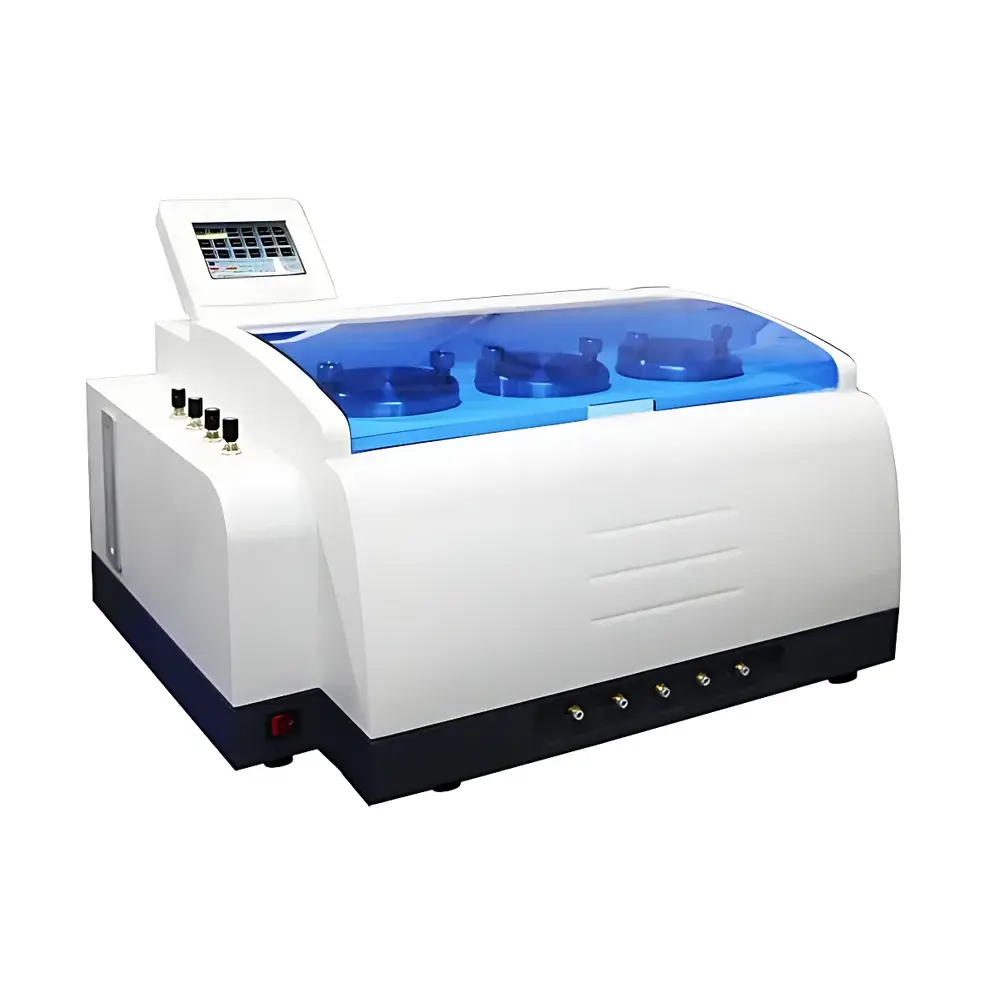
GBPI W403C Infrared Sensor-Based Water Vapor Transmission Rate (WVTR) Tester
| Brand | GBPI |
|---|---|
| Origin | Guangdong, China |
| Manufacturer Type | Direct Manufacturer |
| Country of Origin | China |
| Model | W403C |
| Test Range | 0.001–100 g/m²·24h |
| Test Accuracy | 0.001 g/m²·24h |
| Temperature Control Range | 15–45°C (optional up to 60°C) |
| Temperature Control Accuracy | ±0.1°C |
| Humidity Control Range | 0% RH (dry), 30–90% RH, and 100% RH |
| Humidity Control Accuracy | ±1% RH |
| Permeation Area | 50.24 cm² (reducible to 0.785 cm² with optional fixtures) |
| Specimen Diameter | Φ100 mm |
| Specimen Thickness | ≤2 mm |
| Sample Capacity | 2 independent test chambers |
| Carrier Gas | ≥99.999% N₂ (user-supplied) |
| Gas Pressure | ≥0.1 MPa |
| Gas Flow Rate | 5–120 mL/min |
| Gas Inlet | 1/8″ metal tubing |
| Dimensions | 61 × 55 × 40 cm |
| Weight | 80 kg |
| Power | 750 W |
| Supply | AC 220 V, 50 Hz |
| Compliance Standards | GB/T 26253-2010, YBB 00092003-2015, BS EN ISO 15106-2:2005, ASTM F1249-2013, JIS K7129-2008 |
Overview
The GBPI W403C Infrared Sensor-Based Water Vapor Transmission Rate (WVTR) Tester is an engineered analytical instrument designed for precise, gravimetrically traceable measurement of water vapor permeation through polymeric films, laminates, foils, and rigid packaging structures. It operates on the principle of infrared absorption spectroscopy—where a high-stability, temperature-compensated IR sensor quantifies water vapor concentration in a carrier gas stream downstream of a conditioned test specimen. The system maintains strict environmental control across both test chambers, enabling dual-sample evaluation under identical or independently defined temperature and relative humidity (RH) gradients per ASTM F1249 and ISO 15106-2 protocols. This methodology delivers direct, real-time quantification of mass transfer without reliance on desiccant weight gain or condensation-based detection, ensuring high reproducibility and minimal operator intervention.
Key Features
- Dual-chamber architecture with two independent IR sensors—enabling concurrent testing of dissimilar materials or replicate measurements under identical conditions.
- Electromagnetic step-programmable temperature control (±0.1°C accuracy) eliminating bulky external chillers or heaters and reducing thermal lag.
- Dynamic dual-gas humidity generation (dry + saturated streams) for stable, programmable RH control from 0% to 100% (±1% RH accuracy).
- ARM-based embedded controller supporting standalone operation—no external PC required for routine testing, data logging, or report generation.
- Modular hardware design with field-replaceable sensor modules, gas flow controllers, and humidity generators—minimizing downtime and service complexity.
- Comprehensive audit trail functionality compliant with FDA 21 CFR Part 11 and EU Annex 11 requirements, including system-level, method-level, and event-level tracking of all user actions and parameter changes.
- Integrated 7-inch color touchscreen interface with real-time visualization of temperature, RH, vapor concentration, and cumulative WVTR curves—including toggle visibility, zoom, and historical overlay functions.
Sample Compatibility & Compliance
The W403C accommodates flat specimens up to Φ100 mm and ≤2 mm thick—including monolayer plastics (e.g., PET, PE, PP), metallized films, aluminum foil, barrier-coated papers, ceramic substrates, rubber sheets, and medical-grade hydrogel patches. With optional fixtures, it extends to 3D packaging forms such as pouches, trays, bottles, and blister cavities—enabling headspace-based permeation assessment per ASTM F2622. All measurement protocols align with internationally recognized standards: GB/T 26253-2010 (Chinese national standard for plastic film WVTR), YBB 00092003-2015 (Chinese pharmaceutical packaging regulation), BS EN ISO 15106-2:2005 (infrared detection method), ASTM F1249-2013 (standard test method for WVTR using modulated IR detection), and JIS K7129-2008 (Japanese industrial standard). Instrument calibration is traceable to GBW(E)130543/4 certified reference materials issued by China’s National Institute of Metrology.
Software & Data Management
The GBPI proprietary software platform supports multi-tiered user access (Administrator, Operator, Viewer) with role-specific permissions configurable via intuitive GUI. All test methods—including gradient definition, dwell time, flow rate ramping, and baseline stabilization criteria—are stored as reusable templates. Raw sensor outputs, environmental logs, and calculated WVTR values are archived in an encrypted local SQLite database with automatic daily backup. Reports comply with GLP/GMP documentation requirements: each includes instrument ID, operator ID, calibration status, environmental setpoints, raw curve exports, statistical summaries (mean, SD, RSD), and digital signatures. Export formats include PDF (print-ready), Excel (.xlsx), and CSV (for LIMS integration). Audit trails record timestamped entries for login/logout events, method edits, result modifications, and calibration interventions—retained for ≥36 months.
Applications
This instrument serves quality assurance laboratories in regulated and non-regulated sectors requiring deterministic moisture barrier validation. Key applications include: shelf-life modeling of pharmaceutical blister packs and sachets; verification of solar backsheet integrity in photovoltaic module manufacturing; qualification of OLED encapsulation films; stability testing of transdermal drug delivery patches; QC of food packaging laminates (e.g., coffee pouches, snack bags); and R&D of novel nanocomposite barrier coatings. Its sub-milligram sensitivity (0.001 g/m²·24h) enables reliable characterization of ultra-high-barrier materials such as AlOx-coated PET or SiOx-deposited films—where traditional cup-based methods lack resolution.
FAQ
What carrier gas is required, and why must it be ≥99.999% pure nitrogen?
High-purity nitrogen eliminates interfering spectral absorbance from CO₂, O₂, and hydrocarbons that would distort IR signal fidelity. Impurities may also accelerate sensor drift or catalyze surface contamination.
Can the W403C test rigid containers like bottles or jars?
Yes—using optional volumetric fixtures that seal the container opening and establish a controlled headspace environment. WVTR is calculated based on internal vapor accumulation rate normalized to surface area.
How is calibration traceability maintained?
The instrument accepts certified reference standards (GBW(E)130543/4) for periodic performance verification. Users perform routine tests using these standards and input measured values into the calibration module, which adjusts sensor gain and offset coefficients accordingly.
Is remote monitoring supported?
While the embedded ARM system operates autonomously, optional Ethernet/Wi-Fi modules enable secure remote access to live data streams, alarm notifications, and historical database queries via TLS-encrypted web interface.
Does the system support 21 CFR Part 11 compliance out-of-the-box?
Yes—the software enforces electronic signature workflows, audit trail retention, and role-based access control without third-party add-ons. Full validation documentation (IQ/OQ/PQ protocols) is available upon request.



