
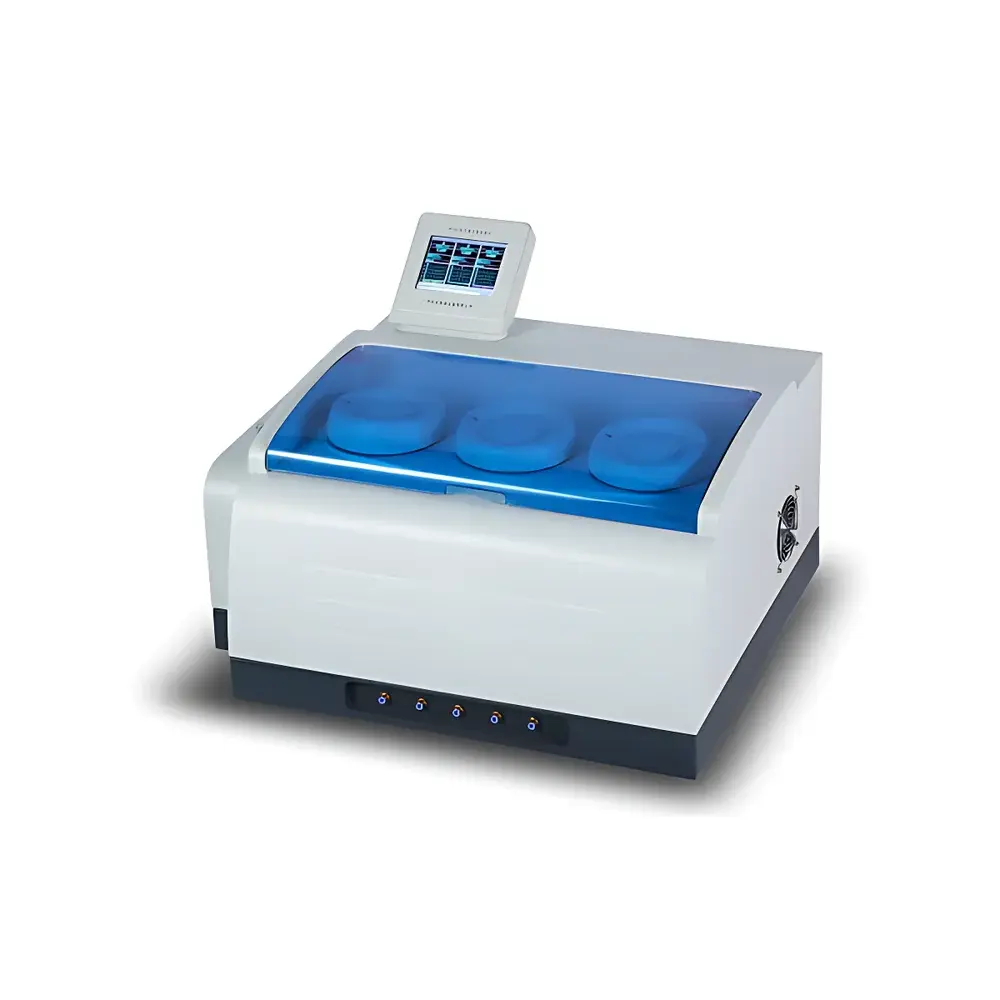
GBPI W405-A Infrared Water Vapor Transmission Rate (WVTR) Tester
| Brand | GBPI |
|---|---|
| Model | W405-A |
| Measurement Principle | Infrared Detection of Water Vapor |
| Test Range | 0.005–500 g/(m²·24h) |
| Accuracy | ±0.001 g/(m²·24h) |
| Temperature Control | 15–45°C (optional up to 60°C), ±0.1°C |
| Humidity Control | 0%, 30–90%, or 100% RH, ±1% RH |
| Test Area | 50.24 cm² (down to 0.785 cm² with optional fixtures) |
| Sample Size | Ø100 mm, ≤3 mm thickness |
| Sample Capacity | 1–3 specimens per run |
| Carrier Gas | High-purity nitrogen (99.999%), 5–120 mL/min, ≥0.1 MPa |
| Power | AC 220 V, 50 Hz, 1000 W |
| Dimensions | 610 × 550 × 400 mm |
| Weight | 57.1 kg |
Overview
The GBPI W405-A Infrared Water Vapor Transmission Rate (WVTR) Tester is an ISO/ASTM-compliant gravimetric-free instrument engineered for precise, traceable, and repeatable measurement of water vapor permeation through packaging materials and functional barriers. It operates on the principle of infrared absorption spectroscopy: a conditioned test specimen separates two climate-controlled chambers — a humidified upstream chamber (e.g., 90% RH) and a dry downstream chamber purged with ultra-high-purity nitrogen. Driven by the humidity gradient, water vapor diffuses across the sample and is swept into an infrared detection cell, where its concentration is quantified in real time via calibrated IR absorbance at 2.7 µm. This non-destructive, continuous monitoring method eliminates weighing artifacts and enables dynamic kinetic profiling of permeation behavior. Recognized as the arbitration method in China’s 2015 Pharmacopoeia Packaging Materials Standards (YBB 00092003-2015), the W405-A delivers metrological rigor aligned with international regulatory expectations for barrier validation in pharmaceutical, medical device, food, and electronics packaging.
Key Features
- Triple independent test chambers support concurrent, asynchronous evaluation of up to three distinct specimens — each with full parameter autonomy and individual report generation.
- ARM-based embedded control architecture enables standalone operation without external PC dependency; all system logic, data acquisition, and real-time curve visualization are hosted onboard.
- Electromagnetic programmable temperature control ensures ±0.1°C stability across 15–45°C (extendable to 60°C); dual-stream humidity regulation (dry + humid gas mixing) achieves ±1% RH accuracy at setpoints including 0%, 30–90%, and 100% RH.
- Modular sensor protection architecture includes automatic over-range cutoff for the IR detector, preventing thermal or saturation-induced drift during high-flux testing (e.g., low-barrier films).
- Integrated 7-inch color touchscreen provides live monitoring of four synchronized real-time curves: temperature, relative humidity, water vapor concentration (ppm), and calculated WVTR (g/m²·24h); curve visibility is user-configurable with preview/hide toggles.
- Factory-certified traceability: supplied with GBW(E)130543/4 National Standard Reference Materials for WVTR calibration; supports user-performed in-house verification using certified permeation standards per ISO 15106-2 Annex B.
Sample Compatibility & Compliance
The W405-A accommodates rigid and flexible substrates per ISO 15106-2 and ASTM F1249 requirements. Validated geometries include flat films (plastic, metallized PET, Al foil, laminates), sheets (rubber, ceramic, polymer composites), and 3D containers (bottles, pouches, trays) when used with optional fixture kits. Minimum test area is configurable down to 0.785 cm² (Ø10 mm), enabling micro-scale barrier assessment for OLED encapsulation films or transdermal patch backing layers. All hardware and software comply with GLP/GMP data integrity mandates: electronic records meet FDA 21 CFR Part 11 criteria for audit trails, role-based access control, and immutable metadata logging. Regulatory alignment extends to GB/T 26253-2010, JIS K7129-2008, and BS EN ISO 15106-2:2005.
Software & Data Management
The GBPI WVTR Workstation software implements a tiered user permission model (Administrator, Operator, Viewer) with granular privilege assignment — e.g., restricting method editing to Administrators while permitting Operators to execute validated protocols only. Every system action (login, parameter change, report export, calibration event) is timestamped and logged in three layered audit trails: System Audit Trail (OS-level events), Method Audit Trail (protocol versioning and modification history), and Run Audit Trail (per-test sequence, raw sensor output, environmental logs). Reports auto-generate in PDF and Office-compatible formats with embedded digital signatures, uncertainty statements, and compliance footers referencing applicable standards. All data reside in a local encrypted SQLite database with optional network backup; no cloud transmission occurs unless explicitly configured by the site IT administrator.
Applications
This instrument serves critical quality control and R&D functions across regulated industries. In pharmaceutical packaging, it validates moisture barrier integrity of blister foils, cold-forming aluminum, and desiccant-containing sachets per USP <671> and ICH Q5C stability guidance. For flexible food packaging, it quantifies shelf-life limiting factors in retort pouches, vacuum-sealed trays, and microwaveable films. Electronics manufacturers employ it to qualify moisture-sensitive encapsulation layers for solar backsheet laminates and TFT-LCD polarizer films. Medical device firms use it to assess hydrolytic stability of wound dressing membranes and drug-eluting stent coatings. Research labs leverage its kinetic resolution to model Fickian vs. anomalous diffusion mechanisms in nanocomposite barrier films.
FAQ
Is the W405-A compliant with FDA 21 CFR Part 11 for electronic records and signatures?
Yes — the embedded software enforces ALCOA+ principles: attributable, legible, contemporaneous, original, accurate, complete, consistent, enduring, and available. Audit trails are non-erasable and include operator ID, timestamp, and action context.
Can the instrument test rigid containers such as glass bottles or plastic jars?
Yes — with the optional Container Test Fixture Kit (sold separately), the system adapts to ASTM F1249 Annex A for 3D package testing, maintaining ISO-defined boundary conditions and flow dynamics.
What calibration standards are required for routine verification?
GBPI supplies certified National Standard Reference Materials (GBW(E)130543/4) traceable to NIM (China National Institute of Metrology). Users perform periodic verification using the same test protocol applied to unknown samples.
Does the system support method transfer between laboratories?
Yes — methods are saved as encrypted XML files containing all parameters, environmental setpoints, and reporting templates; import/export functionality ensures identical execution across instruments within a multi-site network.
How is sensor longevity maintained during extended operation?
The IR detector features active thermal stabilization and automatic zero-point recalibration during idle cycles; the nitrogen purge stream continuously scavenges ambient contaminants, extending optical path lifetime beyond 5 years under typical QC lab usage.




