
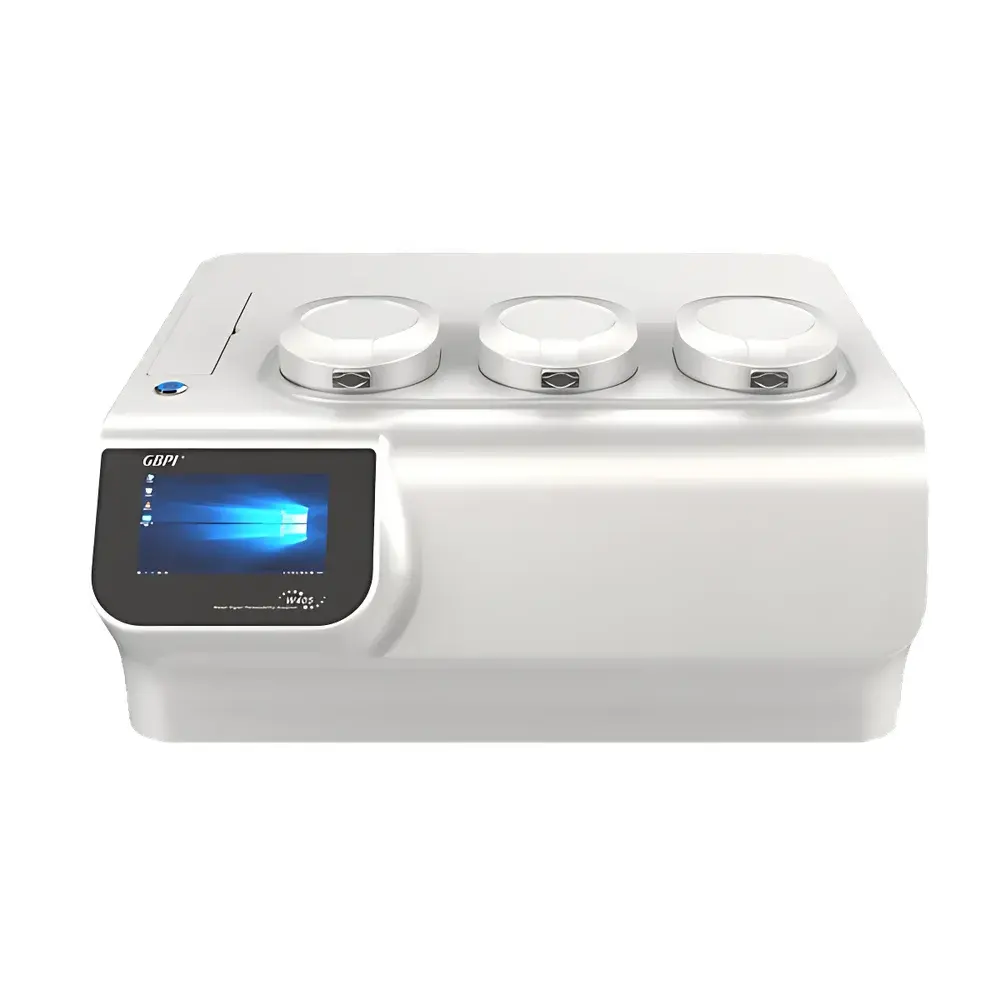
GBPI W413 2.0R Infrared-Based Water Vapor Transmission Rate (WVTR) Tester
| Brand | GBPI |
|---|---|
| Origin | Guangdong, China |
| Manufacturer Type | Direct Manufacturer |
| Product Category | Domestic |
| Model | W413 2.0R |
| Price Range | USD 42,000–70,000 |
| Measurement Principle | Infrared Detection of Moisture Permeation |
| Standards Compliance | GB/T 26253-2010, ASTM F1249-2013, ISO 15106-2:2005, JIS K7129-2008, YBB 00092003-2015 |
| Test Range | 0.002–500 g/(m²·24h) |
| Resolution | 0.001 g/(m²·24h) |
| Temperature Control Range | 15–45 °C |
| Temperature Accuracy | ±0.1 °C |
| Humidity Control Range | 0–100 %RH (dual-stream dry/wet gas method) |
| Humidity Accuracy | ±1 %RH |
| Test Area | 50.24 cm² |
| Specimen Diameter | Φ100 mm |
| Max Specimen Thickness | 3 mm |
| Sample Capacity | 3 specimens per cycle |
| Carrier Gas | ≥99.999% N₂, 5–100 mL/min, ≥0.1 MPa pressure |
| Pneumatic Clamping Pressure | ≥0.3 MPa |
| Power | 750 W, AC 220 V / 50 Hz |
Overview
The GBPI W413 2.0R Infrared-Based Water Vapor Transmission Rate (WVTR) Tester is a precision-engineered instrument designed for quantitative determination of water vapor permeation through planar and three-dimensional packaging materials under controlled temperature and humidity conditions. It operates on the principle of infrared spectroscopic detection—where water vapor molecules diffusing across a test specimen are carried by a high-purity nitrogen stream into an IR moisture sensor, enabling real-time, non-destructive quantification of transmission flux. This methodology delivers high sensitivity, long-term signal stability, and minimal drift—critical for evaluating ultra-high-barrier films such as aluminum foil laminates, PVDC-coated structures, and multilayer coextrusions used in pharmaceutical blister packaging, sterile medical device pouches, and flexible electronics encapsulation.
Key Features
- Infrared moisture sensing architecture with factory-calibrated, NIST-traceable reference standards; certified reference materials (GBW(E)130543/4) supplied for routine instrument verification per ISO/IEC 17025 requirements.
- Integrated electromagnetic programmable temperature control system: achieves ±0.1 °C uniformity across the test chamber without external chiller or heater units—reducing footprint, maintenance intervals, and thermal lag.
- Dual-stream humidity generation: independent dry and saturated wet gas mixing enables precise, stable RH setpoints from 0 to 100 %RH at ±1 %RH accuracy—essential for accelerated aging studies and barrier performance mapping across hygrothermal gradients.
- Modular pneumatic clamping mechanism with adjustable pressure (≥0.3 MPa) ensures consistent specimen sealing for flat films, rigid sheets (≤3 mm thick), and formed containers—including bottles, trays, and stand-up pouches with integrated test ports.
- Embedded 10.1″ color touchscreen HMI eliminates dependency on external PCs; supports full test automation—auto-start, endpoint detection, data logging, and report generation—with real-time overlay of five synchronized trend curves (temperature, RH, WVTR, flow rate, supply voltage).
- GMP-compliant software architecture compliant with Annex 11 (EU GMP) and FDA 21 CFR Part 11: includes role-based user access control, electronic signatures, audit trail (immutable record of all data modifications, parameter changes, and user logins), and secure PDF report export with embedded metadata and digital watermarking.
Sample Compatibility & Compliance
The W413 2.0R accommodates a broad spectrum of material geometries and industrial use cases. Flat specimens—including monolayer polymers (PET, PE, PP), metallized films (AlOx, SiOx), foil-laminates, rubber sheets, ceramic substrates, and functional barrier coatings—are tested using the standard 50.24 cm² diffusion area (Φ100 mm). For 3D packaging, optional custom fixtures enable testing of sealed pouches, blister cavities, and injection-molded containers per ASTM F1249 Annex A2 and ISO 15106-2 Annex B. All measurement protocols adhere to internationally harmonized regulatory frameworks: GB/T 26253-2010 (China), ASTM F1249-2013 (US), ISO 15106-2:2005 (global), JIS K7129-2008 (Japan), and YBB 00092003-2015 (Chinese pharmaceutical packaging standards). Data generated satisfies GLP, GMP, and ISO 9001 documentation requirements for QC release testing and stability protocol submissions.
Software & Data Management
The proprietary GBPI LabControl™ v4.2 software provides a validated, 21 CFR Part 11–ready environment for method development, instrument qualification (IQ/OQ/PQ), and lifecycle data governance. It features configurable test templates aligned with pharmacopeial monographs (e.g., USP ), automated calibration scheduling, and relational database storage with SQL backend support. All raw sensor outputs, environmental logs, and calculation intermediates are retained with timestamped integrity checks. Audit trails capture operator identity, action type, timestamp, and pre-/post-value states for every editable field. Export options include CSV (for statistical process control integration), XML (for LIMS ingestion), and digitally signed PDF reports containing instrument ID, calibration status, environmental validation records, and uncertainty budgets per GUM (JCGM 100:2008).
Applications
- Pharmaceutical packaging: Quantifying WVTR of cold-form blister lidding foils, sachets for lyophilized biologics, and barrier layers in prefilled syringe stoppers.
- Medical device packaging: Validating shelf-life claims for Tyvek®-based sterile barrier systems and pouch seal integrity under accelerated humidity stress.
- Flexible electronics: Measuring moisture ingress rates through encapsulation films for OLED displays, solar backsheet laminates, and thin-film transistor substrates.
- Food packaging R&D: Benchmarking moisture barrier performance of bio-based films (PLA, PHA), nanocomposite coatings, and vacuum-metallized cellulose derivatives.
- Academic & regulatory research: Supporting ISO/TC 61 and ASTM D3350 working group activities on standardized permeation modeling and interlaboratory comparison studies.
FAQ
What carrier gas is required, and why must it be ≥99.999% pure nitrogen?
High-purity nitrogen minimizes interference from ambient moisture and CO₂ in the carrier stream, ensuring baseline stability and measurement specificity. Impurities >10 ppm H₂O can elevate background noise and compromise resolution at low WVTR levels (<0.01 g/m²·24h).
Can the instrument test rigid containers without modification?
Yes—when equipped with the optional Container Test Module (CTM-200), the W413 2.0R performs gravimetric-equivalent WVTR measurements on sealed bottles, trays, and tubs per ASTM F1249 Annex A2, using differential pressure-driven vapor flow and IR detection.
How is temperature and humidity uniformity verified during qualification?
GBPI provides IQ/OQ documentation kits including calibrated PT100 probes and chilled-mirror hygrometers for spatial mapping of chamber gradients; acceptance criteria follow ISO 17025 clause 6.4.2 and ASTM E2877-13.
Is remote monitoring supported?
The system supports secure TLS 1.2–encrypted Ethernet communication; authorized users may view live trends, initiate tests, and retrieve audit logs via browser-based interface—fully compatible with corporate IT security policies.
Does the software support multi-language UI and report localization?
Yes—English, Simplified Chinese, Japanese, and Korean language packs are available; report templates auto-localize units, terminology, and regulatory references based on selected regional standard profile.





