
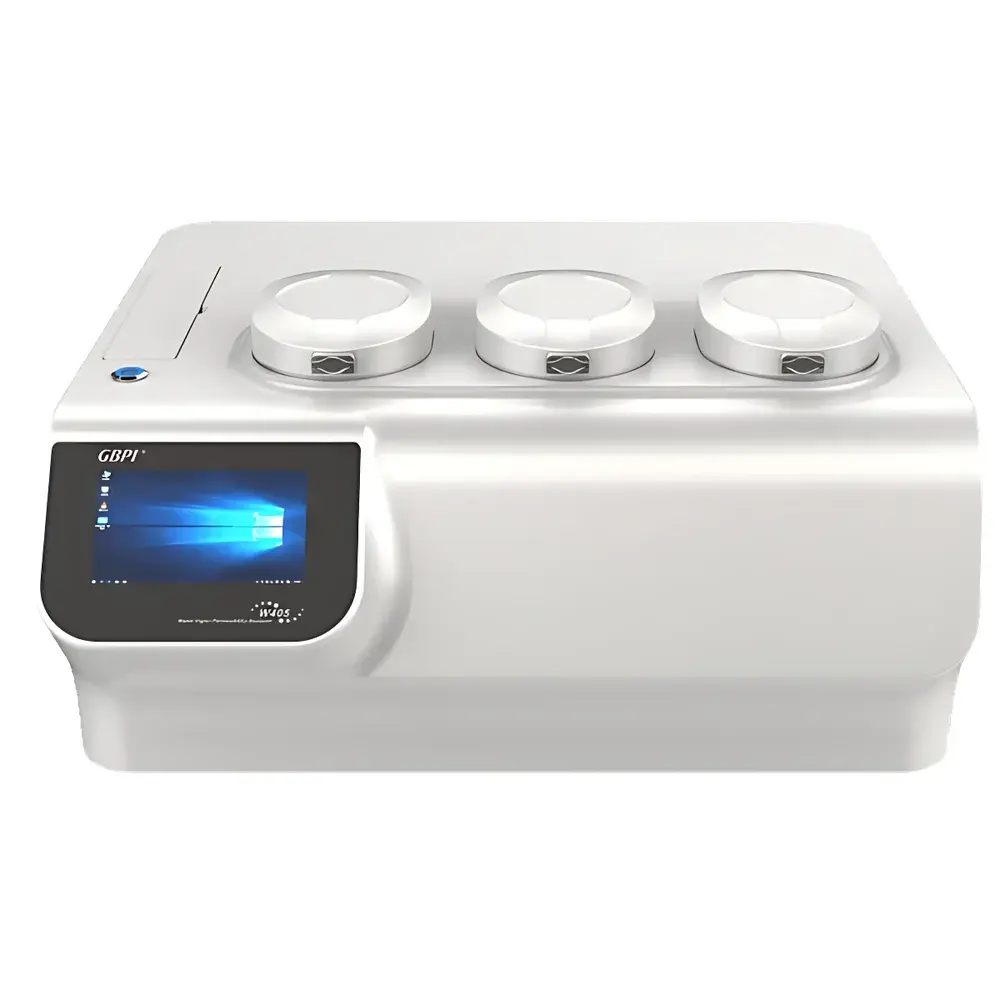
GBPI Y310 2.0A Coulometric Oxygen Transmission Rate (OTR) Analyzer
| [Brand | GBPI |
|---|---|
| Origin | Guangdong, China |
| Manufacturer Type | Original Equipment Manufacturer (OEM) |
| Product Category | Domestic Scientific Instrument |
| Model | Y310 2.0A |
| Test Range | 0.05–1000 cm³/(m²·24 h) (up to 260,000 cm³/(m²·24 h) with mask adapter) |
| Resolution | 0.001 cm³/(m²·24 h) |
| Temperature Control Range | 15–45 °C |
| Temperature Stability | ±0.1 °C |
| Permeation Area | 50.24 cm² (customizable down to 0.785 cm²) |
| Specimen Diameter | Φ100 mm |
| Max Specimen Thickness | ≤3 mm |
| Sample Capacity | 3 independent test cells |
| Carrier Gas Pressure | ≥0.1 MPa |
| Pneumatic Actuation Pressure | ≥0.3 MPa |
| Power Consumption | 750 W |
| Electrical Supply | AC 220 V, 50 Hz] |
Overview
The GBPI Y310 2.0A Coulometric Oxygen Transmission Rate (OTR) Analyzer is an ISO/ASTM-compliant benchtop instrument engineered for precise, traceable measurement of oxygen permeability through polymeric films, laminates, foils, and rigid or flexible packaging structures. It operates on the coulometric detection principle—where oxygen molecules permeating across a conditioned specimen are swept by high-purity nitrogen carrier gas into a galvanic coulometric sensor. The sensor quantifies oxygen via electrochemical reduction, generating a current proportional to molar oxygen flux. This fundamental physical measurement—rooted in Faraday’s law—ensures absolute quantification without calibration drift, delivering metrologically sound OTR values in standard units (cm³/[m²·24 h·0.1 MPa]). Designed for regulatory-grade testing environments, the Y310 2.0A supports method validation under ISO 15105-2, ASTM D3985, ASTM F1307, ASTM F1927, GB/T 19789, and YBB 00082003, making it suitable for QC laboratories operating under GLP, GMP, or FDA 21 CFR Part 11 compliance frameworks.
Key Features
- Triple independent test chambers enable parallel, statistically robust measurements—reducing cycle time by up to 67% versus single-cell systems while maintaining full data traceability per cell.
- Coulometric oxygen sensor with factory-calibrated sensitivity (0.001 cm³/[m²·24 h] resolution) and <500-hour operational stability between recalibrations; certified against NIM-traceable national standard reference materials (GBW(E)130497 / GBW(E)130498).
- Electromagnetic temperature control system with PID-driven ramping and real-time feedback—achieving ±0.1 °C uniformity across the entire test zone (15–45 °C range), critical for Arrhenius-based barrier modeling.
- Automated pneumatic clamping mechanism ensures repeatable 0.3 MPa sealing pressure and eliminates operator-induced variability in specimen mounting.
- Integrated 11.6-inch capacitive touchscreen interface running a GMP Annex 11–aligned embedded OS with role-based access control (Administrator, Technician, Reviewer), electronic signatures, and full audit trail (user actions, parameter changes, test events).
- Real-time six-channel trending: OTR vs. time, temperature vs. time, humidity vs. time (optional sensor), N₂ flow rate vs. time, O₂ flow rate vs. time, and sensor output concentration vs. time—with on-screen curve toggling and exportable raw time-series datasets.
Sample Compatibility & Compliance
The Y310 2.0A accommodates flat specimens up to Φ100 mm and 3 mm thickness—including monolayer and multilayer polymer films (PET, PE, PP, BOPP, CPP, PVC), metallized substrates, paperboard composites, pharmaceutical blister lidding, medical device pouches, photovoltaic backsheet laminates, and elastomeric tubing. With optional fixture kits, it extends to 3D packaging formats: bottles (PET, HDPE), cups (PP, PS), trays (vacuum-formed PETG), foil-laminated sachets, and capped containers. All test methods align with internationally recognized standards: ISO 15105-2 (coulometric mode), ASTM D3985 (oxygen sensor method), ASTM F1307 (packaged goods), and Chinese Pharmacopoeia YBB 00082003. Instrument qualification includes IQ/OQ documentation templates compliant with EU Annex 15 and USP , supporting 21 CFR Part 11 readiness when paired with validated LIMS integration.
Software & Data Management
The proprietary GBPI LabOS v4.2 firmware implements ALCOA+ data integrity principles: Attributable, Legible, Contemporaneous, Original, Accurate, Complete, Consistent, Enduring, and Available. Each test record embeds digital signatures, timestamped metadata (operator ID, environmental logs, sensor diagnostics), and version-controlled method templates. Statistical modules compute mean OTR, standard deviation, RSD%, and confidence intervals (95%) across replicates. Data exports support CSV, PDF (with embedded digital signature), XML (for LIMS ingestion), and encrypted SQLite archives. Remote diagnostics and firmware updates are enabled via secure TLS-encrypted connection to GBPI’s cloud-based InstrumentLink platform—allowing authorized users to monitor instrument status, retrieve historical runs, download SOPs, and stream training videos without local IT intervention.
Applications
This analyzer serves as a primary barrier characterization tool across regulated industries: In pharmaceutical packaging, it verifies OTR compliance for blister packs, cold-form foil, and child-resistant closures per ICH Q5C stability guidelines. In food packaging R&D, it quantifies shelf-life limiting factors for MAP (modified atmosphere packaging) films and compostable PLA/PBAT laminates. Medical device manufacturers use it to validate sterile barrier system integrity per ISO 11607-1. Photovoltaic material suppliers assess backsheet oxidation resistance under accelerated aging protocols (IEC 61215). Additionally, it supports academic research in polymer physics—enabling diffusion coefficient (D), solubility coefficient (S), and permeability coefficient (P = D × S) derivation via temperature-dependent OTR profiling.
FAQ
What gases are required for operation?
High-purity oxygen (≥99.999%) and nitrogen (≥99.999%), each supplied via dedicated cylinders with dual-stage stainless-steel regulators capable of 0–0.4 MPa output.
Is external PC hardware mandatory?
No—the instrument operates autonomously via its embedded OS and touchscreen; a PC is optional for advanced reporting, LIMS integration, or long-term archival.
Can the system be validated for 21 CFR Part 11 compliance?
Yes—GBPI provides IQ/OQ protocols, electronic signature validation reports, and audit trail configuration guides aligned with FDA expectations for computerized systems used in regulated environments.
How often does the coulometric sensor require recalibration?
Under routine use (≤5 tests/day), sensor verification with certified reference films is recommended every 90 days; full recalibration using NIM standard gases is advised annually or after sensor replacement.
Does the system support humidity-controlled testing?
Humidity control is available as a factory-installed option (RH 10–90% ±2% at 23 °C), enabling water vapor–oxygen interaction studies per ISO 15105-1 Annex B protocols.




