
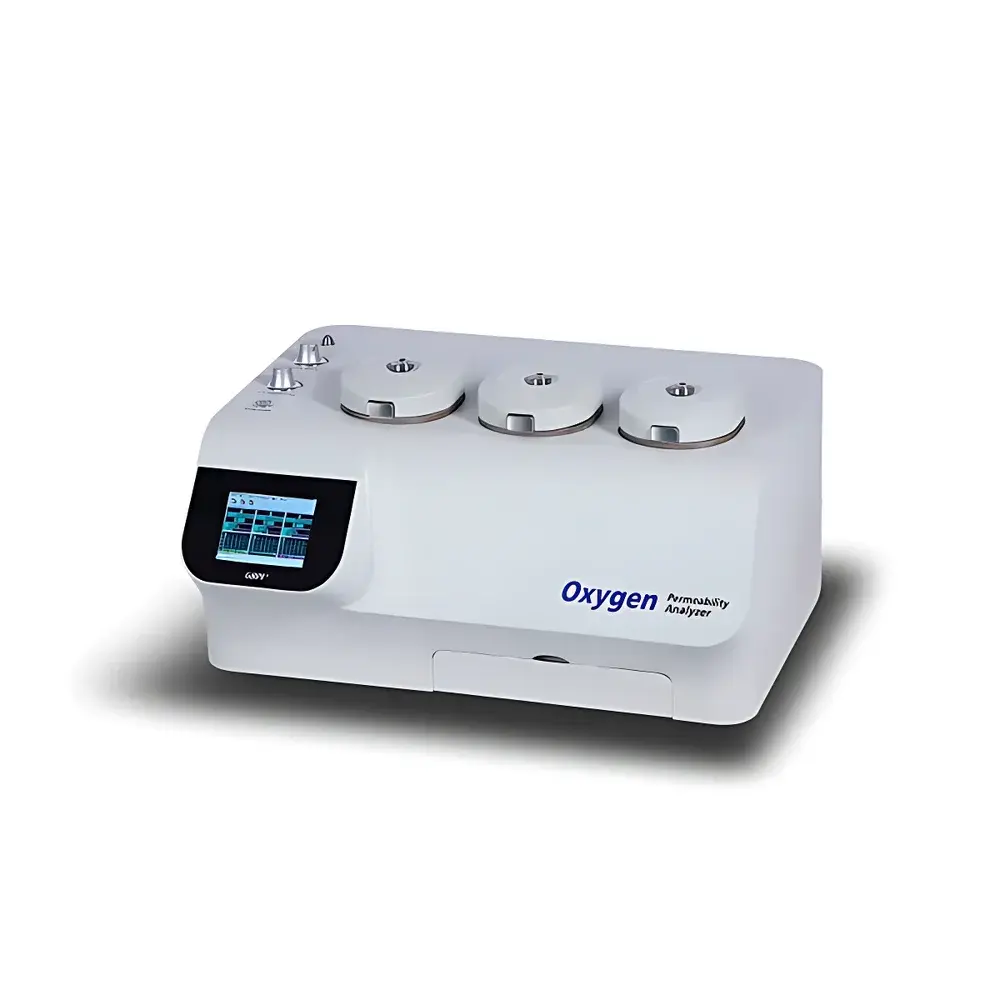
GBPI Y310 Coulometric Oxygen Transmission Rate (OTR) Tester
| Brand | GBPI |
|---|---|
| Origin | Guangdong, China |
| Manufacturer Type | Direct Manufacturer |
| Region | Domestic (China) |
| Model | Y310-0 |
| Price Range | USD 14,000 – 70,000 |
| Test Range | 0.02–16,500 cm³/(m²·24h) (film) |
| O₂ Resolution | 0.001 cm³/(m²·24h) |
| Temp Control | 15–45°C (5–50°C optional) |
| RH Control | 0% (dry), 30–90% RH |
| Test Area | 50.24 cm² |
| Specimen Size | Ø100 mm |
| Max Thickness | ≤3 mm |
| Sample Capacity | 1–3 independent chambers |
| Carrier Gas Pressure | 0.1–0.2 MPa |
| Interface | 1/8″ stainless steel tubing |
| Dimensions | 700 × 560 × 370 mm |
| Weight | 100 kg |
| Power | 750 W, AC 220 V, 50 Hz |
| Compliance | GB/T 19789–2005, ASTM D3985, ASTM F1927, ASTM F1307, ASTM F2622, ISO 15105-2, YBB00082003–2015, DIN 53380-3, JIS K-7126-B |
Overview
The GBPI Y310 Coulometric Oxygen Transmission Rate (OTR) Tester is a precision laboratory instrument engineered for the quantitative determination of oxygen permeability through polymeric films, laminates, foils, rigid sheets, and packaging containers. It operates on the principle of coulometric detection—where oxygen molecules permeating through a conditioned test specimen are swept by a high-purity nitrogen carrier gas into an electrochemical sensor that quantifies oxygen concentration via Faraday’s law of electrolysis. This method delivers trace-level sensitivity, exceptional long-term stability, and direct SI-traceable measurement without reliance on calibration curves. Designed for regulated environments, the Y310 meets the metrological and operational requirements of quality control laboratories in pharmaceutical packaging, medical device manufacturing, food preservation R&D, and advanced material development—where barrier performance directly impacts shelf life, sterility assurance, and regulatory compliance.
Key Features
- Coulometric oxygen sensor with 0.001 cm³/(m²·24h) resolution, enabling accurate quantification of ultra-high-barrier materials including aluminum foil, SiOx-coated PET, and multilayer pharmaceutical blisters.
- Triple independent test chambers with individual temperature/humidity control and autonomous termination—allowing concurrent testing of up to three dissimilar specimens under identical or customized environmental conditions.
- High-precision climate control system: electromagnetic stepwise thermal regulation (±0.1°C) and dual-stream humidity generation (±1% RH), both validated across the full operating range per ISO 17025-compliant procedures.
- ARM-based embedded controller enabling standalone operation—no host PC required for routine measurements; all data logging, curve visualization, and report generation occur locally on the integrated 7-inch LCD interface.
- GMP-aligned software architecture compliant with FDA 21 CFR Part 11 and EU Annex 11: role-based user authentication (Administrator, Operator, Reviewer), full audit trail (system, method, and run-level), electronic signatures, and immutable data storage with timestamped revision history.
- Modular hardware design with field-replaceable sensor modules, sealed gas manifolds, and SS316 fluidic pathways—minimizing downtime and supporting ISO/IEC 17025-mandated preventive maintenance schedules.
Sample Compatibility & Compliance
The Y310 accommodates flat specimens (films, sheets, ceramics, rubber) up to 3 mm thick and Ø100 mm in diameter, as well as 3D packaging forms—including bottles, pouches, cups, and trays—via optional permeation masks and custom fixtures. Its extended dynamic range (up to 260,000 cm³/(m²·24h) with mask configuration) supports both ultra-low-permeability pharmaceutical barriers and highly permeable agricultural films. The instrument is fully validated against international standards including ASTM D3985 (coulometric method), ASTM F1927 (container testing), ISO 15105-2 (differential pressure method cross-validation), and Chinese pharmacopoeial standard YBB00082003–2015. All factory calibrations are traceable to NIM-certified reference materials (GBW(E)130497/8), and in-house verification protocols align with GLP and GMP documentation requirements.
Software & Data Management
The proprietary GBPI OTR Studio software provides a Windows-native interface with intuitive workflow navigation, real-time multi-parameter monitoring (OTR, O2 concentration, temperature, RH), and interactive curve manipulation (zoom, pan, overlay). Test methods are saved as encrypted templates with version control; each execution generates a PDF/Office-exportable report containing raw data tables, statistical summaries (mean, SD, CV%), environmental logs, and digital signature fields. Database architecture supports SQL-based querying, trend analysis across batches, and integration with LIMS via ODBC. All data modifications trigger automatic audit entries—including operator ID, timestamp, pre- and post-change values—ensuring full ALCOA+ compliance (Attributable, Legible, Contemporaneous, Original, Accurate, Complete, Consistent, Enduring, Available).
Applications
- Pharmaceutical Packaging: Validation of blister cavity OTR for moisture-sensitive APIs; barrier assessment of cold-form foil, peelable lidding films, and sterile barrier systems per ISO 11607.
- Medical Devices: OTR qualification of pouches used in ethylene oxide or gamma sterilization cycles; evaluation of breathable films for wound dressings and transdermal patches.
- Food & Beverage: Shelf-life modeling for retort pouches, vacuum-sealed trays, and modified-atmosphere packaging (MAP) films; correlation studies between OTR and microbial growth kinetics.
- Electronics & Energy: Barrier integrity testing of encapsulation films for OLED displays, perovskite solar cells, and flexible batteries where nanogram-level oxygen ingress causes irreversible degradation.
- Academic & Materials Research: Structure–property relationship studies of nanocomposite films, biodegradable polymers, and atomic-layer-deposited coatings under controlled T/RH gradients.
FAQ
What calibration standards are supported?
The Y310 accepts both certified reference films (e.g., 125 µm polyethylene standard) and primary-standard gases (99.999% O2 in N2) for dual-mode calibration—fully documented in accordance with ISO/IEC 17025 clause 6.6.
Is container testing possible without modification?
Standard configuration supports flat specimens only; container testing requires optional permeation mask kits and custom sealing fixtures—validated per ASTM F1927 and GB/T 19789 Annex C.
How is sensor longevity ensured?
The coulometric sensor incorporates over-range protection circuitry and auto-zero compensation; typical service life exceeds 24 months under routine use with annual NIM-traceable recalibration.
Can test data be exported to external QA systems?
Yes—CSV, XML, and PDF exports are native; database connectivity via ODBC enables direct ingestion into enterprise QMS platforms such as TrackWise, MasterControl, or Veeva Vault.
What environmental conditions are mandatory for operation?
Ambient temperature must be stabilized at 23 ± 2°C with low vibration; dedicated 220 V/50 Hz supply with surge suppression is required; compressed dry air or nitrogen (0.1–0.2 MPa) serves as purge and carrier gas.






