
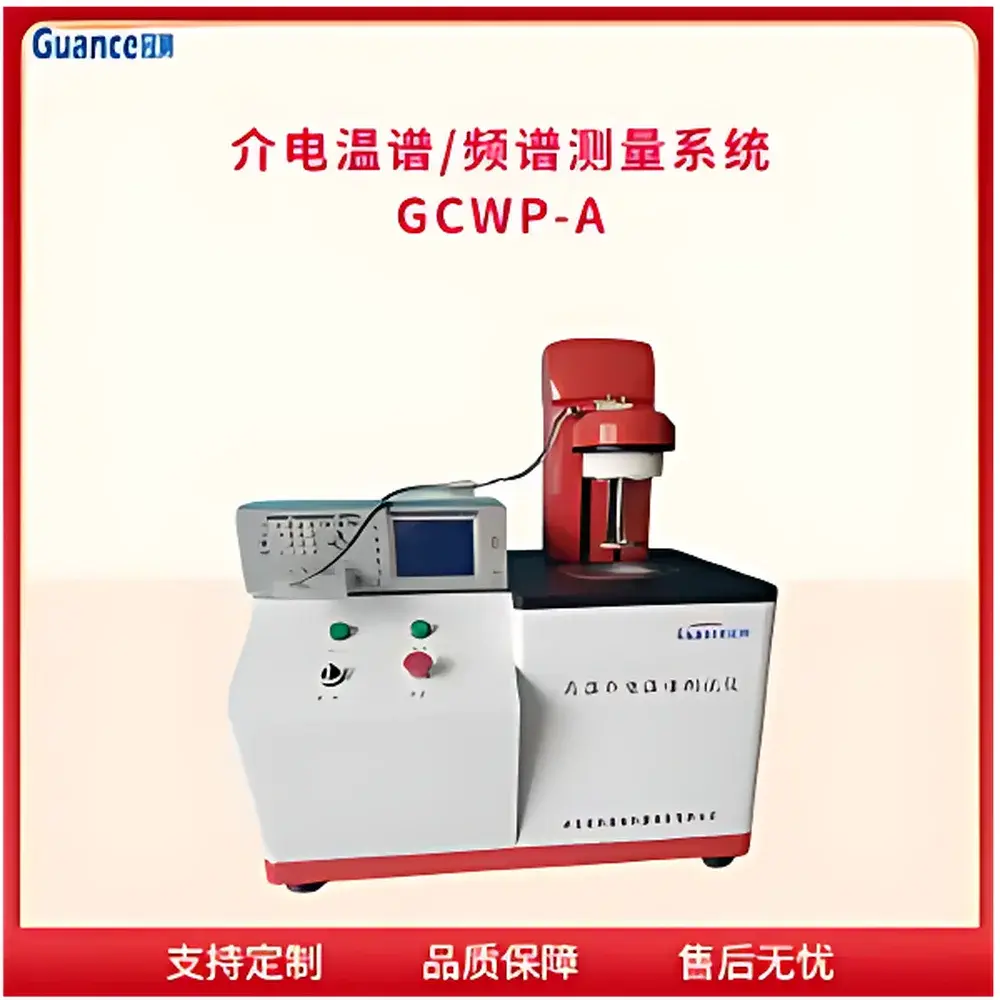
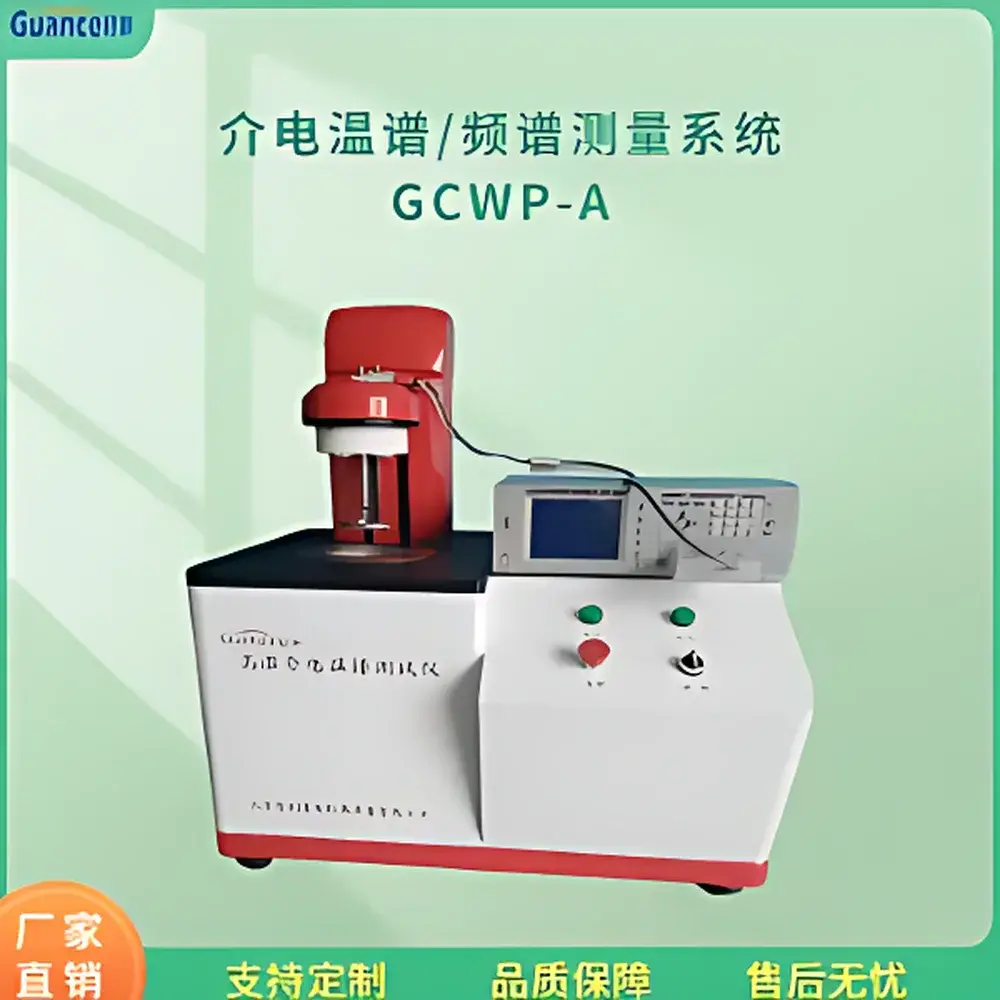
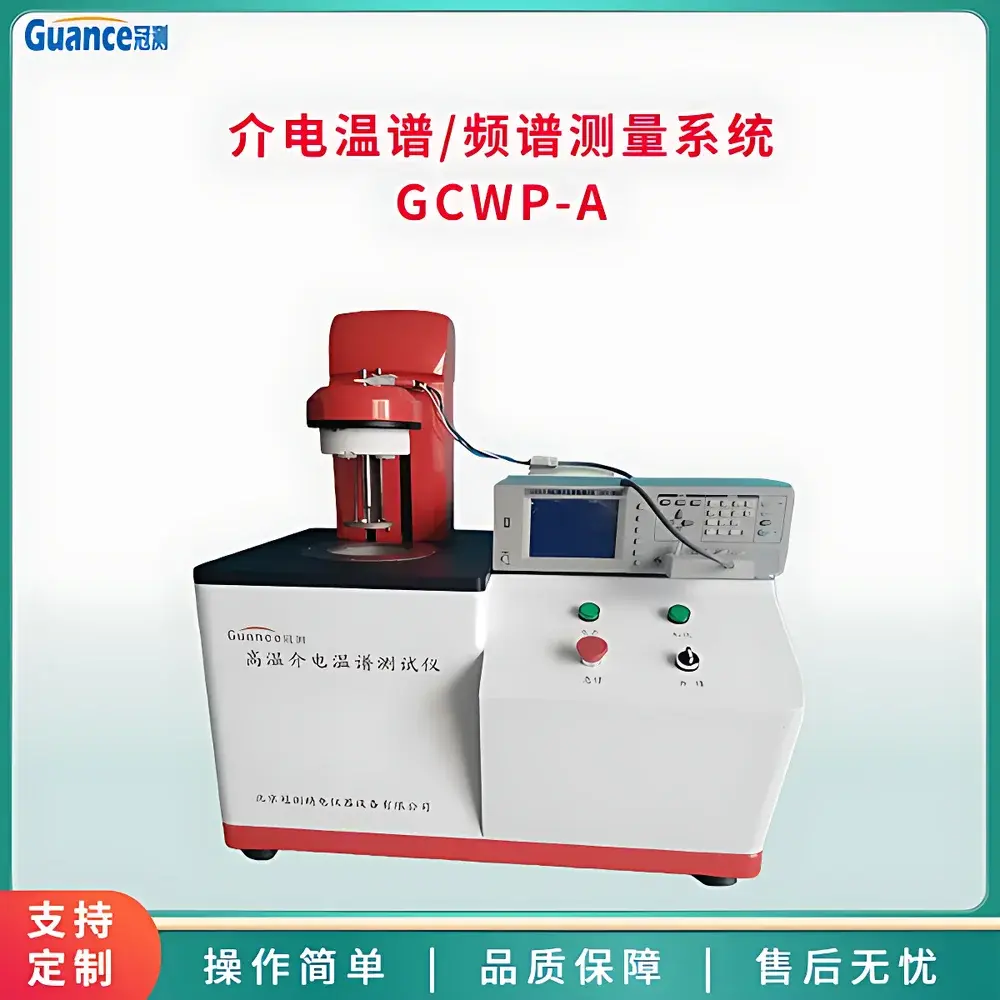
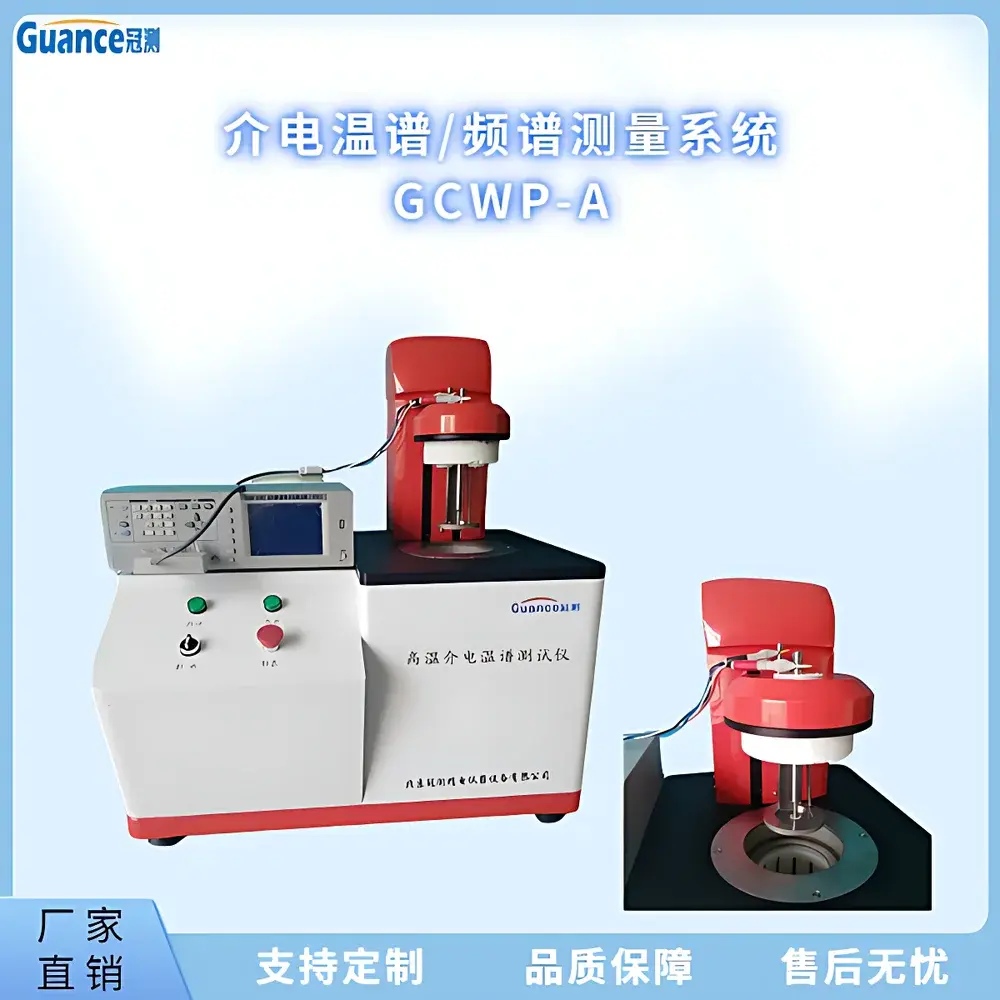
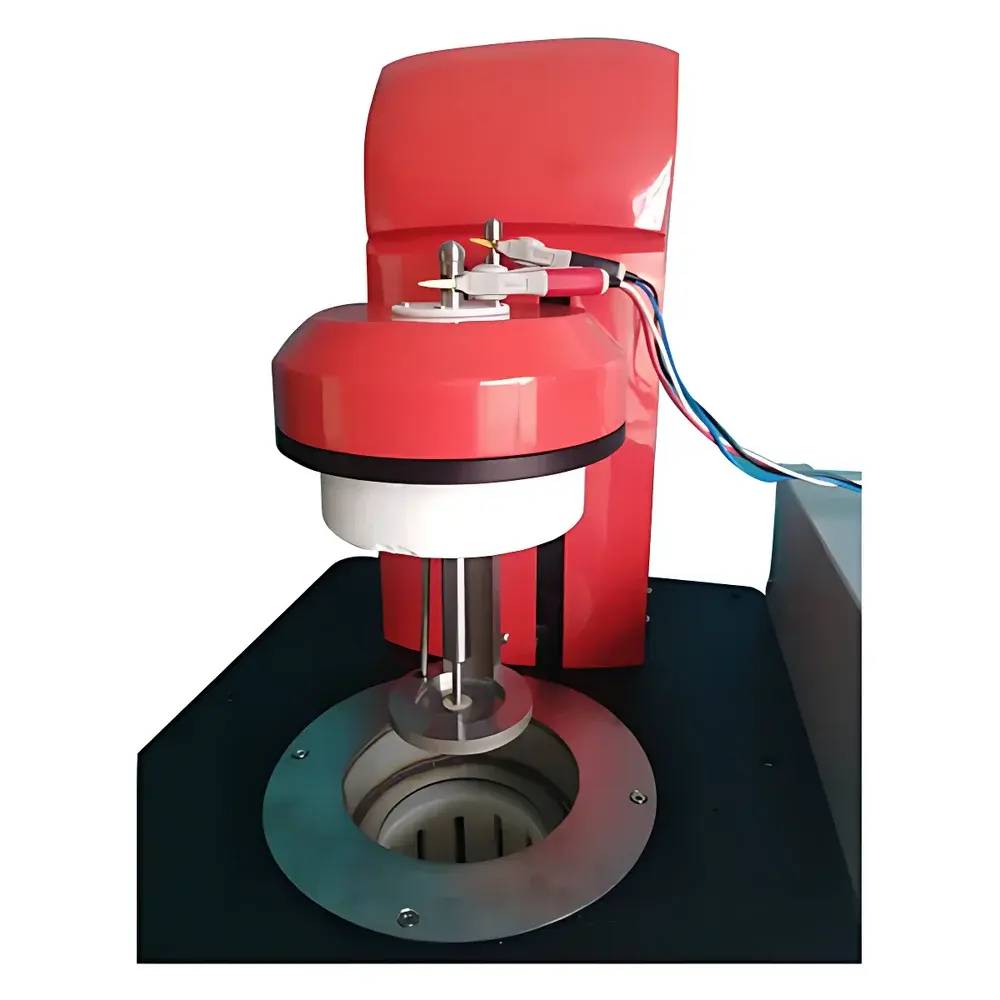
GCWP-A Dielectric Spectroscopy and Temperature-Dependent Permittivity Measurement System by Guance Instruments
| Brand | Guance Instruments |
|---|---|
| Origin | Beijing, China |
| Model | GCWP-A |
| Electrode Diameter | 6 mm (4 electrodes) |
| Electrode Shielding | Inner layer – 304 stainless steel |
| Channel Configuration | Quad-channel simultaneous measurement |
| Frequency Switching | Programmable sample switching interval |
| Operating Modes | Manual and automated sequence control |
| Data Export | Raw data export (CSV/Excel), real-time curve plotting, printable test reports |
| Frequency Range | Determined by integrated Agilent 4294A Precision Impedance Analyzer |
| Temperature Range | −180 °C to +500 °C |
| Heating Rate | 0.5–2.5 °C/min (programmable) |
| Cryogenic Cabling | Silver-plated copper shielded cables |
| Enclosure | Q235 carbon steel chassis with high-temp epoxy powder coating |
| Power Supply | AC 220 V, 50 Hz, 2 kW |
| Core Impedance Analyzer | Agilent 4294A |
| Environmental Requirements | Avoid dusty, high-vibration, direct sunlight, or corrosive gas environments |
Overview
The GCWP-A Dielectric Spectroscopy and Temperature-Dependent Permittivity Measurement System is a laboratory-grade instrument engineered for precise, multi-parameter characterization of dielectric properties across wide thermal and frequency domains. It operates on the principle of precision impedance spectroscopy—leveraging the Agilent 4294A broadband impedance analyzer as its core signal acquisition engine—to quantify complex permittivity (ε* = ε′ − jε″), loss tangent (tan δ), capacitance (C), and conductance (G) as functions of temperature and frequency. Designed for materials science R&D, polymer physics, ceramic development, and functional thin-film evaluation, the system enables controlled thermally stimulated dielectric response mapping under rigorously stabilized thermal conditions—from cryogenic (−180 °C) to high-temperature (500 °C) regimes. Its quad-channel electrode architecture supports comparative analysis of up to four specimens in parallel under identical thermal and electrical boundary conditions, significantly improving experimental throughput and inter-sample reproducibility.
Key Features
- Quad-channel independent electrode system with 6 mm diameter gold-plated brass electrodes, each fully shielded by concentric 304 stainless steel (inner) and PTFE (outer) layers to minimize stray capacitance and thermal EMF effects.
- Programmable thermal ramping (0.5–2.5 °C/min) and isothermal hold capability, enabled by a dual-zone PID-controlled cryo-furnace with liquid nitrogen cooling and resistive heating elements.
- Integrated Agilent 4294A impedance analyzer (40 Hz – 110 MHz) providing traceable, NIST-compatible magnitude/phase measurements with <0.05% basic impedance accuracy and 0.001° phase resolution.
- Automated sample switching logic allows user-defined dwell times per specimen, enabling unattended sequential testing without manual reconfiguration.
- Rugged mechanical construction: Q235 structural steel chassis with high-temperature epoxy-polyester powder coating (rated to 600 °C), ensuring dimensional stability and EMI shielding integrity over extended thermal cycling.
- Low-noise signal path: silver-plated copper coaxial cabling with double-braid shielding and cryo-rated insulation, validated for stable performance down to −180 °C without microphonic artifacts or impedance drift.
Sample Compatibility & Compliance
The GCWP-A accommodates solid dielectric samples in disk, pellet, or thin-film form (thickness 0.1–5 mm), including ceramics (e.g., BaTiO₃, Al₂O₃), polymers (e.g., PVDF, PI, epoxy composites), ferroelectrics, and ionic conductors. Electrode contact is established via spring-loaded, low-force probe assemblies to prevent sample deformation. The system complies with ASTM D150 (Standard Test Methods for Dielectric and Resistivity Properties of Solid Electrical Insulating Materials) and ISO 257-3 (Plastics — Determination of dielectric properties — Part 3: Determination of dielectric loss factor and permittivity). All thermal and electrical calibration protocols follow internal SOPs aligned with GLP requirements, supporting audit-ready documentation for regulated environments.
Software & Data Management
The proprietary GCWP Control Suite (v3.2) runs on Windows 10/11 and provides full instrument orchestration—including temperature profile definition, frequency sweep setup, channel selection, and real-time impedance vector display. Raw measurement datasets are stored in HDF5 format with embedded metadata (timestamp, setpoint, ambient RH, operator ID). Export options include CSV (for MATLAB/Python post-processing), XML (for LIMS integration), and PDF (with embedded curves and pass/fail annotations per ASTM D150 criteria). Audit trail functionality records all parameter changes, calibration events, and user logins—fully compliant with FDA 21 CFR Part 11 requirements when deployed with Windows domain authentication and electronic signature modules.
Applications
- Characterization of glass transition (Tg) and secondary relaxations in amorphous polymers via dielectric loss peak tracking vs. temperature.
- Evaluation of grain boundary vs. bulk conduction mechanisms in polycrystalline oxides using Arrhenius and modulus spectroscopy analysis.
- Quality control of capacitor dielectrics (e.g., MLCC tapes) across production batches, monitoring ε′ consistency and tan δ dispersion at 1 kHz and 100 kHz.
- Thermal aging studies of insulating varnishes and encapsulants, correlating permittivity drift with oxidation kinetics.
- Development of high-k gate dielectrics for semiconductor applications, measuring frequency-dependent ε′ collapse and interfacial trap density estimation.
FAQ
What impedance analyzer is integrated into the GCWP-A system?
The GCWP-A is factory-integrated with the Agilent 4294A Precision Impedance Analyzer, operating from 40 Hz to 110 MHz with calibrated accuracy traceable to NIST standards.
Can the system perform isothermal frequency sweeps at fixed temperatures?
Yes—users may define arbitrary temperature setpoints and execute full frequency sweeps (or discrete point measurements) while holding temperature within ±0.1 °C stability for durations up to 24 hours.
Is cryogenic operation limited to liquid nitrogen cooling only?
The base configuration uses LN₂-based cooling; optional closed-cycle helium refrigeration (−196 °C to +500 °C continuous) is available upon request for extended low-temperature stability and reduced operational cost.
How is data integrity ensured during long-duration thermal ramps?
All analog signal paths are thermally anchored and actively compensated; raw data timestamps are synchronized with furnace thermocouple readings (Type T, ±0.5 °C accuracy) and logged with 100 ms resolution.
Does the system support third-party software integration?
Yes—HDF5 and CSV exports enable seamless import into Python (SciPy, scikit-rf), MATLAB, OriginPro, and commercial impedance analysis packages such as LEVMW and ZView.



