
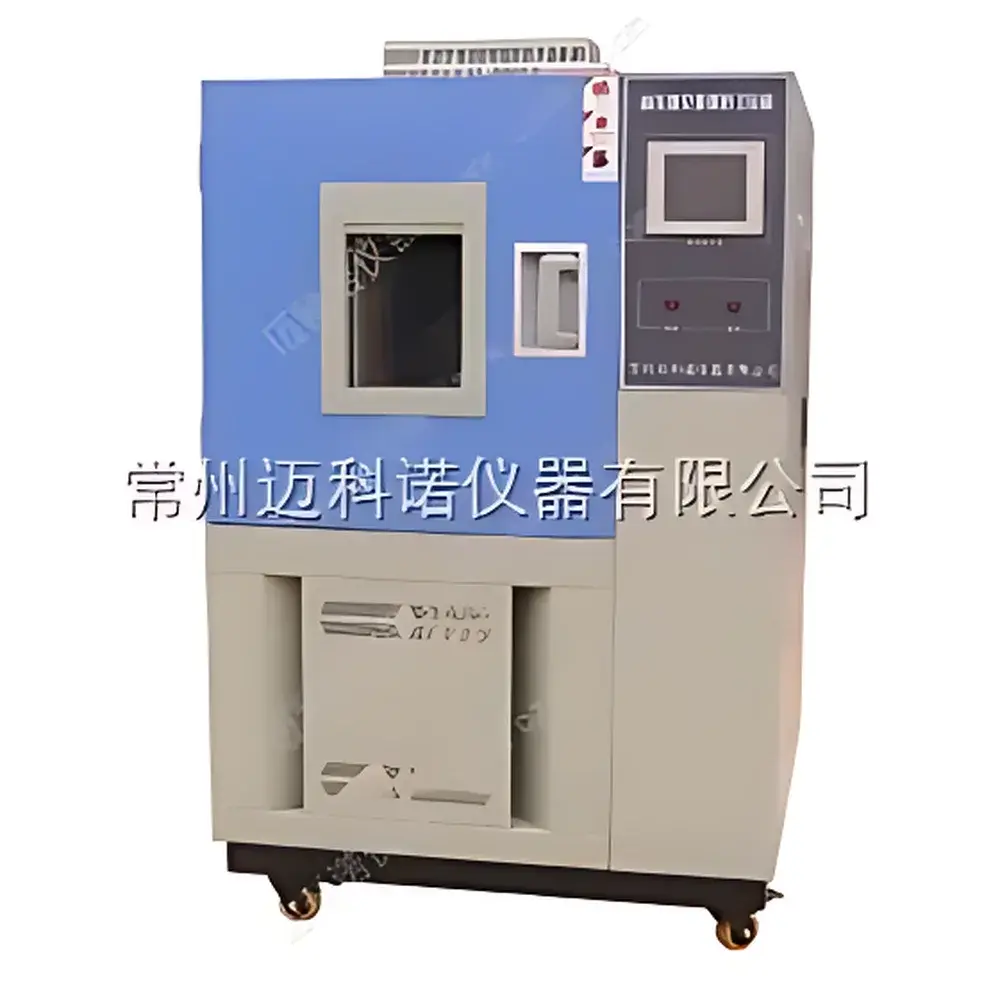
GDS GDS-100 Series High-Low Temperature & Humidity Environmental Test Chamber
| Origin | Zhejiang, China |
|---|---|
| Manufacturer Type | Authorized Distributor |
| Origin Category | Domestic (China) |
| Model | GDS-100A/B/C |
| Quotation | Available Upon Request |
| Temperature Range | −40 °C to +100 °C |
| Temperature Uniformity | ≤ ±2 °C |
| Temperature Fluctuation | ≤ ±0.5 °C |
| Heating Rate | ≥ 2–3 °C/min |
| Cooling Rate | ≤ 1 °C/min |
| Interior Dimensions (W×D×H) | 400×500×500 mm to 1000×1000×1000 mm |
| Insulation | Ultra-fine Glass Fiber + Rigid Polyurethane Foam |
| Heater | Nickel-Chromium Alloy with Stainless Steel Finned Radiator |
| Evaporator | Multi-stage Diaphragm-type (Finned Multi-section) |
| Air Circulation | Single-loop, Extended-shaft Low-noise Stainless Steel Centrifugal Fan |
| Refrigeration System | Single-stage or Cascade (Dual-compressor) Configuration (Air-cooled or Water-cooled) |
| Compressor | Hermetic “Tecumseh” (France) Refrigeration Unit |
| Controller | Fuji Electric (Japan) or Honeywell Programmable PID Controller |
| Sensor | PT100 Platinum Resistance Thermometer |
| Safety Protections | Leakage Current Protection, Over-temperature Cut-off, Fast-blow Fuse, Compressor High-pressure Protection |
| Standard Accessories | 250×300 mm Double-glazed Observation Window, Φ25 mm Test Port, Two Adjustable Sample Shelves, Interior LED Lighting |
| Power Supply | 380 V ±10%, 50 Hz, 3-phase 4-wire |
Overview
The GDS GDS-100 Series High-Low Temperature & Humidity Environmental Test Chamber is a precision-engineered climatic simulation system designed for rigorous reliability assessment of industrial components and materials under controlled thermal and hygrothermal stress conditions. Based on the principle of balanced heating and humidification—where independent proportional-integral-derivative (PID) control loops dynamically regulate refrigeration output, electric heating power, and steam generation—the chamber maintains stable, repeatable environmental profiles across its full operational range. It supports both steady-state and cyclic test protocols, including temperature-only, humidity-only, and combined temperature-humidity profiles in accordance with internationally recognized test standards. Its architecture integrates dual-stage cascade refrigeration (optional), high-efficiency insulation, and corrosion-resistant stainless-steel construction to ensure long-term stability and minimal thermal drift during extended testing campaigns.
Key Features
- Robust chamber construction: Interior chamber fabricated from electropolished SUS304 stainless steel; exterior housing available in either brushed SUS304 or A3 steel with epoxy-polyester powder coating for enhanced durability and chemical resistance.
- Advanced sealing system: High-performance silicone rubber gasket rated for continuous operation between −70 °C and +150 °C, ensuring consistent chamber integrity and minimizing moisture leakage during humidity cycling.
- Intelligent climate control: Equilibrium-based temperature/humidity regulation eliminates overshoot and reduces settling time; automatic selection of active refrigeration circuit (single-stage or cascade) based on setpoint ensures optimal energy efficiency and compressor longevity.
- Surface-evaporation humidification: Shallow-water reservoir design enables rapid, uniform vapor generation without condensate carryover—ideal for maintaining precise RH control within 10–98% RH at temperatures ≥ +10 °C.
- Human-centric interface: Optional wide-screen LCD touchscreen controller (imported programmable unit) supports multi-segment ramp-soak profiles, real-time trend logging, and USB data export compliant with GLP documentation requirements.
- Comprehensive safety architecture: Integrated hardware-level protections include Class II residual current device (RCD), independent over-temperature limiter, compressor high-pressure cut-out, and fast-acting fusing—all certified per IEC 61000-6-2/6-4 EMC and IEC 61010-1 safety standards.
Sample Compatibility & Compliance
The GDS-100 accommodates a broad spectrum of test specimens—from printed circuit boards and automotive ECUs to aerospace composites and pharmaceutical packaging—within customizable interior volumes (40 L to 1000 L). Its performance validation conforms to GB/T 10586–2018 (Environmental Testing Chambers – Technical Specifications), GB/T 10592–2023 (High/Low Temperature Test Chambers – Performance Requirements), and GB/T 2423.1–2022 / GB/T 2423.2–2022 / GB/T 2423.3–2016 / GB/T 2423.4–2022 (Environmental Testing for Electrical and Electronic Products). The chamber is routinely deployed in laboratories accredited to ISO/IEC 17025 and supports audit-ready traceability for GLP/GMP-regulated environments when paired with Fuji or Honeywell controllers featuring 21 CFR Part 11–compliant electronic signature and audit trail functionality.
Software & Data Management
Standard configuration includes Fuji’s PXR series or Honeywell’s UDC3500 digital controllers with RS485 Modbus RTU communication. Optional upgrade to a Windows-based PC software suite enables remote monitoring, automated report generation (PDF/CSV), alarm event logging with timestamped metadata, and compliance with FDA 21 CFR Part 11 requirements—including user access levels, electronic signatures, and immutable audit trails. All data acquisition systems sample temperature and relative humidity at minimum 2-second intervals, with calibration traceability to NIM (National Institute of Metrology, China) or UKAS-accredited reference standards.
Applications
- Accelerated life testing of lithium-ion battery modules under thermal shock and humidity cycling.
- Validation of conformal coatings and encapsulants used in avionics and defense electronics per MIL-STD-810H Method 502.7.
- Material compatibility screening for medical device housings exposed to sterilization-grade humid heat (e.g., ISO 11137).
- Qualification of optical sensors and MEMS devices subjected to repeated thermal expansion/contraction stresses.
- Pre-compliance screening for IEC 60068-2-1 (Cold), IEC 60068-2-2 (Dry Heat), IEC 60068-2-30 (Damp Heat, Cyclic), and JEDEC JESD22-A104E.
FAQ
What is the difference between GDS-100A, GDS-100B, and GDS-100C models?
The suffix denotes the lowest achievable operating temperature: GDS-100A = −20 °C, GDS-100B = −40 °C, GDS-100C = −60 °C. All share identical upper temperature limit (+100 °C), humidity range (10–98% RH), and control architecture.
Is water-cooling mandatory for the cascade refrigeration option?
No—both air-cooled and water-cooled configurations are supported. Water-cooling is recommended for ambient temperatures exceeding 32 °C or for installations requiring minimal heat rejection into the lab environment.
Can the chamber be integrated into an existing MES or LIMS infrastructure?
Yes. Native Modbus RTU support allows seamless integration with most laboratory information management systems (LIMS) and manufacturing execution systems (MES) via OPC UA gateways or custom middleware.
Does the system support automatic calibration verification?
While not fully self-calibrating, the controller supports scheduled sensor verification routines using external reference probes, with results logged and exportable for internal QA review per ISO/IEC 17025 Clause 7.7.
What maintenance intervals are recommended for long-term reliability?
Compressor oil analysis every 24 months; evaporator coil cleaning every 6 months in high-dust environments; annual verification of door seal compression force and PT100 sensor accuracy against NIST-traceable references.



