
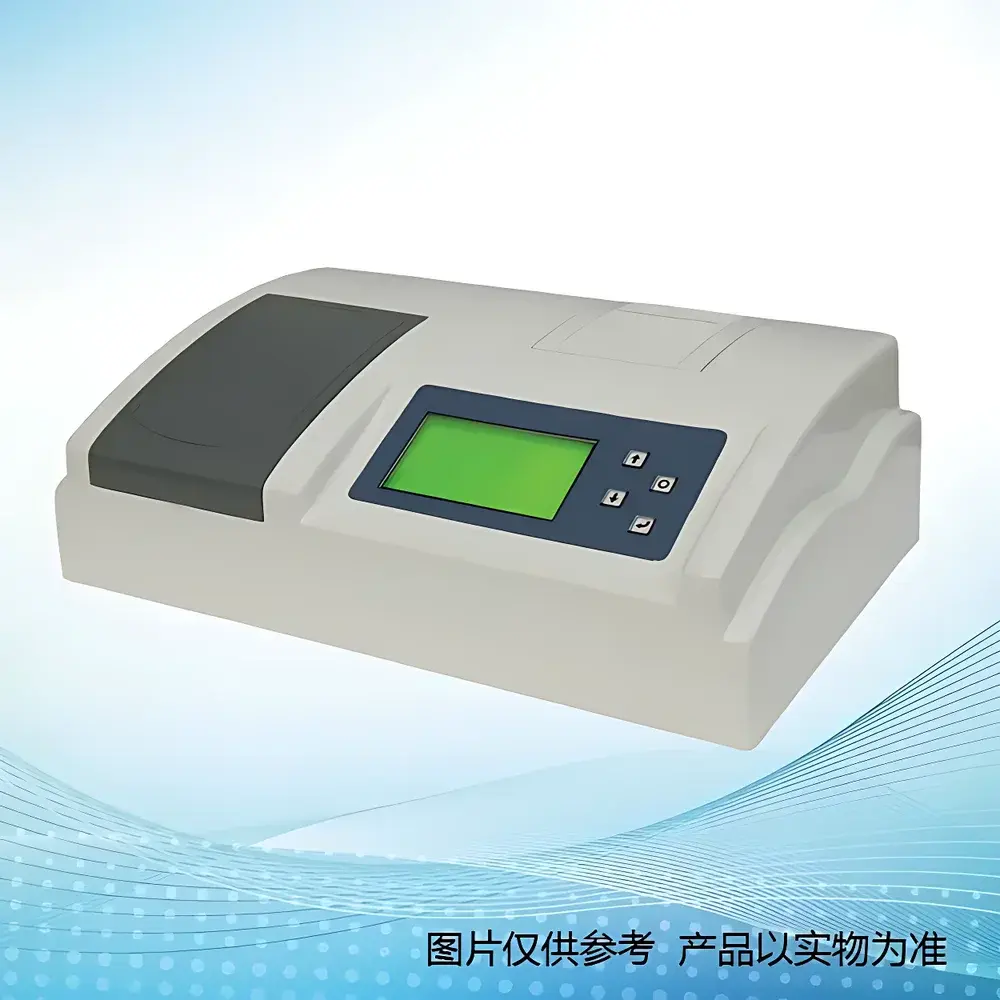
GDYN-300S Jida Xiaotian’e Leather Hydrolysate Protein Analyzer
| Brand | Jida Xiaotian’e |
|---|---|
| Origin | Jilin, China |
| Manufacturer Type | Direct Manufacturer |
| Origin Category | Domestic (China) |
| Model | GDYN-300S |
| Pricing | Upon Request |
| Light Source | High-brightness LED |
| Wavelength | 538 nm |
| Detection Limit | 0.10% (L-hydroxyproline) |
| Measurement Range | 0.00–40.00% (w/w L-hydroxyproline) |
| Accuracy | ±5% |
| Sample Throughput | 20 samples/hour |
| Digestion Time | 15 min (catalytic digestion) |
| Light Source Lifetime | ≥100,000 hours |
| Integrated Optical Design | LED-based solid-state light source acting as both emitter and monochromator |
| Display | Large backlit LCD with Chinese interface |
| Data Output | Built-in thermal printer (sample ID, matrix type, concentration, date, operator ID) |
| Calibration | Zero-point calibration only |
Overview
The GDYN-300S Leather Hydrolysate Protein Analyzer is a dedicated benchtop photometric analyzer engineered for the rapid, quantitative determination of L-hydroxyproline—a biochemical marker specific to collagen-derived proteins—in dairy and food matrices. It operates on the principle of colorimetric quantification following acid hydrolysis and catalytic oxidation of L-hydroxyproline to yield a chromophore measurable at 538 nm. The instrument implements the methodology specified in the former Ministry of Health of the People’s Republic of China Standard “Identification of Leather Hydrolysate Protein in Milk and Dairy Products—Determination of L(–)-Hydroxyproline Content” (WS/T 216–2002), making it suitable for regulatory screening and quality assurance laboratories performing routine adulteration testing in milk powder, liquid milk, infant formula, and whey-based products.
Key Features
- Integrated solid-state optical architecture: A high-intensity LED serves simultaneously as light source and spectral filter—eliminating moving parts, slit mechanisms, and traditional grating-based monochromators. This design ensures long-term photometric stability, resistance to mechanical shock, and tolerance to ambient humidity fluctuations.
- Catalytic sample digestion module: Replaces conventional 16-hour reflux hydrolysis with a 15-minute catalytic digestion protocol. Up to 20 samples can be processed in parallel using standardized reaction vessels, significantly improving lab throughput without compromising hydrolysis completeness.
- Zero-calibration workflow: Pre-programmed calibration curves for L-hydroxyproline are embedded in firmware. Users perform only a single zero-point correction using reagent blank—no manual standard curve preparation or serial dilution required.
- Dedicated thermal printer: Outputs traceable reports containing sample ID, matrix classification (e.g., “skim milk powder”), measured hydroxyproline concentration (% w/w), analysis date, and operator identifier—supporting basic documentation requirements under GLP-aligned workflows.
- Robust embedded system: Features a large-character Chinese-language LCD interface optimized for factory-floor or QC lab environments. All measurement, parameter configuration, data logging, statistical summary (mean, SD, CV%), and print functions are accessible via intuitive menu navigation.
Sample Compatibility & Compliance
The GDYN-300S is validated for use with liquid milk, reconstituted milk powder, whey protein concentrates, caseinates, and infant formula suspensions. Sample preparation follows standardized acid hydrolysis (6 mol/L HCl, catalyzed by ferric chloride) and oxidative derivatization (chloramine-T + Ehrlich’s reagent), generating a stable pink chromophore proportional to hydroxyproline concentration. While not certified to ISO/IEC 17025 or accredited per CNAS requirements out-of-the-box, the method implemented aligns with the foundational chemistry referenced in AOAC Official Method 990.11 (Hydroxyproline in Collagen) and supports internal verification against reference materials traceable to NIST SRM 1846 (Bovine Collagen). For laboratories operating under GMP or food safety management systems (e.g., FSSC 22000, BRCGS), method validation—including specificity, linearity (0.00–40.00%), LOD (0.10%), and intra-laboratory precision (≤5% RSD)—must be performed prior to routine deployment.
Software & Data Management
The GDYN-300S operates entirely via embedded firmware with no external PC dependency. Data storage accommodates up to 1,000 test records, each timestamped and tagged with user-defined sample IDs. Statistical functions include arithmetic mean, standard deviation, coefficient of variation, and pass/fail flagging against configurable upper limits (e.g., 0.50% hydroxyproline as an indicative threshold for adulteration). Export is limited to thermal printouts; no USB, Ethernet, or cloud connectivity is provided. For laboratories requiring electronic records compliant with FDA 21 CFR Part 11 or EU Annex 11, integration with a validated LIMS or ELN is recommended—using printed reports as primary raw data, with digital copies generated externally.
Applications
- Routine screening of raw milk and dairy ingredients for illegal addition of leather hydrolysates or gelatin-based adulterants.
- Verification of collagen-free claims in plant-based dairy alternatives (e.g., oat, soy, almond beverages).
- QC release testing in infant formula manufacturing facilities where hydroxyproline content must remain below defined thresholds.
- Method transfer support in contract testing labs serving domestic food safety authorities (e.g., SAMR provincial centers).
- Educational use in food science programs demonstrating protein adulteration detection principles and spectrophotometric assay development.
FAQ
Does the GDYN-300S comply with international standards such as ISO or AOAC?
It implements a national Chinese health standard (WS/T 216–2002) and shares chemical principles with AOAC 990.11, but it is not AOAC Performance Tested or ISO 17025 accredited.
Can the instrument measure hydroxyproline in non-dairy matrices such as meat extracts or bone broth?
Yes—though method validation for each matrix is required due to interferences from endogenous amino acids and pigment compounds.
Is the 5% accuracy specification verified across the full 0.00–40.00% range?
Accuracy is specified as ±5% relative standard deviation at mid-range concentrations (1.00–20.00%); performance at extremes (≤0.10% or ≥35.00%) should be confirmed during user qualification.
What maintenance is required for the optical system?
No alignment or lamp replacement is needed—the solid-state LED has a rated lifetime exceeding 100,000 hours. Routine cleaning of the cuvette chamber and sensor window with lint-free tissue and isopropanol is recommended weekly.
Are reagents supplied by the manufacturer or third-party vendors?
Jida Xiaotian’e supplies proprietary, lot-controlled reagent kits optimized for the GDYN-300S; cross-compatibility with generic hydroxyproline assay reagents is not guaranteed.






