
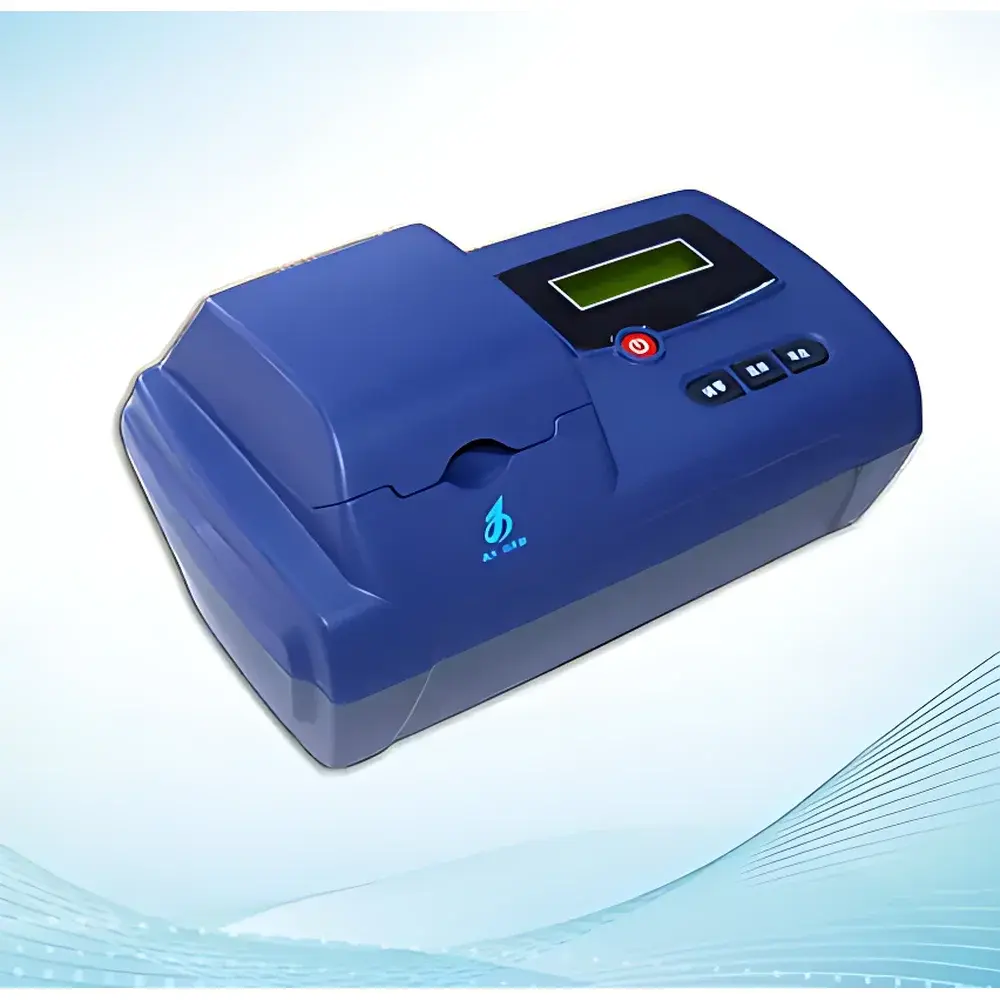
GDYS-103SA2 Arsenic Water Quality Analyzer by Jilin University Xiaotian’e
| Brand | Jilin University Xiaotian’e |
|---|---|
| Origin | Jilin, China |
| Manufacturer Type | Direct Manufacturer |
| Origin Category | Domestic (China) |
| Model | GDYS-103SA2 |
| Instrument Type | Portable/HANDHELD Water Quality Analyzer |
| Target Analyte | Arsenic (As) |
| Detection Limit | 0.006 mg/L |
| Measurement Range | 0.000–1.000 mg/L |
| Accuracy | ±5% |
| Analysis Time | ≤60 minutes |
| Reagent Format | Single-use, pre-packaged test kits |
| Compliance | Designed for field-deployable, on-site quantitative arsenic analysis in drinking water and surface water per Chinese EPA HJ 694-2014 and WHO Guideline Values (10 µg/L) |
Overview
The GDYS-103SA2 Arsenic Water Quality Analyzer is a portable, field-deployable photometric instrument engineered for rapid, quantitative determination of total inorganic arsenic (As(III) + As(V)) in drinking water, groundwater, and surface water samples. It operates on the principle of colorimetric detection via silver diethyldithiocarbamate (Ag-DDC) derivatization—where arsenic species are reduced to arsine gas (AsH₃) under acidic conditions, subsequently reacted with Ag-DDC to form a stable red-colored complex measurable at 510 nm. This method conforms to the foundational chemistry of ISO 17294-2:2016 (water quality — elemental specifications by ICP-MS) and aligns with the procedural rigor of EPA Method 200.7 and Chinese standard HJ 694-2014 for arsenic in water. The analyzer integrates a precision optical path, temperature-stabilized LED light source, and calibrated photodiode detector to deliver reproducible absorbance readings without laboratory infrastructure.
Key Features
- Field-ready design: Compact, battery-powered unit (rechargeable Li-ion, ≥8 h operation) with integrated touchscreen interface and onboard calibration memory.
- Quantitative performance: Achieves detection limit of 0.006 mg/L (6 µg/L), covering the WHO provisional guideline value (10 µg/L) and China’s GB 5749-2022 limit (10 µg/L) with margin for verification.
- Standardized reagent delivery: Uses single-use, lyophilized Ag-DDC reagent kits—pre-measured, vacuum-sealed, and lot-certified for shelf stability (≥18 months at 4–25 °C).
- Controlled reaction environment: Built-in heating module maintains optimal digestion temperature (35–40 °C) during hydride generation; integrated gas-liquid separator ensures consistent arsine transfer efficiency.
- Robust architecture: IP65-rated enclosure, shock-absorbing silicone housing, and corrosion-resistant fluidic path compatible with chlorinated and low-pH water matrices.
Sample Compatibility & Compliance
The GDYS-103SA2 accepts raw or filtered water samples (no centrifugation required) with turbidity < 5 NTU and residual chlorine < 1.0 mg/L. It supports direct analysis of tap water, well water, river water, and treated effluent—provided interfering ions (e.g., S²⁻, Se⁴⁺, Bi³⁺) are within documented tolerance thresholds defined in HJ 694-2014 Annex B. All measurement protocols comply with GLP documentation requirements: each test run logs operator ID, sample ID, reagent lot number, ambient temperature/humidity, and timestamp. Data export (CSV/Excel) supports audit-ready reporting for municipal water utilities operating under China’s “Water Safety Supervision Regulation” and ISO/IEC 17025-accredited field labs.
Software & Data Management
The embedded firmware (v3.2+) provides guided workflow navigation, automatic blank subtraction, multi-point calibration curve generation (linear/range-weighted), and real-time QC flagging (e.g., absorbance drift >2%, out-of-range blank). Internal storage retains ≥1,000 test records with full metadata. USB-C and Bluetooth 5.0 enable secure data transfer to LIMS or regulatory reporting platforms. Software validation documentation—including IQ/OQ protocols and traceable NIST-traceable photometric verification—is supplied with each instrument shipment to support FDA 21 CFR Part 11 readiness where applicable.
Applications
- Routine surveillance of arsenic in rural drinking water sources across endemic regions (e.g., Inner Mongolia, Shanxi, Xinjiang).
- Emergency response screening following geological events (e.g., flooding, mining runoff) where rapid As assessment informs boil-water advisories.
- Validation of point-of-use (POU) arsenic removal devices (e.g., iron-oxide filters, activated alumina units) via pre-/post-treatment sampling.
- Field verification for national monitoring programs aligned with China’s “Blue Sky and Clear Water Protection Campaign” (2021–2035).
- Academic and NGO-led water safety assessments requiring portable, non-instrumental lab dependency.
FAQ
What sample volume is required for one test?
A minimum of 10.0 mL of homogenized water sample is required; no dilution or pre-concentration is needed within the 0.000–1.000 mg/L range.
Can the instrument distinguish between As(III) and As(V)?
No—the GDYS-103SA2 measures total inorganic arsenic; speciation requires HPLC-ICP-MS or sequential chemical reduction methods not supported by this platform.
Is reagent lot-to-lot variability controlled?
Yes—each reagent kit batch undergoes spectrophotometric certification against NIST SRM 2702 (Arsenic in Water) and includes Certificate of Analysis with LOD/LOQ verification data.
How often must the optical system be recalibrated?
Factory calibration remains valid for 12 months under normal use; users perform daily blank verification using deionized water prior to sample analysis.
Does the device meet international export compliance standards?
It complies with CE marking requirements (EMC Directive 2014/30/EU, RoHS 2011/65/EU); additional country-specific certifications (e.g., UKCA, KC Mark) are available upon request with local representative coordination.







