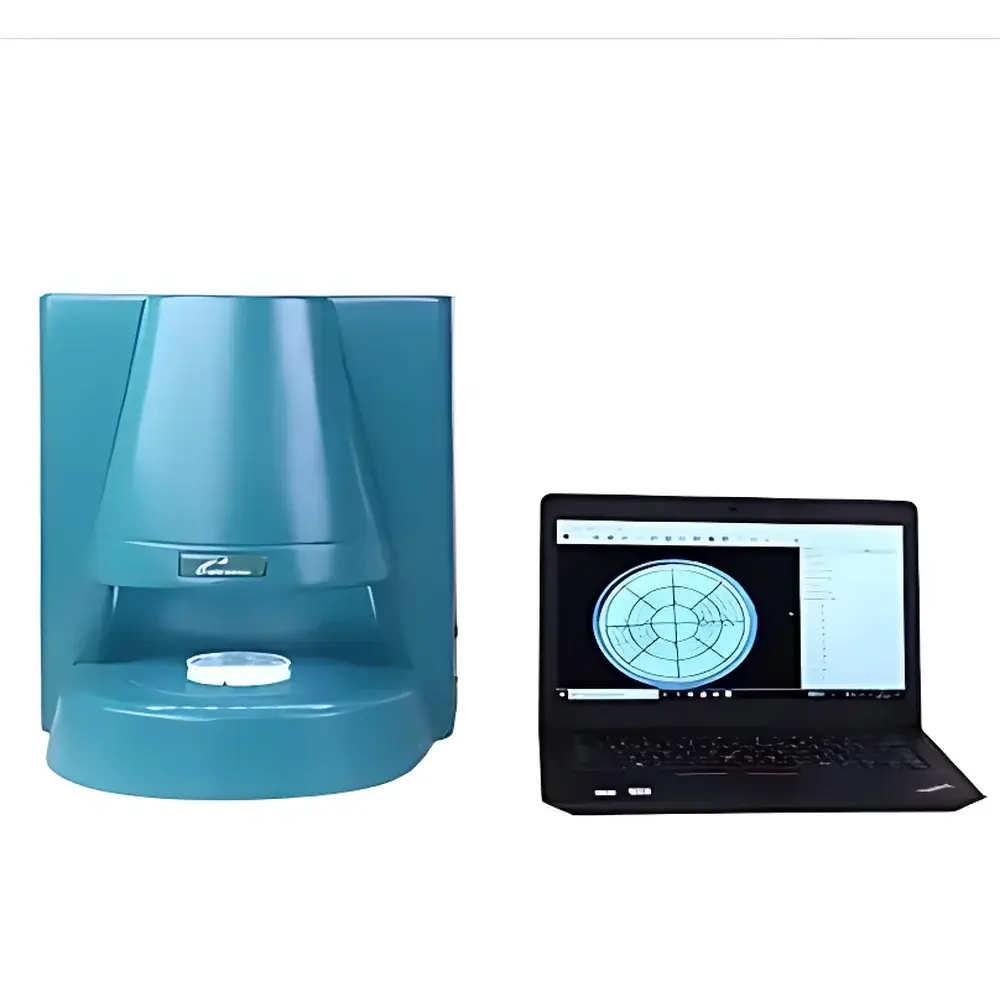
GENE SCIENCE ColonyCounter 500 Automated Colony Counter
| Brand | GENE SCIENCE |
|---|---|
| Origin | USA |
| Model | ColonyCounter 500 |
| Instrument Type | Fully Automated Colony Counter |
| Counting Speed | >50,000 hours (light source lifetime) |
| Maximum Petri Dish Diameter | 150 mm |
| Minimum Detectable Colony Size | 43 µm |
| Zone-of-Inhibition Resolution | 0.5 mm (theoretical limit: 0.1 mm) |
| Camera | Scientific-grade color CCD, 5 MP resolution |
| Lens | F1.2 ultra-high-resolution Japanese lens, 69× magnification |
| Illumination | Uniform 360° ring LED white light (5000 K), 21 cm emission diameter, 2100 lux intensity, 10 W power, >50,000 h lifetime |
| Background Options | 6 configurable illumination modes |
| Compatible Substrates | Standard pour plates, spread plates, spiral plates, membrane filters (with grid removal), Petrifilm™, NeoFilm™/Sanita-kun™, Compact Dry™, multi-sector plates, OPKA/SBA/SRD/Ames assay plates |
| Antibiotic Disk & Well Detection | Yes |
| Color-based Segmentation | Multi-color colony classification by hue, size, and morphology |
| Dimensions (W × D × H) | 47 × 47 × 64 cm |
| Weight | 35 kg |
| Power Supply | 200–240 V~, 50/60 Hz |
| OS Compatibility | Windows 7 or later |
Overview
The GENE SCIENCE ColonyCounter 500 is a fully automated, high-precision colony counting and inhibition zone analysis system engineered for regulatory-compliant microbiological quality control in pharmaceutical, clinical, food safety, and academic laboratories. It operates on digital image acquisition and algorithmic morphometric segmentation principles—capturing high-fidelity color images of microbial growth on solid media, then applying adaptive thresholding, edge detection, and machine-learning-assisted pattern recognition to distinguish colonies from background noise, overlapping clusters, and substrate artifacts. Unlike manual or semi-automated systems, the ColonyCounter 500 eliminates inter-operator variability and subjective interpretation while maintaining full traceability under GLP and GMP frameworks. Its optical architecture—featuring a 5-megapixel scientific CCD sensor, F1.2 Japanese optics, and a patented 360° uniform 5000 K LED ring illuminator—ensures sub-50 µm spatial resolution and photometric consistency across heterogeneous sample types, including opaque membranes, chromogenic agars, and low-contrast spiral dilutions.
Key Features
- Scientific-grade 5 MP color CCD imaging system with real-time auto-focus and dynamic exposure control for optimal contrast across diverse media (e.g., R2A, TSA, MacConkey, CHROMagar)
- Uniform 21 cm-diameter 360° white LED illumination (2100 lux, 5000 K) with six selectable background modes to suppress glare, shadowing, and edge falloff—critical for reproducible quantification of colonies on dark or textured surfaces
- Sub-43 µm colony detection capability validated per ISO 4833-2:2013 and AOAC Official Method 977.27, enabling reliable enumeration of slow-growing or microcolony-forming organisms (e.g., Campylobacter, Helicobacter)
- Integrated inhibition zone measurement engine compliant with CLSI M02-A13 and EUCAST guidelines, delivering ±0.5 mm accuracy with automatic disk/well localization and concentric ellipse fitting
- Multi-modal counting algorithms supporting pour plate, spread plate, spiral plate (log-decay deposition), multi-sector, and membrane filter configurations—including grid-removal functionality for filter-based assays
- Color-based classification engine capable of simultaneous identification and quantification of up to eight distinct colony phenotypes per image based on hue, saturation, brightness, circularity, and area thresholds
Sample Compatibility & Compliance
The ColonyCounter 500 accommodates standard 90 mm and 150 mm round Petri dishes, 120 mm square plates, and all major commercial rapid-test formats: Petrifilm™ (3M), Compact Dry™ (Nissui), NeoFilm™/Sanita-kun™ (Neogen), as well as custom multi-well and sector plates used in OPKA, SBA, SRD, Ames, and preservative efficacy testing (USP ). Its software enforces audit-trail logging per FDA 21 CFR Part 11 requirements—including user authentication, electronic signatures, immutable timestamped records of all count parameters, modifications, and export events. System validation documentation supports IQ/OQ/PQ protocols aligned with ISO/IEC 17025 and EU Annex 11 for computerized system qualification.
Software & Data Management
The proprietary ColonyCounter Software Suite (v5.x) provides a role-based interface with three operational tiers: Technician (guided workflow), Supervisor (method configuration and calibration), and Administrator (user access control and audit log review). All counting methods—including spiral plate enumeration per ISO 7218:2017 Annex D—are pre-validated and configurable via intuitive sliders and drop-down menus. Raw images, annotated overlays, and tabular results are stored in encrypted SQLite databases with optional DICOM or CSV export. Batch processing supports up to 96 plates per session, with auto-generated PDF reports containing plate thumbnails, statistical summaries (mean, SD, CV%), and compliance metadata (e.g., analyst ID, instrument serial number, calibration date). Data integrity safeguards include checksum verification, write-once archival mode, and scheduled backup to network drives or cloud storage (AWS S3 or Azure Blob compatible).
Applications
- Pharmaceutical Microbiology: USP / microbial limits testing (membrane filtration and pour plate), sterility test colony enumeration, bioburden assessment, and preservative efficacy testing (PET) per USP
- Clinical Diagnostics: Quantitative culture of urine, sputum, and wound swabs; AST reporting per CLSI standards; detection of mixed flora in polymicrobial infections
- Food & Beverage Safety: Total viable count (TVC), E. coli/coliform enumeration on selective media, Listeria confirmation, and shelf-life modeling via spiral plating
- Vaccine Development: OPKA and SBA assay quantification for functional antibody titers against Streptococcus pneumoniae and other encapsulated pathogens
- Environmental Monitoring: Settle plate analysis per ISO 14644-1, air sampler membrane enumeration, and water microbiology (membrane filtration per ISO 9308-1)
- Toxicology & Mutagenicity: Ames test colony scoring with differential color discrimination for His+ revertants on minimal agar
FAQ
Does the ColonyCounter 500 support 21 CFR Part 11 compliance?
Yes—the software includes electronic signature capture, audit trail generation, user permission levels, and data immutability controls required for regulated environments.
Can it process spiral plates with logarithmic dilution patterns?
Yes—its dedicated spiral counting module applies ISO 7218:2017 Annex D algorithms to calculate CFU/mL directly from spiral trace density and calibration curves.
Is calibration traceable to NIST standards?
Yes—optional NIST-traceable calibration kits (including certified microsphere arrays and zone-size reference disks) are available for annual performance verification.
What file formats can be exported for LIMS integration?
CSV, PDF, PNG (annotated), and XML (structured metadata); API support for HL7 and ASTM E1384 message exchange is available via enterprise license.
How is system maintenance performed?
Preventive maintenance includes quarterly LED intensity verification, annual camera sensor flat-field correction, and biannual optical path cleaning—documented via built-in service log with technician e-signature.