
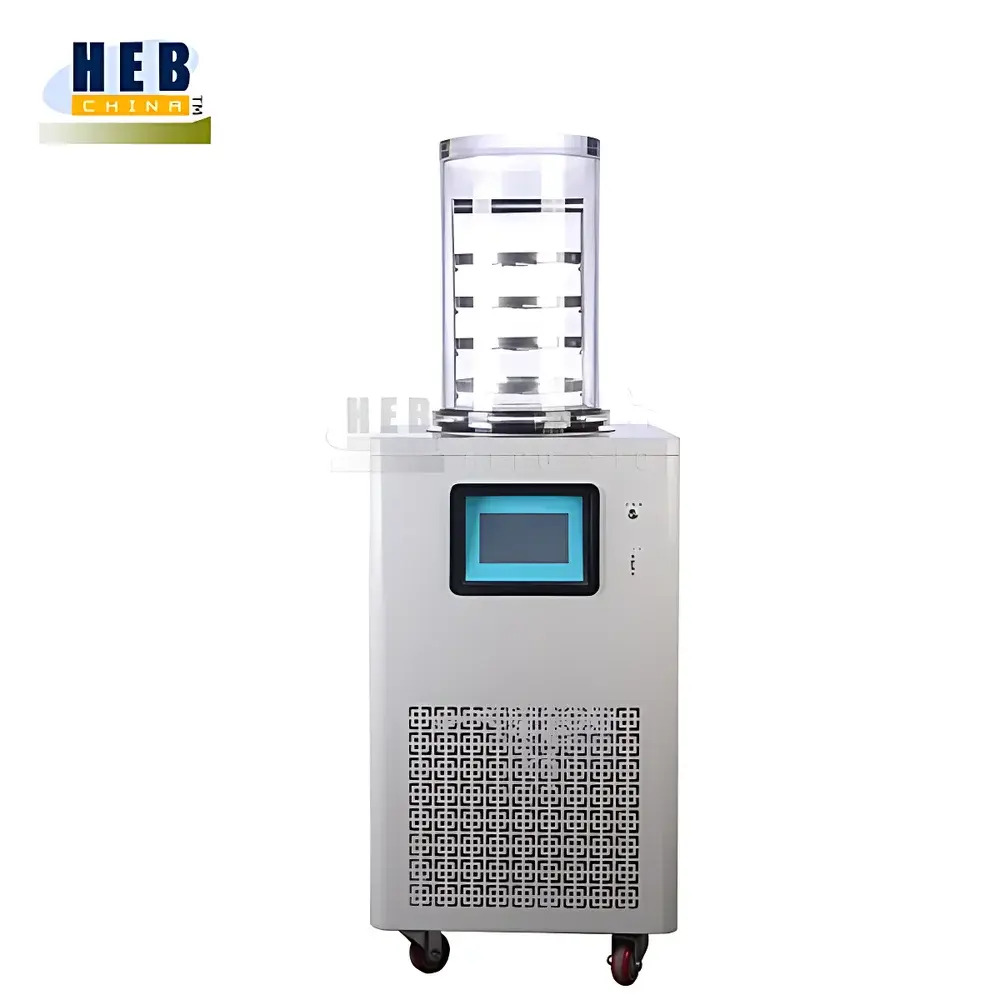
Hebei Jihepu ZLGJ-18 Standard Benchtop Freeze Dryer
| Brand | Jihepu (Jinan Hebei Jihepu Instrument Co., Ltd.) |
|---|---|
| Origin | Shandong, China |
| Type | Standard Shelf-Type Freeze Dryer |
| Lyophilization Area | 0.18 m² |
| Ultimate Vacuum | <5 Pa (empty chamber) |
| Condenser Temperature | ≤−55 °C (standard), optional −80 °C |
| Water Capture Capacity | 6 kg/24 h |
| Condenser Cooling | Air-cooled |
| Defrost Mode | Natural Thawing |
| Chamber Dimensions (W×D×H) | 560 × 560 × 980 mm |
| Net Weight | 88 kg |
| Power Supply | 220 V ±10%, 50 Hz, 1100 W |
| Operating Ambient | 10–30 °C, RH ≤70%, non-corrosive/non-explosive environment |
Overview
The Hebei Jihepu ZLGJ-18 Standard Benchtop Freeze Dryer is an engineered solution for laboratory-scale lyophilization of heat-sensitive biologicals, pharmaceuticals, and analytical standards. It operates on the principle of sublimation under deep vacuum—where frozen water is removed directly from the solid to vapor phase without passing through liquid state—preserving structural integrity, activity, and stability of labile compounds. Designed as a compact, integrated unit with no external condenser or refrigeration lines, the ZLGJ-18 eliminates potential leakage points and simplifies installation in shared core facilities or regulated QC labs. Its air-cooled condenser system, combined with a high-efficiency international-brand compressor and a robust 4 L/s vacuum pump, delivers stable operation across extended drying cycles while maintaining ≤−55 °C condenser temperature (−80 °C optional) and ultimate vacuum performance below 5 Pa.
Key Features
- Monolithic stainless steel construction for cold trap and drying chamber—corrosion-resistant, GLP-compliant, and easily sanitized between batches.
- Large-diameter condenser chamber with no internal coil design—enables uniform ice deposition, maximizes surface area for water vapor capture, and supports pre-freezing of samples directly on shelves (eliminating need for ultra-low temperature freezers).
- Patented gas flow path optimization ensures laminar, low-turbulence vapor migration from shelf to condenser—improving drying homogeneity and reducing cycle time variability.
- 7-inch full-color industrial touchscreen interface powered by SH-HPSC-II modular control architecture—supports precise PID regulation of shelf temperature (±0.5 °C accuracy), real-time vacuum monitoring, and multi-stage program scheduling.
- Integrated data logging system records cold trap temperature, shelf temperature, and chamber pressure at user-defined intervals; exportable CSV files support audit-ready traceability per FDA 21 CFR Part 11 requirements when paired with secure network storage.
- Dual-level access control with password-protected user roles (operator, supervisor, administrator) enables compliance with laboratory SOPs and separation of duties.
- Onboard sensor calibration utility allows field verification and adjustment of thermocouples and vacuum transducers—ensuring long-term measurement fidelity without third-party service intervention.
- Vacuum pump start delay logic prevents oil backstreaming by enforcing minimum condenser temperature threshold before pump activation—extending pump service life and reducing maintenance frequency.
Sample Compatibility & Compliance
The ZLGJ-18 accommodates standard laboratory sample formats including 4 × φ240 mm stainless steel trays (70 mm vertical spacing), and direct vial loading for common pharmaceutical containers: up to 1320 × 12 mm, 740 × 16 mm, or 540 × 22 mm serum vials per batch. All wetted surfaces contact only electropolished 304 stainless steel or food-grade PTFE—fully compliant with ISO 13485 material compatibility guidelines and suitable for GMP-aligned environments. The system meets general electrical safety standards IEC 61010-1 and electromagnetic compatibility per EN 61326-1. While not certified to ASTM F2476 or USP , its operational parameters align with established lyophilization process development practices described in PDA Technical Report No. 36 and EU Annex 1.
Software & Data Management
Data acquisition is handled via embedded firmware supporting timestamped logging of three critical process variables: condenser temperature (Type T thermocouple), shelf temperature (PT100 sensor), and absolute chamber pressure (capacitance manometer). Raw logs are stored internally and exportable via USB to standard spreadsheet applications. Optional PC-based software (sold separately) adds trend visualization, comparative batch analysis, alarm history review, and electronic signature functionality compatible with 21 CFR Part 11 Annex A validation protocols. Audit trail metadata—including user ID, parameter change timestamps, and event type—is retained for ≥30 days and exportable in tamper-evident format.
Applications
- Stabilization of monoclonal antibodies, enzymes, vaccines, and other biologics during pre-formulation studies.
- Preparation of reference standards for HPLC, GC-MS, and ICP-MS analysis where solvent residue or thermal degradation must be avoided.
- Drying of microbial cultures, plant extracts, and forensic tissue samples requiring morphological preservation.
- Small-batch production of sterile lyophilized powders for clinical trial materials under cGMP pilot conditions.
- Teaching laboratories conducting fundamental freeze-drying kinetics experiments, mass transfer modeling, and collapse temperature determination.
FAQ
What is the maximum allowable load volume for optimal drying efficiency?
For consistent primary drying performance, total sample mass should not exceed 4.5 kg (75% of 6 kg/24 h capacity) when using aqueous solutions with ≤15% solids content.
Can the ZLGJ-18 be used for organic solvent-based formulations?
No—this model is designed exclusively for aqueous systems. Solvents such as ethanol, acetone, or acetonitrile require explosion-proof vacuum pumps, specialized condensers, and solvent-compatible seals not present in the standard configuration.
Is remote monitoring supported out-of-the-box?
The base unit does not include Ethernet or Wi-Fi connectivity; however, RS485 Modbus RTU output is available for integration into facility-wide SCADA or LabVantage systems via third-party gateways.
How often should the vacuum pump oil be changed?
Under typical laboratory usage (2–3 cycles/week), oil replacement is recommended every 500 operating hours or annually—whichever occurs first—to maintain ≤5 Pa vacuum stability and prevent hydrocarbon contamination.
Does the system support shelf temperature ramping during primary drying?
Yes—the controller permits programmable shelf temperature profiles with up to 12 segments, enabling controlled ramping to optimize drying rate while avoiding melt-back or collapse in sensitive formulations.



