
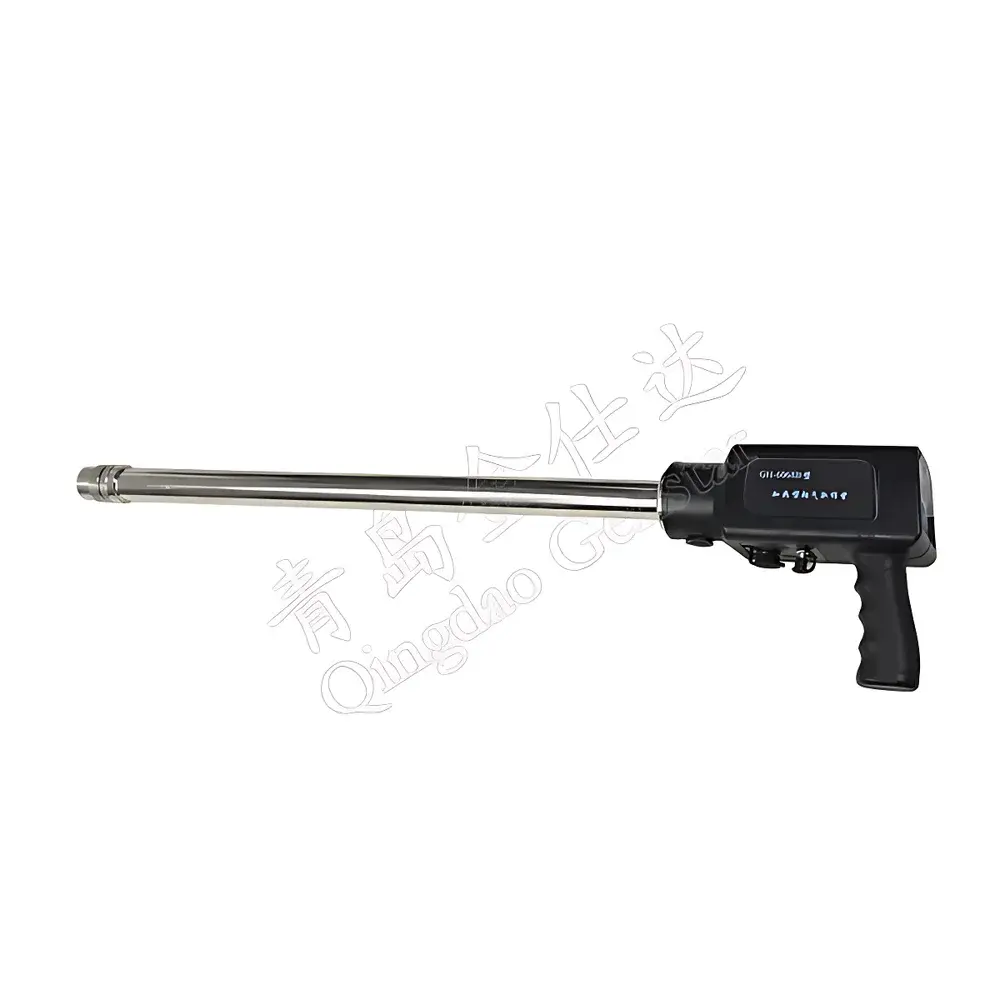
Genetc GH-6068B Heated Flue Gas Sampling Probe
| Brand | Genetc |
|---|---|
| Origin | Shandong, China |
| Manufacturer Type | Direct Manufacturer |
| Instrument Type | Heated Flue Gas Sampling Probe |
| Compliance Standards | HJ/T 47–1999, HJ 732–2014, HJ 38–2017 |
| Filter Medium | Titanium Sintered Filter Cartridge |
| Filtration Precision | 20 µm |
| Temperature Control | Digital PID Thermostat |
| Customizable Probe Length | Yes |
| Application | Wet, Low-Temperature Flue Gas Sampling from Fixed Emission Sources |
| Condensation Prevention | Integrated Heating Zone Along Entire Sampling Path |
Overview
The Genetc GH-6068B Heated Flue Gas Sampling Probe is an engineered solution for representative and artifact-free sampling of moist, low-temperature flue gas streams from fixed emission sources—such as coal-fired boilers, waste incinerators, chemical reactors, and cement kilns. Designed in strict accordance with Chinese environmental monitoring standards HJ/T 47–1999 (Technical Specifications for Flue Gas Samplers), HJ 732–2014 (VOC Sampling via Tedlar® Bags), and HJ 38–2017 (GC-based Determination of Total Hydrocarbons, Methane, and NMHC), the probe mitigates condensation-induced analyte loss, adsorption, and phase separation during transit. Its core operational principle relies on active thermal maintenance: a uniformly distributed heating zone maintains the entire gas pathway—including the probe tip, filter housing, and internal sampling tube—at a user-selectable temperature above the dew point of the sampled stream. This ensures gaseous-phase integrity for water-soluble compounds (e.g., SO₂, NH₃, HCl, formaldehyde) and volatile organic compounds (VOCs), thereby preserving quantitative accuracy for downstream analysis by GC, GC-MS, FTIR, or electrochemical sensors.
Key Features
- Titanium sintered filter cartridge with nominal pore size of 20 µm—chemically inert, corrosion-resistant, and thermally stable up to 400 °C—provides robust particulate removal without catalytic interference or metal leaching.
- Digital PID temperature controller with ±1 °C setpoint stability and real-time LED display enables precise, repeatable thermal management across ambient to 180 °C operating range.
- Modular stainless-steel construction (316L probe shaft, Inconel® heater sheath) ensures mechanical durability under high-vibration industrial conditions and compatibility with acidic or alkaline flue gas matrices.
- Heating zone extends continuously from probe tip to outlet flange, eliminating cold spots where condensate can accumulate and cause cross-contamination or flow restriction.
- Probe length is fully customizable—from 0.5 m to 3.0 m—to accommodate diverse stack diameters and access constraints while maintaining ISO 5167-compliant sampling positioning (e.g., ≥1.5× pipe diameter upstream of disturbances).
- No internal insulation gaps or polymer seals; all wetted surfaces are metallic, supporting cleaning validation and long-term GLP-compliant reuse.
Sample Compatibility & Compliance
The GH-6068B is validated for use with EPA Method 1–5 compatible sampling trains and supports regulatory workflows aligned with HJ 38–2017 (hydrocarbon speciation), HJ 732–2014 (VOC bag sampling), and HJ/T 47–1999 (performance verification of heated probes). It is suitable for sampling flue gases containing ≤30 vol% water vapor, temperatures as low as 40 °C, and corrosive constituents including SO₂ (≤5,000 ppm), NOₓ (≤1,000 ppm), and HCl (≤200 ppm). The titanium filter meets ASTM F2792 requirements for sintered metal filtration integrity. Probe calibration and performance verification follow documented SOPs traceable to national metrology institutes, and thermal uniformity mapping reports are available upon request for audit readiness.
Software & Data Management
While the GH-6068B operates as a standalone hardware module, its digital thermostat supports RS-485 Modbus RTU output (optional) for integration into centralized SCADA or CEMS platforms. Temperature setpoints, real-time probe-tip readings, and heater status are loggable at 1-second intervals. When deployed within a full-stack certified sampling system (e.g., paired with a Genetc GDS-3000 heated transport line and TE-5000 dilution calibrator), full electronic records—including time-stamped temperature profiles, operator ID, and calibration certificates—can be archived in compliance with GB/T 32200–2015 (Environmental Monitoring Data Management Specification) and support 21 CFR Part 11–aligned audit trails when hosted on validated LIMS environments.
Applications
- Continuous emission monitoring system (CEMS) probe retrofitting for moisture-prone stacks.
- Source testing campaigns requiring VOC preservation per HJ 732–2014 and HJ 38–2017 protocols.
- Method validation studies for sulfuric acid mist, aldehydes, or amine-based scrubber effluents.
- Research-grade flue gas characterization in pilot-scale carbon capture units or biomass co-firing trials.
- QA/QC verification of unheated probes’ bias due to condensation artifacts.
FAQ
What is the maximum recommended operating temperature for the GH-6068B probe?
The probe is rated for continuous operation at up to 180 °C at the tip; heater sheath material (Inconel® 600) retains structural integrity beyond this, but temperature settings above 180 °C require prior engineering review.
Can the GH-6068B be used with Teflon®-lined or SilcoNert®-treated sample lines?
Yes—its heated outlet interface is compatible with all standard 6–10 mm OD heated transfer lines, provided the line’s minimum operating temperature exceeds the probe’s setpoint.
Is the titanium filter replaceable in the field?
Yes—the filter cartridge is housed in a quick-release flanged assembly; replacement requires only a 17 mm wrench and takes <90 seconds without disassembling the heater circuit.
Does Genetc provide calibration certificates traceable to CNAS?
Yes—each probe ships with a factory temperature uniformity report and optional CNAS-accredited calibration (CNAS-CL01:2018) upon request.
How is probe length customization implemented without compromising thermal continuity?
Custom lengths use segmented heater zones with overlapping thermal blankets and calibrated power distribution to maintain ±2 °C axial uniformity across the full length.
Related Products







