
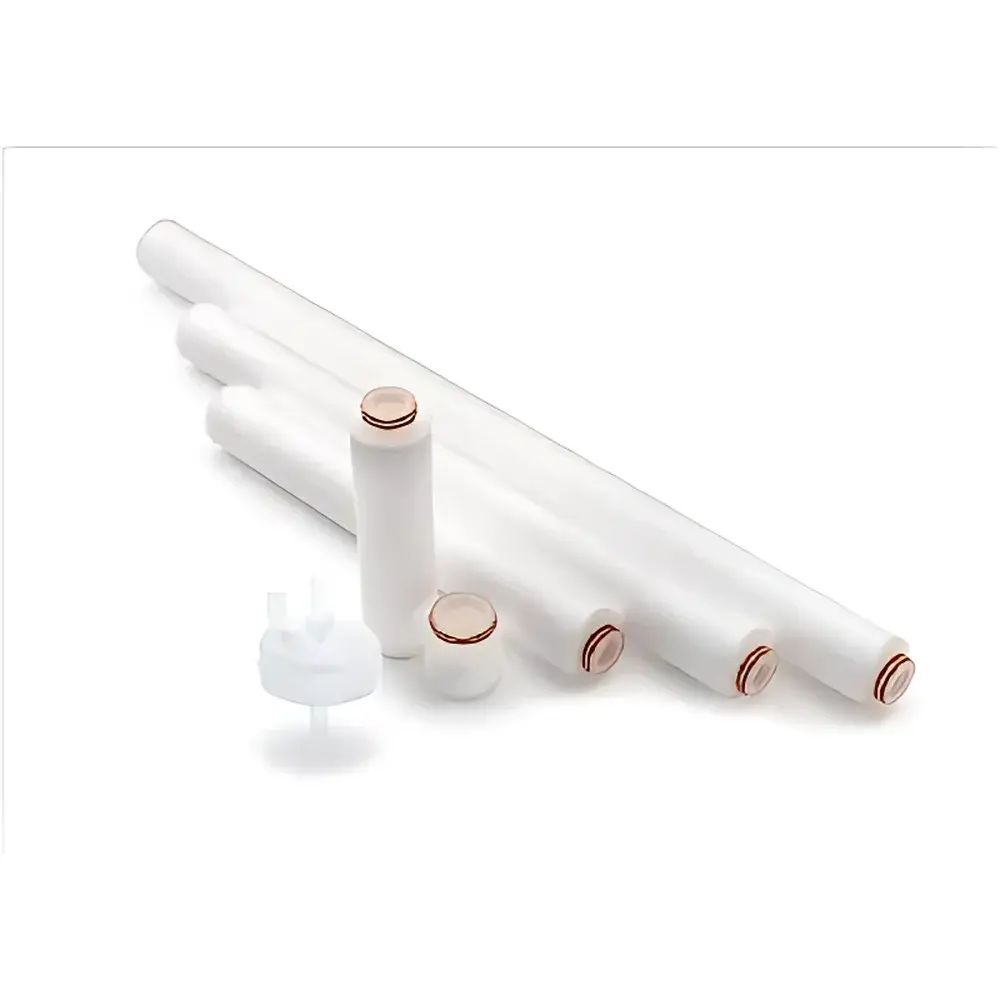
Millipore Clarigard® Gradient-Density Depth Filter Cartridge
| Brand | Millipore |
|---|---|
| Origin | USA |
| Manufacturer Type | Authorized Distributor |
| Product Origin | Imported |
| Model | Clarigard® |
| Pricing | Available Upon Request |
| Filtration Rating | 0.2 µm and 0.3 µm (Sterile-Grade Pre-Filter) |
| Construction Material | Polypropylene |
| Configuration Options | Opticap® XL Single-Use Capsule Format and Standard Cartridge Format |
| Available Pore Sizes | Five grades (including 0.2 µm, 0.3 µm, 1 µm, 5 µm, 10 µm) |
| Extractables Profile | Low-level, compliant with USP <661.1> and EP 3.1.11 |
| Chemical Compatibility | Broad—resistant to alcohols, acids, bases, and common process solvents |
| Bioburden Reduction | Consistent 1–2 log reduction |
| Regulatory Alignment | Designed for use in cGMP-compliant bioprocessing environments |
Overview
The Millipore Clarigard® Gradient-Density Depth Filter Cartridge is an engineered pre-filtration solution designed for robust particulate removal upstream of critical final filtration steps—including sterile-grade membrane filters and chromatography columns—in biopharmaceutical manufacturing and life science research applications. Operating on the principle of depth filtration, Clarigard® employs a precisely graded polypropylene fiber matrix with increasing density from inlet to outlet. This architecture enables progressive particle entrapment across multiple strata, maximizing contaminant holding capacity while maintaining low differential pressure rise over extended service life. Unlike surface filters that rely solely on pore-size exclusion, Clarigard®’s three-dimensional retention mechanism ensures high efficiency for sub-micron aggregates, gelatinous precipitates, and irregularly shaped contaminants—such as denatured proteins, cell debris, or activated carbon fines—that often challenge conventional membrane-based systems.
Key Features
- Gradient-density depth media delivering ≥99.99% particle retention efficiency at rated pore sizes (0.2 µm and 0.3 µm), verified per ASTM F838-22 bacterial challenge testing protocols.
- Polypropylene construction ensuring low extractables and leachables—fully compliant with USP , EP 3.1.11, and ISO 10993-12 for biocompatibility assessment in drug product contact applications.
- Scalable platform available in two primary configurations: Opticap® XL single-use capsule filters (ideal for pilot-scale and clinical manufacturing) and standard cylindrical cartridge formats (validated for commercial-scale processing).
- Five nominal pore size options (0.2 µm, 0.3 µm, 1 µm, 5 µm, and 10 µm) enable precise process alignment—from sterile pre-filtration to coarse clarification—without requalification across scales.
- Demonstrated 1–2 log reduction in bioburden under controlled process conditions, supporting risk mitigation strategies aligned with ICH Q5A(R2) and EU Annex 1 requirements for microbial control in aseptic processing.
- Chemical resistance profile validated against >40 common bioprocess solvents, buffers, and cleaning agents—including 1 M NaOH, 70% ethanol, and 0.5 M phosphoric acid—enabling reuse in multi-cycle CIP/SIP operations where applicable.
Sample Compatibility & Compliance
Clarigard® filters are routinely deployed in the clarification of high-viscosity biologics streams—including monoclonal antibody harvests, plasma-derived fractions, and viral vector lysates—as well as low-viscosity applications such as buffer polishing, ophthalmic solution sterilization, and large-volume parenteral (LVP) finishing. The filter’s inert polypropylene matrix exhibits negligible protein binding and minimal adsorptive loss of therapeutic molecules. All Clarigard® configurations undergo rigorous validation per ISO 13408-1 for sterility assurance and meet ASTM F640-23 dimensional tolerances for housing interface integrity. Documentation packages include full Certificate of Conformance, extractables study reports, and biocompatibility dossiers suitable for regulatory submissions under FDA BLA/MAA and EMA CMC modules.
Software & Data Management
While Clarigard® is a passive filtration device, its integration into automated process trains supports full traceability when paired with industry-standard SCADA and MES platforms. Batch records generated during filtration campaigns—including flow rate, transmembrane pressure (TMP), temperature, and total throughput volume—can be captured in compliance with 21 CFR Part 11 requirements using validated electronic logging systems. Millipore provides comprehensive validation support documentation—including IQ/OQ templates, filter integrity test SOPs (forward flow and water intrusion), and change control guidance—to facilitate GMP audits and regulatory inspections.
Applications
- Removal of insoluble precipitates in recombinant protein purification workflows, including host cell protein aggregates and misfolded species.
- Clarification of cell culture harvests prior to downstream depth or membrane filtration, reducing fouling of expensive 0.22 µm sterilizing-grade membranes by up to 70% in comparative studies.
- Polishing of formulation buffers, saline solutions, and ophthalmic preparations where endotoxin-free clarity and low particle counts are mandated per USP and Ph. Eur. 2.9.19.
- Activated carbon and powdered charcoal removal following decolorization steps in small-molecule API synthesis and water-for-injection (WFI) polishing loops.
- Particulate control in compressed gas lines feeding bioreactors or filling isolators—removing rust, scale, and ambient dust per ISO 8573-1 Class 2 purity specifications.
FAQ
What is the recommended integrity test method for Clarigard® filters?
Forward flow testing is the primary method for 0.2 µm and 0.3 µm Clarigard® units; water intrusion testing applies to hydrophobic configurations used in gas filtration.
Can Clarigard® filters be steam sterilized?
Opticap® XL capsule formats are gamma-irradiated and supplied pre-sterilized; standard cartridges may undergo autoclaving at 121°C for 30 minutes, provided housing compatibility is confirmed.
Is there a maximum operating temperature limit?
Continuous operation is rated to 80°C; short-term exposure up to 100°C is permissible with pressure derating per Millipore Technical Bulletin TB-002.
How does Clarigard® compare to traditional cellulose-based depth filters?
Polypropylene construction eliminates beta-glucan leaching risks, improves chemical stability in alkaline CIP cycles, and reduces endotoxin carryover by >90% versus regenerated cellulose alternatives.
Are filter extractables data available for regulatory filing?
Yes—comprehensive extractables profiles, generated via LC-MS and ICP-MS per USP , are included in the Master File (MF# 3521) accessible to licensed users upon request.





