
GeoSynth CFI20 Capillary Fluid Inclusion Synthesizer
| Origin | Beijing, China |
|---|---|
| Manufacturer Type | Authorized Distributor |
| Regional Origin | Domestic (PRC) |
| Model | CFI20 |
| Pricing | Upon Request |
Overview
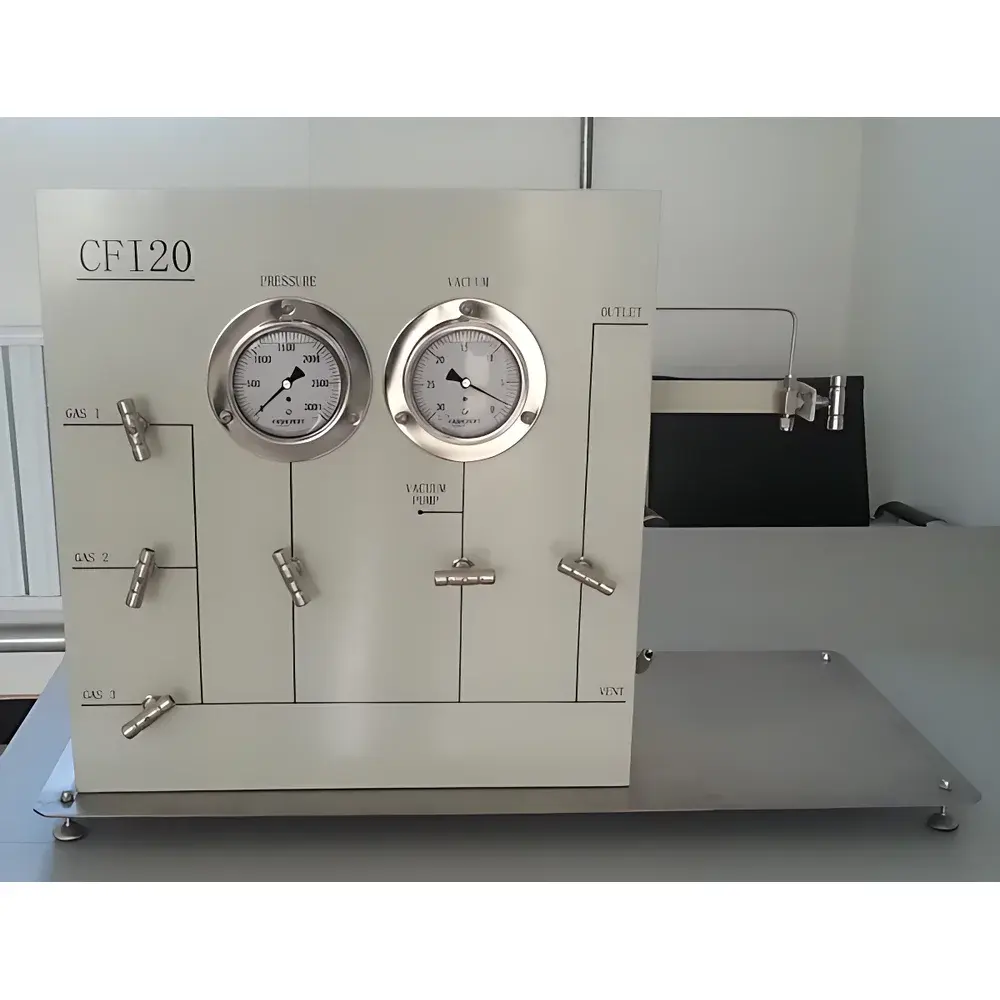
The GeoSynth CFI20 Capillary Fluid Inclusion Synthesizer is an engineered laboratory system designed for the controlled synthesis of synthetic fluid inclusions within fused silica or quartz capillaries. It operates on the principle of sealed-capillary hydrothermal synthesis, enabling precise replication of natural geological fluid inclusion assemblages—including aqueous, gaseous, and mixed organic–inorganic systems—under programmable pressure and compositional constraints. Unlike conventional autoclave-based methods, the CFI20 employs a modular gas/liquid injection manifold and real-time pressure feedback control to establish thermodynamically stable fluid phases at defined P–T–X conditions. This capability supports quantitative calibration of microanalytical instruments (e.g., laser Raman spectrometers, heating–freezing stages) and facilitates experimental petrology studies requiring well-characterized reference standards with known composition, phase ratio, and trapping pressure.
Key Features
- Precise compositional control: Independent or simultaneous introduction of up to three distinct gases (e.g., CO₂, CH₄, N₂, H₂) and one liquid phase (aqueous or organic solvent), enabling synthesis of multicomponent fluid systems representative of hydrothermal, diagenetic, or metamorphic environments.
- Dynamic pressure regulation: Integrated high-accuracy pressure transducer and proportional control valve maintain target pressures from 0.1 MPa to 150 MPa (depending on capillary geometry and temperature), with stability ±0.5% FS over extended durations.
- Thermally robust capillary compatibility: Supports standard and custom-fused silica capillaries rated for continuous operation up to 400 °C; compatible with rapid quenching protocols and in situ observation on calibrated heating–freezing stages.
- Modular gas handling architecture: Gas mixing module with mass flow controllers (MFCs) ensures reproducible stoichiometric ratios; all wetted parts are electropolished stainless steel or Hastelloy® C-276 to prevent catalytic interference or corrosion during H₂- or sulfide-bearing experiments.
- Seal integrity verification: Integrated leak-test sequence prior to sealing (via laser welding or flame-pinch) confirms hermeticity under elevated pressure, minimizing post-synthesis leakage artifacts.
Sample Compatibility & Compliance
The CFI20 accommodates capillaries with inner diameters from 100 µm to 500 µm and lengths up to 20 mm. It is routinely used to synthesize inclusions containing pure H₂O, NaCl–H₂O, CO₂–CH₄ mixtures, hydrocarbon–brine emulsions, and redox-buffered systems (e.g., H₂–H₂O in molten silica capsules for fO₂ control). All operational procedures align with ASTM D7279 (Standard Practice for Preparation of Synthetic Fluid Inclusions) and ISO/IEC 17025 requirements for reference material production. When integrated into GLP-compliant laboratories, the instrument supports audit-ready documentation via optional digital log export (CSV/Excel), including timestamped pressure–temperature–composition records traceable to NIST-calibrated sensors.
Software & Data Management
The CFI20 is operated via a dedicated Windows-based control interface featuring PID-regulated pressure ramping, multi-step gas injection sequencing, and real-time graphical monitoring of pressure, temperature, and flow rates. Software logs include full experiment metadata (capillary ID, operator, date/time, setpoints, deviations), supporting 21 CFR Part 11 compliance when paired with user authentication and electronic signature modules. Exported datasets are structured for direct import into geochemical modeling platforms (e.g., SUPCRT92, PHREEQC) and statistical analysis suites (e.g., Python Pandas, MATLAB). No cloud connectivity or remote access is enabled by default—data remains fully on-premise unless explicitly configured per institutional IT policy.
Applications
- Calibration of microthermometric stages and confocal Raman systems using synthetic inclusions with certified homogenization temperatures (Th), eutectic melting points (Te), and known bulk composition.
- In situ phase-equilibrium studies: Coupled with cryo- or thermo-stages and Raman/FTIR spectroscopy to observe bubble nucleation, hydrate formation/dissolution kinetics, and immiscibility gaps in CH₄–H₂O–NaCl systems.
- Experimental geochemistry: As a sealed reaction vessel for water–rock interaction experiments—e.g., sulfate reduction kinetics under controlled fO₂ (via H₂ buffer in molten quartz), organic matter maturation pathways, or metal complex stability under variable pH–Eh conditions.
- Diffusion coefficient determination: Integration with gas-permeation manifolds enables measurement of gas solubility and diffusion coefficients (e.g., CO₂ in brines) across temperature gradients using time-resolved pressure decay analysis.
FAQ
What capillary materials are supported?
Fused silica (quartz) capillaries are standard; custom borosilicate or sapphire options available upon request for specialized optical or mechanical requirements.
Can the CFI20 synthesize pure vapor-phase inclusions?
Yes—by injecting and sealing pure gases (e.g., CO₂, CH₄, N₂) at subcritical temperatures followed by controlled cooling, single-phase vapor inclusions can be reliably produced.
Is pressure calibration traceable to national standards?
All pressure transducers are factory-calibrated against NIST-traceable deadweight testers and include certificate-of-calibration with uncertainty budgets.
How is oxygen fugacity controlled in redox experiments?
By encapsulating H₂ gas within molten quartz capillaries, the system establishes a fixed H₂–H₂O buffer; fO₂ is calculated from measured P(H₂) and temperature using established thermodynamic expressions (e.g., Frost & Wood, 1997).
Does the system support automated long-duration runs?
Yes—unattended operation up to 72 hours is validated; pressure drift remains <0.3% FS/hour at 100 MPa and 300 °C with active thermal stabilization.



