
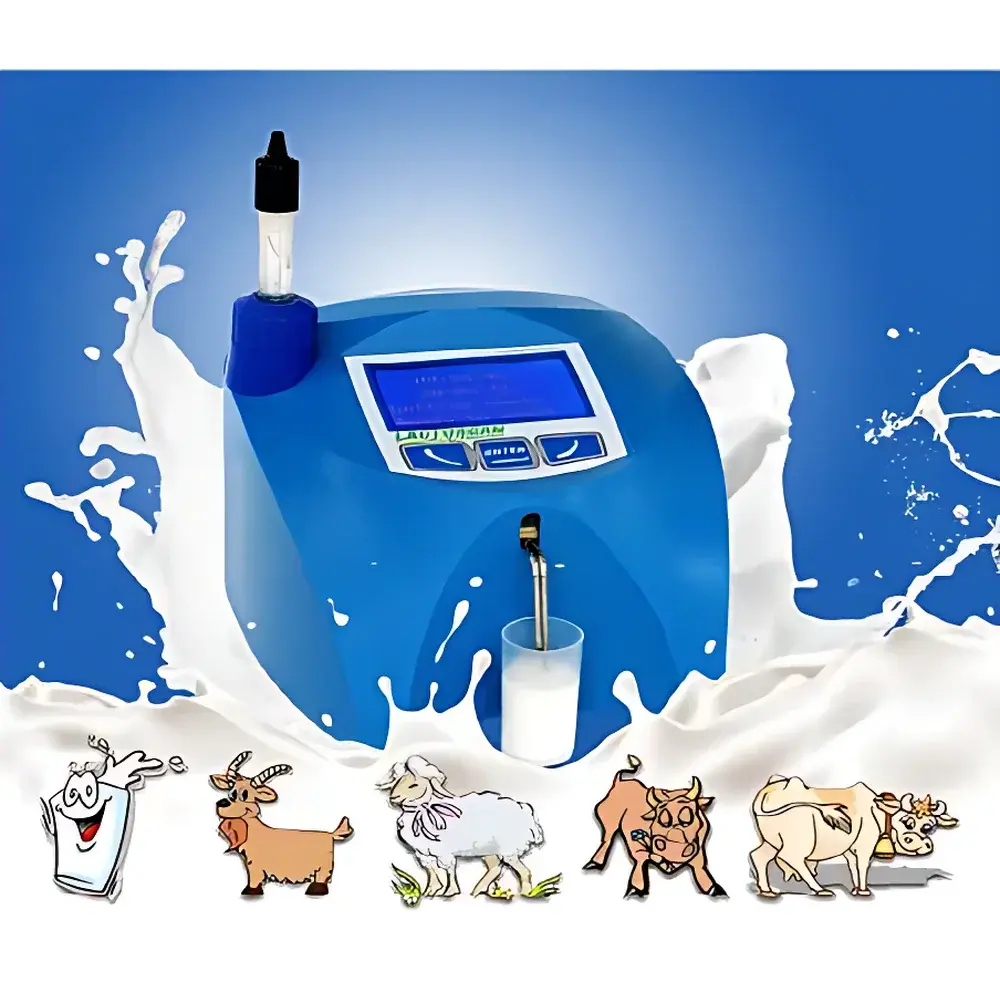
Gerber Lactoscan SP Dairy Analyzer
| Brand | Gerber (FUNKE GERBER) |
|---|---|
| Origin | Bulgaria |
| Model | Lactoscan SP |
| Automation | Fully Automatic |
| Analysis Time | ≤60 s per sample |
| Detection Range | Fat 0.01–25% (optional up to 45%), Non-Fat Solids 3–45%, Protein 2–28%, Lactose 0.01–24%, Density 1015–1160 kg/m³, Freezing Point −0.400 to −0.700 °C, Water Adulteration 0–70%, Ash 0.4–1.5% |
| Repeatability | <0.01% (for fat) |
| Accuracy | ±0.01% (fat), ±0.15% (protein & non-fat solids), ±0.2% (lactose), ±3% (water adulteration), ±0.001 °C (freezing point), ±0.3 kg/m³ (density), ±1 °C (milk temperature) |
| Operating Environment | Ambient Temp. 10–40 °C, Milk Temp. 1–40 °C, Relative Humidity 30–80%, Power Supply AC 110/220 V or DC 12–14.2 V, Power Consumption ≤30 W |
| Dimensions (W×D×H) | 100 × 223 × 216 mm |
| Weight | <3.5 kg |
Overview
The Gerber Lactoscan SP Dairy Analyzer is a fully automated, benchtop near-infrared (NIR) and ultrasonic multi-parameter analyzer engineered for rapid, non-destructive compositional analysis of raw and processed dairy matrices. Based on dual-technology measurement principles—NIR spectroscopy for molecular absorption quantification (fat, protein, lactose, ash) and ultrasonic time-of-flight for density and freezing point determination—the instrument delivers traceable, reference-grade results compliant with ISO 9622:2013 (IDF 141:2013) and AOAC Official Method 991.18. Designed for high-throughput quality control in dairy collection centers, processing plants, and regulatory laboratories, the Lactoscan SP operates without reagents, solvents, or sample preparation, enabling direct analysis of chilled or ambient-temperature milk samples within 60 seconds.
Key Features
- Fully automatic operation with integrated sample aspiration, temperature equilibration, optical path calibration, and result generation—no manual intervention required.
- Dual-sensor architecture combining broadband NIR (1100–2500 nm) and high-frequency ultrasonic transducers (1–5 MHz) ensures independent cross-validation of critical parameters including fat, protein, lactose, non-fat solids, density, freezing point depression, and water adulteration.
- Factory-calibrated using certified reference materials traceable to NIST and EU Reference Laboratories; supports user-defined calibration updates via standardized milk reference sets (e.g., ISO 5725-2 validated pools).
- Compact footprint (100 × 223 × 216 mm) and low power consumption (<30 W) enable deployment in mobile labs, farm-side stations, or ISO-classified cleanrooms without dedicated HVAC or grounding infrastructure.
- Real-time thermal compensation across milk temperature range (1–40 °C) and ambient conditions (10–40 °C, 30–80% RH) maintains metrological stability per ISO/IEC 17025:2017 clause 5.4.2.
- Onboard thermal printer interface (RS-232 or USB) enables immediate hardcopy output with GLP-compliant metadata: sample ID, timestamp, operator code, instrument serial number, and calibration status flag.
Sample Compatibility & Compliance
The Lactoscan SP accepts undiluted, unfiltered liquid dairy samples—including bovine, ovine, caprine, buffalo, and camel milk—as well as whey, skim milk, reconstituted powder, fermented products (e.g., set-style yogurt), and flavored or fortified milks. It meets the analytical scope defined in IDF Standard 103A (2021) for raw milk testing and supports verification against Codex Alimentarius STAN 206-1999 (Milk and Milk Products). All reported values comply with maximum permissible uncertainties outlined in EU Regulation (EC) No 853/2004 Annex III Section IX and are suitable for inclusion in HACCP prerequisite programs. Instrument firmware includes audit-trail logging (user actions, calibration events, result exports) aligned with FDA 21 CFR Part 11 requirements for electronic records and signatures.
Software & Data Management
Built-in Gerber DairySoft v4.x firmware provides intuitive touchscreen navigation, multi-language UI (EN/DE/FR/ES/RU/CN), and secure local data storage (≥10,000 test records with full metadata). Export options include CSV, PDF, and XML formats compatible with LIMS integration (HL7 v2.5.1 and ASTM E1384-07 interfaces available). Advanced software modules support trend analysis (Shewhart X-bar/R charts), batch deviation alerts, and automated report generation per ISO/IEC 17025 clause 7.8.2. All calibration and performance verification logs are digitally signed and time-stamped, fulfilling GLP/GMP documentation requirements for laboratory accreditation (e.g., UKAS, DAkkS, ANAB).
Applications
- Raw milk procurement: Real-time fat/protein payment grading at collection hubs per national standards (e.g., USDA AMS 56.102, India FSSAI Regulation 2.4.2).
- Process control: In-line monitoring of standardization, homogenization, and pasteurization efficacy through continuous density and freezing point tracking.
- Adulteration screening: Quantitative detection of water dilution (0–70%) and reconstitution anomalies via colligative property deviation (freezing point depression, density ratio).
- Product release testing: Final verification of nutritional labeling compliance (EU Regulation 1169/2011, US FDA 21 CFR 101.9) for protein, fat, and lactose content in UHT, ESL, and fermented dairy products.
- Research & development: High-reproducibility baseline characterization of novel dairy streams (e.g., A2 beta-casein variants, lactose-free formulations, plant-milk blends) under controlled thermal protocols.
FAQ
What regulatory standards does the Lactoscan SP comply with?
The instrument conforms to ISO 9622:2013, IDF 141:2013, AOAC 991.18, and EU Regulation (EC) No 853/2004. Its software supports 21 CFR Part 11 and ISO/IEC 17025 audit-trail requirements.
Can it analyze non-bovine milks such as goat or camel milk?
Yes—calibration models are validated for bovine, caprine, ovine, buffalo, and camel milk matrices, with optional custom model development for regional breeds.
Is external calibration required before daily use?
No. The system performs automatic optical and acoustic self-checks at startup. Daily verification uses a single certified reference standard; full recalibration is recommended every 6 months or after 5,000 analyses.
Does it require consumables or reagents?
No. The NIR/ultrasonic methodology is non-invasive and reagent-free—only deionized water is needed for periodic flow-path cleaning.
How is data integrity ensured during network transmission?
All exported files contain embedded digital signatures and SHA-256 checksums. LIMS-integrated transfers enforce TLS 1.2+ encryption and mutual authentication.





