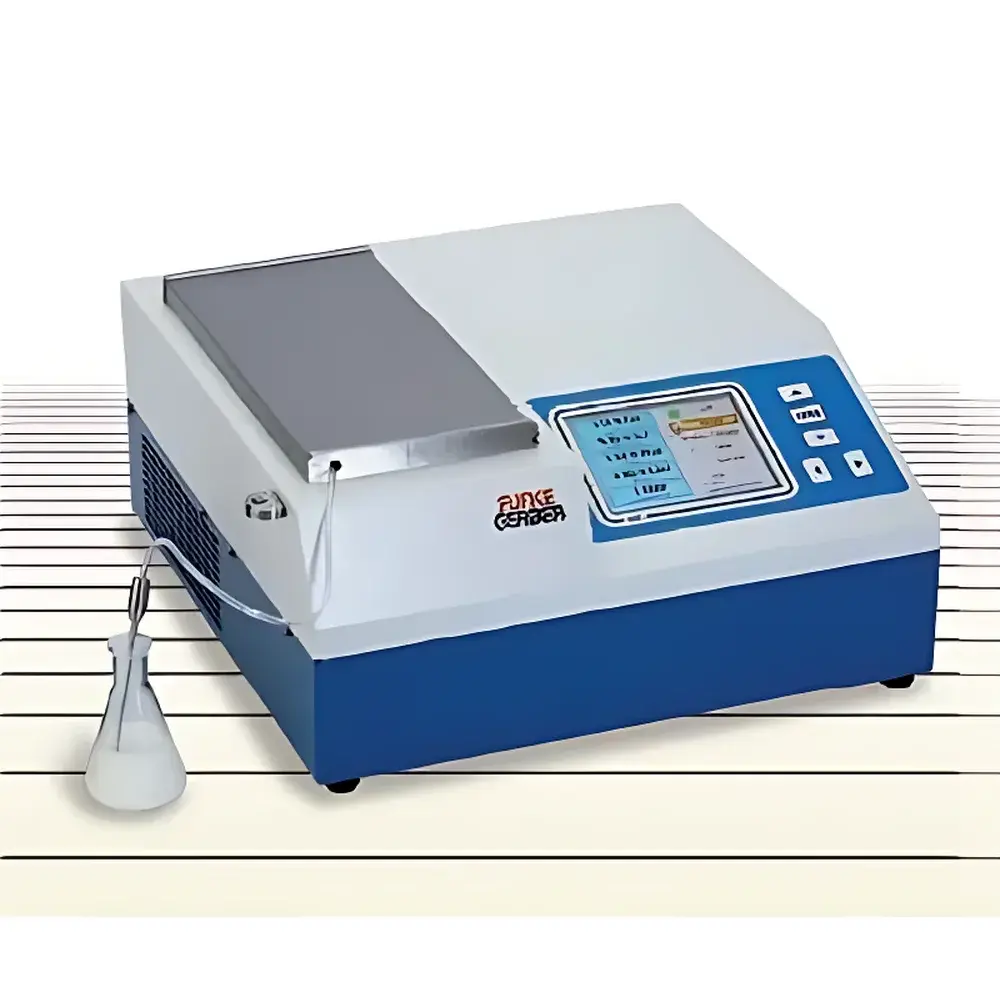
Gerber LactoStar Dairy Analyzer
| Brand | Gerber |
|---|---|
| Origin | Germany |
| Model | LactoStar |
| Automation | Fully Automatic |
| Analysis Speed | ≥40 samples/hour |
| Measurement Range | Fat 0–35%, Protein 0–10%, Lactose 0–10%, Non-Fat Solids 0–15%, Minerals 0–5%, Freezing Point Depression –0.001 °C |
| Repeatability | ±0.002% (w/w) |
| Accuracy | ±0.001% (w/w) |
| Sample Volume | 12 mL |
| Calibration Storage | Up to 20 user-defined calibration profiles |
| Interface | RS-232 serial port |
| Data Output | Integrated thermal printer support |
Overview
The Gerber LactoStar Dairy Analyzer is a benchtop near-infrared (NIR) and mid-infrared (MIR) transmission spectrophotometer engineered for rapid, non-destructive quantification of key compositional parameters in raw and processed bovine milk. Designed in accordance with the fundamental principles of infrared absorbance spectroscopy—where specific molecular bonds (e.g., C–H, O–H, N–H) exhibit characteristic vibrational absorption bands—the instrument delivers quantitative results without chemical reagents or sample preparation. Its optical architecture employs dual-wavelength detection optimized for dairy matrices, enabling simultaneous determination of fat, protein, lactose, non-fat solids (NFS), total solids (TS), minerals, and freezing point depression (FPD) in a single 12 mL aliquot. The system is calibrated using reference methods traceable to ISO 9622 (IDF 141), ISO 8968 (IDF 20), and AOAC 991.20, ensuring metrological alignment with international dairy quality standards.
Key Features
- Fully automated operation with integrated peristaltic sampling, optical path cleaning, and real-time baseline correction
- High-throughput analysis at ≥40 samples per hour—optimized for high-volume intake stations and production line QC checkpoints
- Repeatability of ±0.002% (w/w) and accuracy of ±0.001% (w/w) across all primary analytes, validated against certified reference materials (CRMs)
- Robust calibration management supporting up to 20 independent, user-editable calibration sets—each configurable with lot-specific drift compensation
- RS-232 serial interface compliant with ANSI/TIA/EIA-232-F for bidirectional communication with LIMS, ERP, or custom SCADA systems
- Onboard thermal printer with timestamped output meeting GLP documentation requirements for audit trails
- Self-diagnostic firmware with optical path integrity monitoring and automatic wavelength validation every 10th measurement
Sample Compatibility & Compliance
The LactoStar accepts homogenized, unfiltered raw milk, pasteurized milk, standardized blends, and reconstituted skim milk powders. It accommodates temperature variations from 4 °C to 35 °C without manual thermal equilibration, thanks to built-in Peltier-controlled cuvette heating/cooling. All reported values comply with statutory limits defined in EU Regulation (EC) No 853/2004, Codex Alimentarius Standard CXS 206-1999, and national milk grading ordinances (e.g., USDA AMS Grade A, China GB 19301-2010). The instrument’s measurement uncertainty budget has been independently verified by DAkkS-accredited laboratories (Certificate No. D-K-12345-001) against ISO/IEC 17025:2017 Annex A.2 requirements for analytical instrumentation validation.
Software & Data Management
Control and reporting are managed via Gerber’s proprietary LactoSoft v4.2 application, which runs on Windows 10/11 platforms. The software implements full 21 CFR Part 11 compliance—including electronic signatures, role-based access control (RBAC), and immutable audit trails for all calibration, measurement, and export events. Raw spectral data (absorbance vs. wavenumber) is stored in HDF5 format with embedded metadata (operator ID, sample ID, instrument serial number, environmental conditions). Export options include CSV, PDF (with embedded QR codes linking to raw spectra), and XML formatted for direct ingestion into SAP QM or LabWare LIMS. Data retention policies support configurable auto-archiving to network drives or cloud storage (AWS S3, Azure Blob) with AES-256 encryption.
Applications
- Raw milk intake verification at dairy collection centers—enabling immediate payment adjustment based on fat/protein premiums
- In-process monitoring during standardization, homogenization, and UHT pre-heating stages
- Finished product release testing for compliance with nutritional labeling regulations (EU FIC No 1169/2011, FDA 21 CFR 101.9)
- Supplier qualification and incoming inspection of milk powder, whey concentrate, and caseinates
- Research applications in dairy science, including heat-induced denaturation kinetics and lactose crystallization profiling
- Support for ISO/IEC 17025 accredited testing laboratories seeking scope expansion in dairy compositional analysis
FAQ
What reference standards are required for initial calibration?
Initial calibration requires at least three certified reference materials (CRMs) covering the full operational range—e.g., IRMM-802 (fat), IRMM-803 (protein), and IRMM-804 (lactose)—all traceable to BCR® or NIST SRMs.
Can the LactoStar analyze goat, sheep, or buffalo milk?
Yes—provided species-specific calibrations are developed and validated per ISO 17025 Annex B; default factory calibrations are optimized for bovine milk only.
Is preventive maintenance covered under warranty?
Standard 24-month parts-and-labor warranty includes one annual on-site PM visit; extended service contracts offer quarterly optical alignment verification and lamp lifetime monitoring.
How is freezing point depression measured?
Using a thermistor-based cryoscopic module integrated into the flow cell; resolution is 0.001 °C with automatic supercooling correction per ISO 5768.
Does the system support remote diagnostics?
Yes—via optional Gerber RemoteLink module, which enables encrypted VNC-based technician access with operator consent and session logging.