
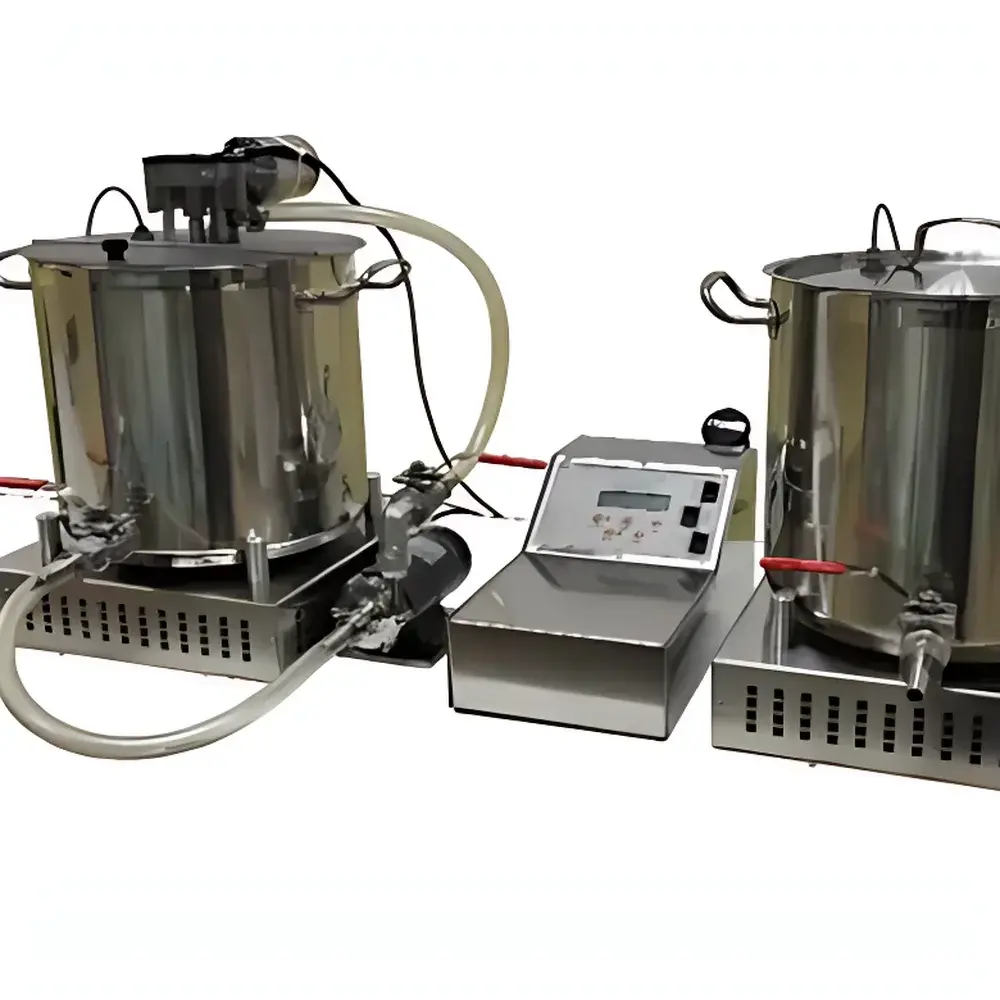
Gerber OB20 Compact Laboratory-Scale Beer Brewing System
| Brand | Gerber (FUNKE GERBER) |
|---|---|
| Origin | Germany |
| Model | OB20 |
| Capacity | 20 L Final Beer Output (10 L Mash Volume) |
| Temperature Accuracy | ±0.5 °C |
| Power Consumption | 2560 W |
| Dimensions (W×D×H) | 128 × 64 × 78 cm |
| Weight | 31.5 kg |
| Energy Compatibility | Standard 230 V / 50 Hz Domestic Electrical Supply |
| Mash Conversion Efficiency | >90% |
| Typical Process Duration | <5 h |
| Construction Material | Electropolished AISI 316 Stainless Steel |
| Modular Design | Fully Disassemblable for CIP/SIP Validation |
| Regulatory Alignment | Compliant with EU Machinery Directive 2006/42/EC and EC 1935/2004 for Food-Contact Surfaces |
Overview
The Gerber OB20 Compact Laboratory-Scale Beer Brewing System is a fully integrated, benchtop-scale brewing platform engineered for reproducible, scientifically controlled wort production and fermentation in academic and R&D environments. Designed according to the fundamental principles of industrial brewhouse engineering—including precise thermal management of mashing, lautering, boiling, and whirlpool stages—the OB20 employs a closed-loop, jacketed stainless steel vessel architecture coupled with PID-controlled heating and cooling circuits. Its core functionality centers on enzymatic starch hydrolysis (via endogenous β-amylase and α-amylase activity), protein degradation, and soluble extract optimization under tightly regulated time–temperature profiles. Unlike simplified homebrew kits, the OB20 replicates full-scale process thermodynamics and mass transfer kinetics—enabling students and researchers to investigate mash conversion efficiency, fermentability index (FAN generation), wort composition (sugar/non-sugar ratio, molecular nitrogen distribution), and thermal stability of key enzymes—all within a GLP-aligned, traceable workflow.
Key Features
- Electropolished AISI 316 stainless steel construction throughout all wetted parts—ensuring corrosion resistance, non-reactivity with acidic wort, and compliance with EC 1935/2004 food-contact material regulations.
- Modular, tool-free disassembly design supporting validated Clean-in-Place (CIP) and Steam-in-Place (SIP) protocols—critical for microbiological control in teaching labs and pilot-scale method development.
- Integrated control unit with real-time graphical display showing current process step, actual vs. setpoint temperatures across all zones (mash tun, kettle, chiller), remaining time to step completion, and cumulative energy consumption.
- High-efficiency heat exchange system achieving >90% starch-to-sugar conversion yield—verified per ASBC Methods of Analysis Section 5 (Malt and Wort) and consistent with EBC Analytica Chapter 4.2.1.
- Compact footprint (128 × 64 × 78 cm) and 31.5 kg operational weight enabling deployment in standard chemistry or food science laboratories without structural reinforcement.
- 230 V / 50 Hz input compatibility—eliminating need for industrial three-phase power or dedicated transformers—ideal for university infrastructure constraints.
Sample Compatibility & Compliance
The OB20 accommodates diverse raw material matrices including malted barley, wheat, rye, oats, adjunct grains (e.g., corn, rice), and specialty malts (crystal, roasted, acidulated). It supports both infusion and step-infusion mashing regimes, with programmable ramp rates (0.1–2.0 °C/min) and hold durations (1–120 min per step). All temperature sensors are calibrated traceably to NIST standards; thermal uniformity across the mash bed is maintained within ±0.5 °C (per DIN EN 61000-4-3 validation). The system conforms to ISO 22000:2018 requirements for food safety management systems and supports audit-ready documentation for GLP-compliant coursework and thesis research.
Software & Data Management
The embedded control firmware logs timestamped process data at 2-second intervals—including temperature, power draw, elapsed time, and step status—to internal flash memory (16 GB). Export is supported via USB 2.0 to CSV format for post-acquisition analysis in MATLAB, Python (Pandas), or JMP. Optional Ethernet interface enables integration into institutional SCADA networks and supports basic OPC UA server functionality for centralized lab monitoring. Audit trails comply with FDA 21 CFR Part 11 requirements when used with institutional identity management systems.
Applications
- Undergraduate and graduate laboratory instruction in brewing science, food engineering, and bioprocess technology.
- Optimization of mash schedules for novel grain blends and enzyme supplementation strategies.
- Wort quality profiling: determination of fermentable sugar composition (glucose, maltose, maltotriose), FAN content, and high-/medium-/low-molecular-weight nitrogen fractions per ASBC Beer-32 and EBC 9.12.
- Accelerated yeast strain screening under controlled wort composition and oxygenation conditions.
- Pilot validation of new recipes prior to scale-up in commercial brewhouses (20 L output maps directly to 20–50 hL production batches).
FAQ
Can the OB20 be used for full fermentation, or is it limited to wort production?
The OB20 includes a dedicated, temperature-controlled fermentation module with active cooling (5–25 °C range) and pressure-rated conical vessel options—supporting complete batch fermentation from wort to green beer.
Is third-party calibration certification available?
Yes—Gerber-certified calibration reports (traceable to PTB, Germany) are provided with each unit shipment and can be renewed annually via authorized service partners.
Does the system support automated pH adjustment during mashing?
No—pH monitoring requires external portable meters; however, the control unit provides analog voltage outputs (0–10 V) for integration with OEM pH controllers.
What maintenance intervals are recommended for academic use?
Daily CIP post-use, quarterly gasket inspection, and annual thermal sensor recalibration—documented in the included GLP-compliant maintenance logbook.
Is training included with purchase?
Yes—two-day on-site or virtual instructor-led training covers operation, method programming, data export, and regulatory documentation practices.




