
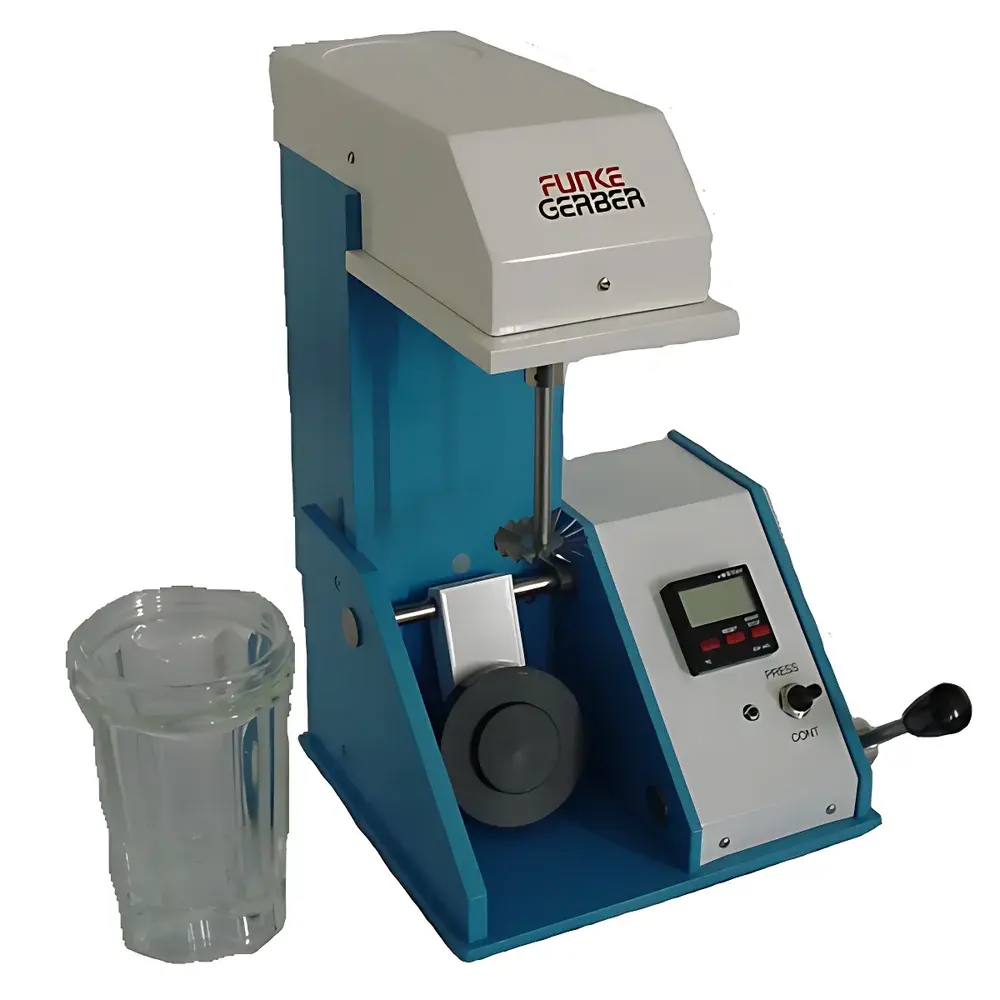
Gerber Solution Index Mixer for Milk Powder Insolubility Testing
| Brand | GERBER |
|---|---|
| Origin | Germany |
| Model | Solution Index Mixer |
| Motor Speed | 2800 rpm (drive), 3600 rpm (impeller) |
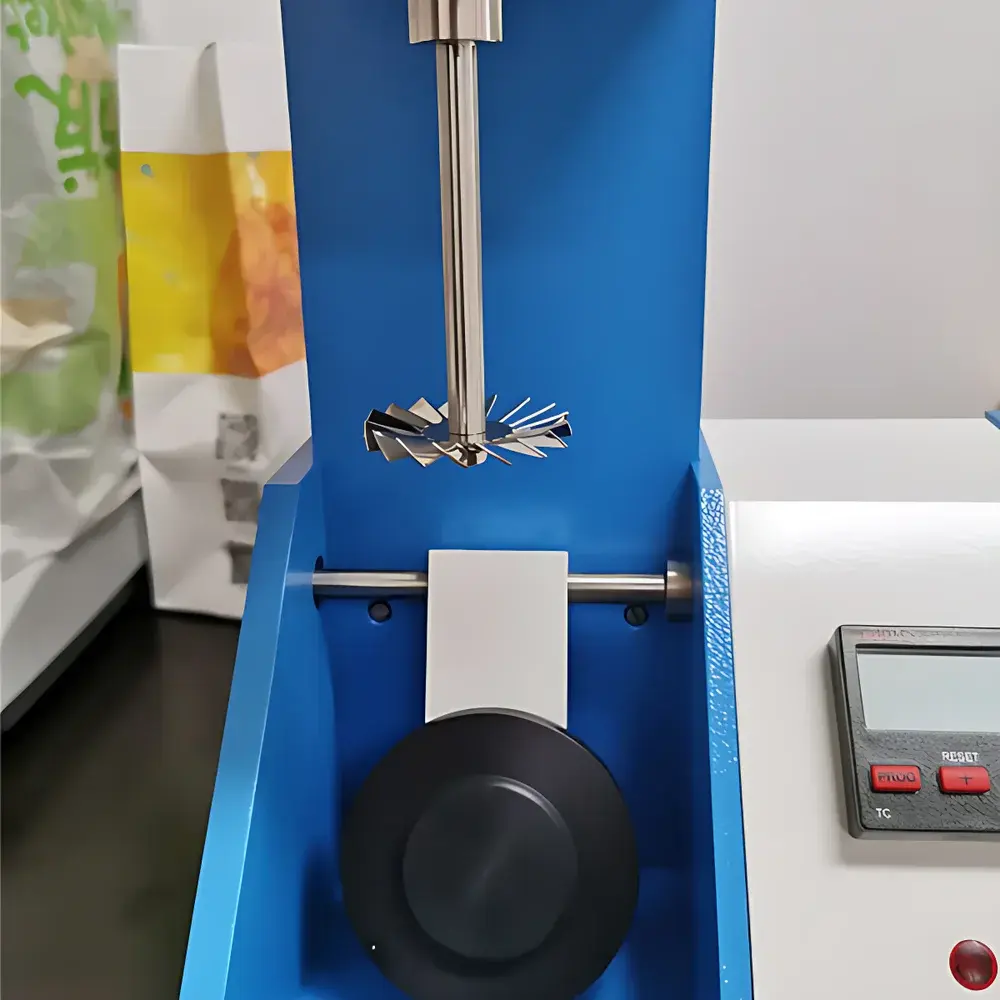
| Impeller | 16-blade stainless steel, clockwise rotation, flat side down, upward tilt from right to left |
| Vessel | 500 mL borosilicate glass beaker |
| Standards Compliance | ADPI, DLG, DIN ISO 8156 |
| Dimensions | 38 × 26 × 25 cm |
| Power | 65 W (220 V, 50 Hz) |
Overview
The Gerber Solution Index Mixer is a precision-engineered laboratory instrument designed exclusively for the standardized determination of insolubility index in milk powder and related dairy powders. It operates on the principle of controlled mechanical agitation under strictly defined hydrodynamic conditions—specifically, a fixed-speed impeller-driven mixing regime that replicates the shear and suspension dynamics outlined in DIN ISO 8156, the internationally recognized standard for milk powder solubility assessment. Unlike general-purpose stirrers, this mixer delivers reproducible rotational energy input to ensure consistent particle dispersion and sedimentation behavior during the test sequence. Its core function is to prepare the sample suspension prior to centrifugation and subsequent quantification of the insoluble residue—making it an indispensable pre-analytical component in quality control workflows across dairy ingredient manufacturing, third-party testing laboratories, and regulatory compliance facilities.
Key Features
- Fixed-speed dual-motor architecture: A dedicated 2800 rpm drive motor powers the mechanical linkage, while the impeller rotates at a calibrated 3600 rpm—matching the exact rotational frequency mandated by DIN ISO 8156 and aligned with ADPI and DLG method requirements.
- 16-blade stainless steel impeller: Precision-machined from corrosion-resistant austenitic stainless steel (AISI 316), with geometrically optimized blade orientation—flat surface facing downward and uniform 15° upward tilt from right to left—to generate laminar upward flow and minimize vortex formation.
- Dedicated 500 mL borosilicate glass mixing vessel: Chemically inert, thermally stable, and optically clear; calibrated to nominal volume with tolerance ≤ ±2 mL; designed for direct compatibility with standard centrifuge tube preparation protocols.
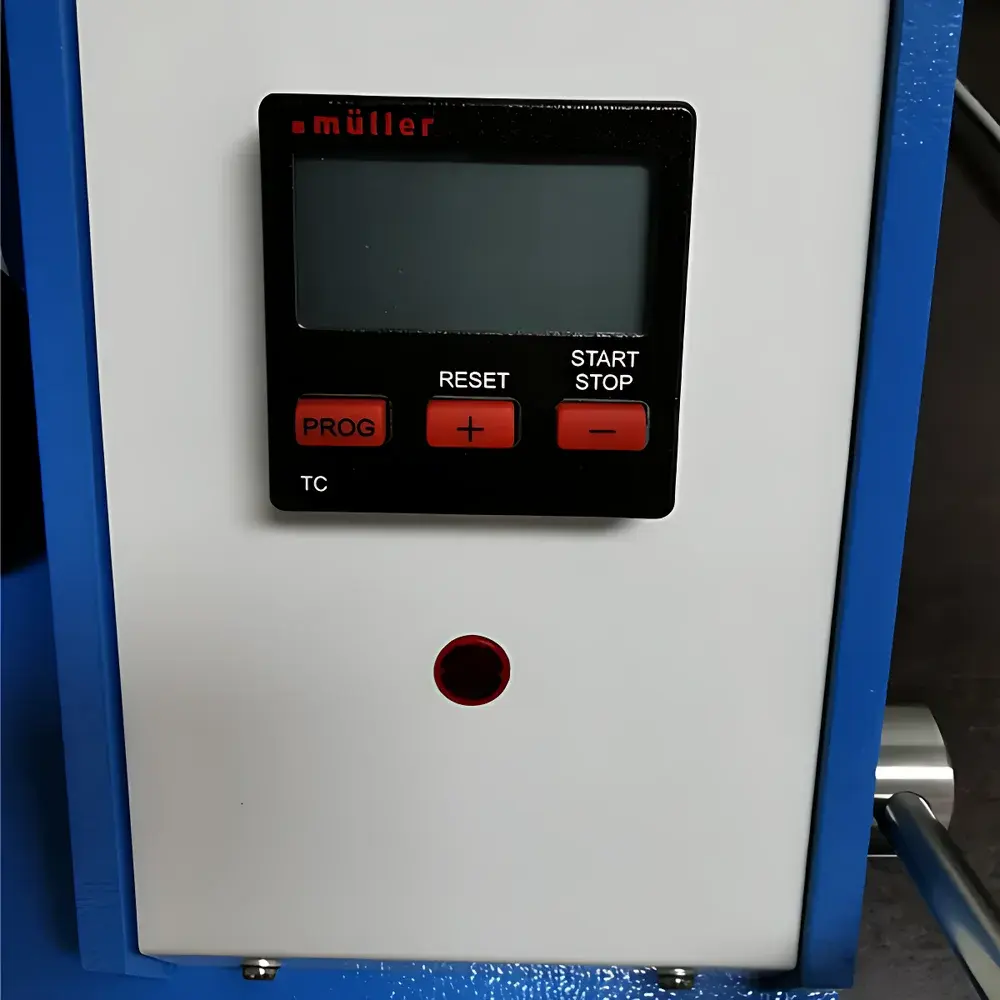
- Operator-selectable operating modes: Toggle switch enables either timed operation (with built-in mechanical timer supporting intervals from 1–120 seconds in 1-second increments) or continuous mode for method development and validation studies.
- Robust benchtop housing: Compact footprint (38 × 26 × 25 cm), IP20-rated enclosure, and vibration-damped base ensure stability during high-speed mixing; 65 W power consumption reflects energy-efficient electromagnetic design compatible with standard 220 V / 50 Hz laboratory mains.
Sample Compatibility & Compliance
The Gerber Solution Index Mixer is validated for use with skim milk powder, whole milk powder, whey protein concentrate (WPC), and infant formula powders within the moisture content range of 2.0–5.5% w/w. It is not intended for viscous suspensions, granular non-dairy analogs, or samples containing >10% fat without prior solvent-assisted pre-wetting. The instrument meets the physical and operational criteria specified in DIN ISO 8156:2017 “Milk and milk products — Determination of the insolubility index of milk powder”, and its mechanical performance has been verified against reference methods published by the American Dry Milk Institute (ADPI) and Deutsche Landwirtschafts-Gesellschaft (DLG). All critical components—including impeller geometry, rotational speed accuracy (±15 rpm), and vessel dimensional conformity—are traceable to national metrological standards and documented in the factory calibration certificate supplied with each unit.
Software & Data Management
This is a stand-alone electromechanical instrument with no embedded microprocessor, touchscreen interface, or digital data output. Operation is fully manual and analog, in accordance with the procedural rigor required by ISO/IEC 17025-accredited laboratories for method-defined physical tests. No firmware, drivers, or software installation is required. All timing functions are executed via a certified mechanical timer compliant with EN 60730-1 for automatic electrical controls. Audit trails for usage are maintained externally via laboratory logbooks or LIMS-integrated manual entry; the device supports GLP-compliant recordkeeping through its unambiguous physical state indicators (mode switch position, visible impeller motion, audible motor tone). No connectivity (USB, Bluetooth, Ethernet) is provided, eliminating cybersecurity risks and ensuring uninterrupted operation in regulated environments governed by FDA 21 CFR Part 11 Annex 11 expectations for non-computerized systems.
Applications
- Routine QC testing of commercial milk powders prior to release, per ISO 8156 pass/fail thresholds (e.g., ≤0.2 mL insoluble residue per 100 mL reconstituted sample).
- Process optimization in spray drying lines, where insolubility index serves as a surrogate indicator of thermal damage and protein denaturation.
- Raw material qualification for infant formula manufacturers subject to Codex Alimentarius Standard 72-1981 and EU Commission Directive 2006/141/EC.
- Interlaboratory comparison studies coordinated under ILAC MRA signatory schemes, where equipment equivalence is verified through round-robin testing using identical Gerber mixer units.
- Educational demonstrations of colloidal stability principles in food science curricula, illustrating the relationship between shear history, casein micelle integrity, and post-reconstitution sedimentation kinetics.
FAQ
Is the Gerber Solution Index Mixer compatible with ISO 8156:2017 revision requirements?
Yes—the impeller speed, geometry, vessel volume, and mixing duration parameters fully satisfy Clause 6.2 and Annex A of DIN ISO 8156:2017.
Can the 500 mL glass vessel be autoclaved?
Yes, the borosilicate glass beaker is rated for steam sterilization at 121°C for 20 minutes; however, repeated autoclaving may affect long-term dimensional stability and is not required for routine use.
Does the instrument require annual recalibration?
Per ISO/IEC 17025, the impeller rotational speed must be verified annually using a traceable optical tachometer; Gerber provides a calibration verification kit (P/N SIM-CV-2024) for in-house checks.
What maintenance is recommended for long-term reliability?
Monthly inspection of impeller blade integrity, biannual lubrication of the gear coupling with food-grade silicone grease (ISO H1), and replacement of the drive belt every 18 months under continuous use.
Is there a CE marking and Declaration of Conformity available?
Yes—each unit ships with EC Declaration of Conformity (2014/30/EU EMC Directive and 2014/35/EU Low Voltage Directive) and bears the CE mark affixed to the rear panel.






