
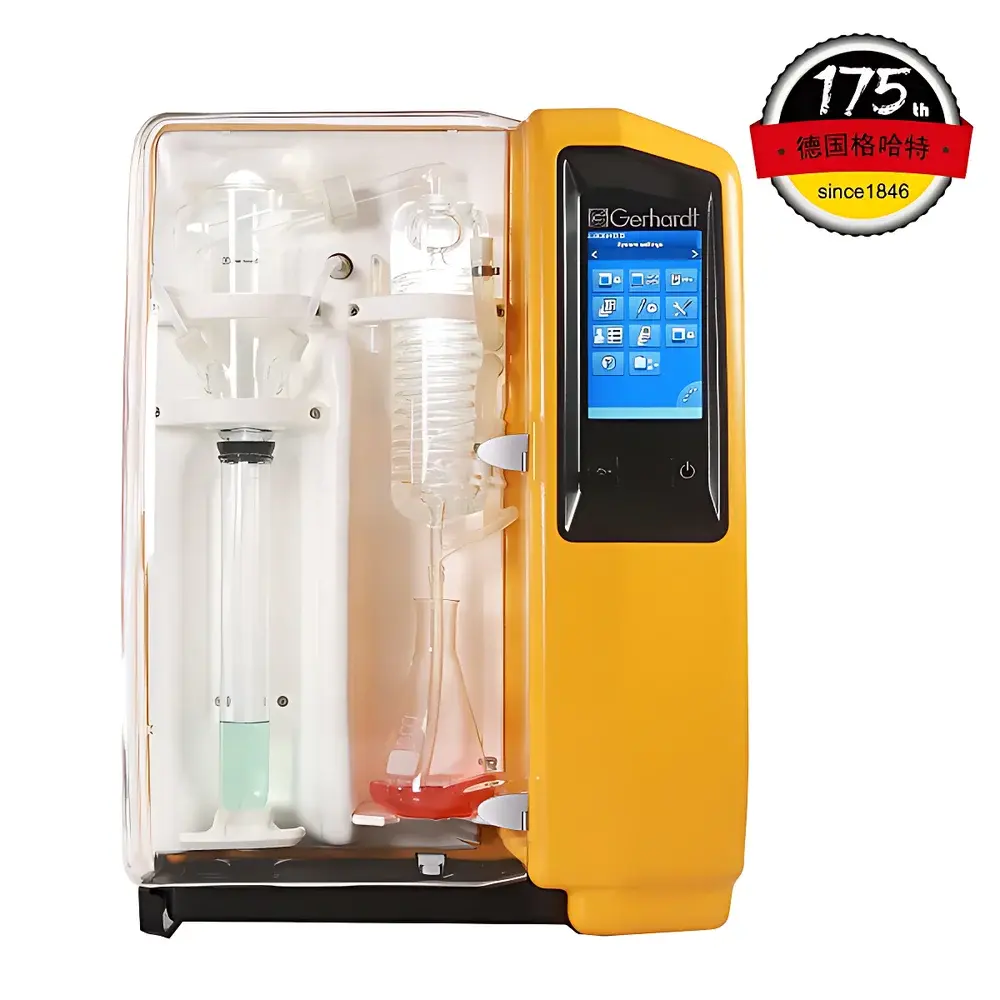
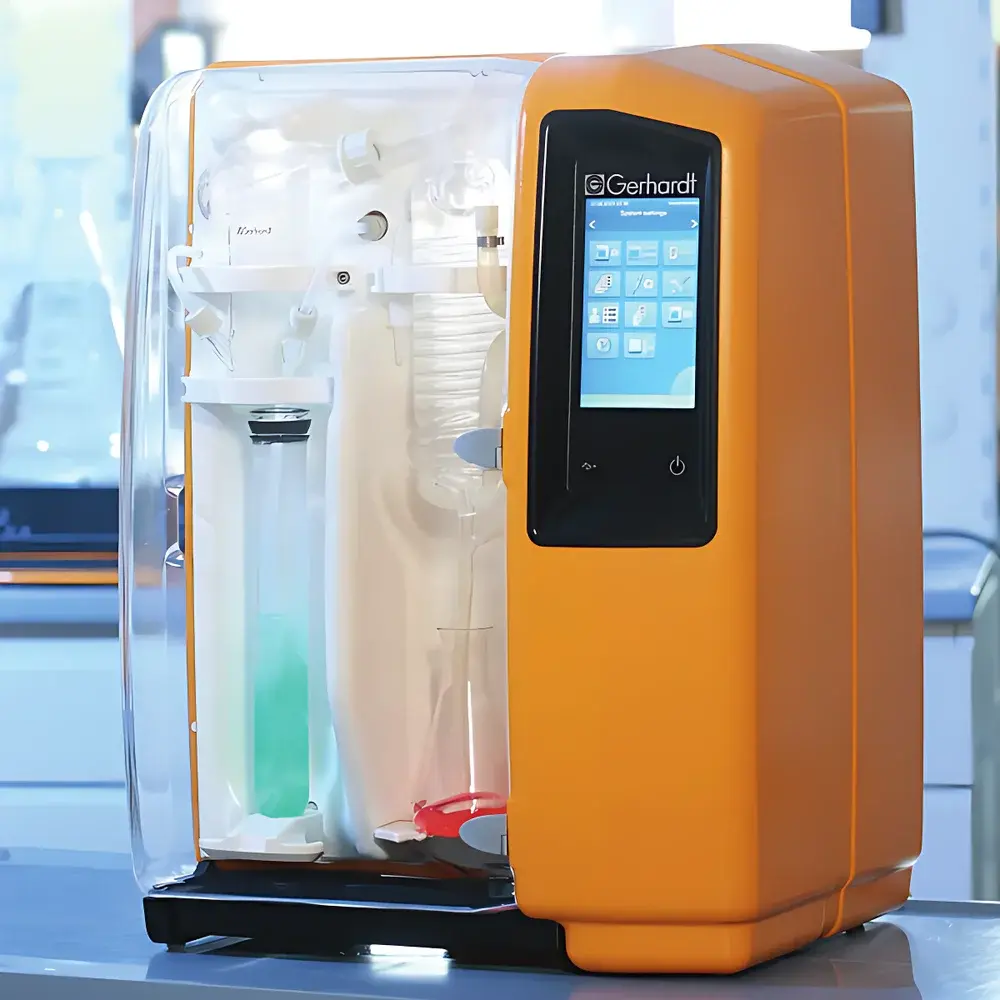
Gerhardt Vapodest 300 Kjeldahl Nitrogen Determinator
| Brand | Gerhardt |
|---|---|
| Origin | Germany |
| Manufacturer | C. Gerhardt GmbH & Co. KG |
| Instrument Type | Kjeldahl Nitrogen Determinator |
| Automation Level | Semi-Automatic |
| Nitrogen Determination Range | 0.1–200 mg |
| Distillation Time | 3.5 min |
| Repeatability | ±1% |
| Sample Weight Capacity | ≤5 g (solid) |
| Nitrogen Recovery Rate | ≥99.5% |
| Power Consumption | 2200 W |
| Dimensions (L×W×H) | 527 mm × 390 mm × 697 mm |
| Linearity Range | 0.1–200 mg N |
| Water Consumption | ~3 L/min |
| Operating Voltage/Frequency | 230 V AC, 50/60 Hz |
| Net Weight | 34 kg |
Overview
The Gerhardt Vapodest 300 is a semi-automatic Kjeldahl nitrogen determinator engineered for precision, reliability, and compliance in routine and regulated laboratory environments. Based on the classical Kjeldahl digestion–distillation–titration principle, the instrument quantifies total nitrogen content in organic and inorganic samples by catalytic acid digestion followed by steam distillation under controlled alkaline conditions and subsequent titrimetric or colorimetric detection. Designed as the mid-range model in Gerhardt’s Vapodest series, the Vapodest 300 integrates proven German engineering with operational robustness—leveraging over 126 years of continuous development in steam distillation instrumentation. Its architecture supports full procedural control of key Kjeldahl steps: automated alkali addition, dilution water dosing, waste discharge, and adjustable steam generation (10–100% output), enabling method flexibility across diverse sample matrices while maintaining strict adherence to ISO 8968, AOAC 981.10, and DIN 1049 standards.
Key Features
- Semi-automatic operation with programmable sequence control for alkali dosing, dilution, distillation, and waste evacuation
- Adjustable steam generator delivering precise, stable steam output from 10% to 100% capacity for optimized energy use and method adaptation
- Large backlit LCD display providing real-time visualization of active process steps, elapsed time, and diagnostic status codes
- Integrated error-detection system with multilingual on-screen alerts for common operational anomalies (e.g., low coolant flow, insufficient reagent volume, condenser temperature deviation)
- Robust stainless-steel housing and corrosion-resistant internal components ensuring long-term durability in high-throughput analytical labs
- Compliance with EN ISO 9001:2000 throughout design, manufacturing, and final inspection—certified at factory level prior to shipment
Sample Compatibility & Compliance
The Vapodest 300 accommodates solid samples up to 5 g and liquid samples within standard Kjeldahl digestion tube specifications (e.g., 100–300 mL borosilicate glass tubes). It supports analysis of foodstuffs (dairy, cereals, meat), feedstuffs, environmental sludges, fertilizers, and pharmaceutical excipients per internationally recognized protocols. All critical performance parameters—including recovery rate (≥99.5%), repeatability (±1%), and detection limit (0.1 mg N)—are validated using certified reference materials traceable to NIST and BAM standards. The system meets essential requirements for GLP-compliant laboratories and provides documentation support for audits aligned with FDA 21 CFR Part 11 when integrated with Gerhardt’s optional TitroLine 7700 titration module and LabSoft data management software.
Software & Data Management
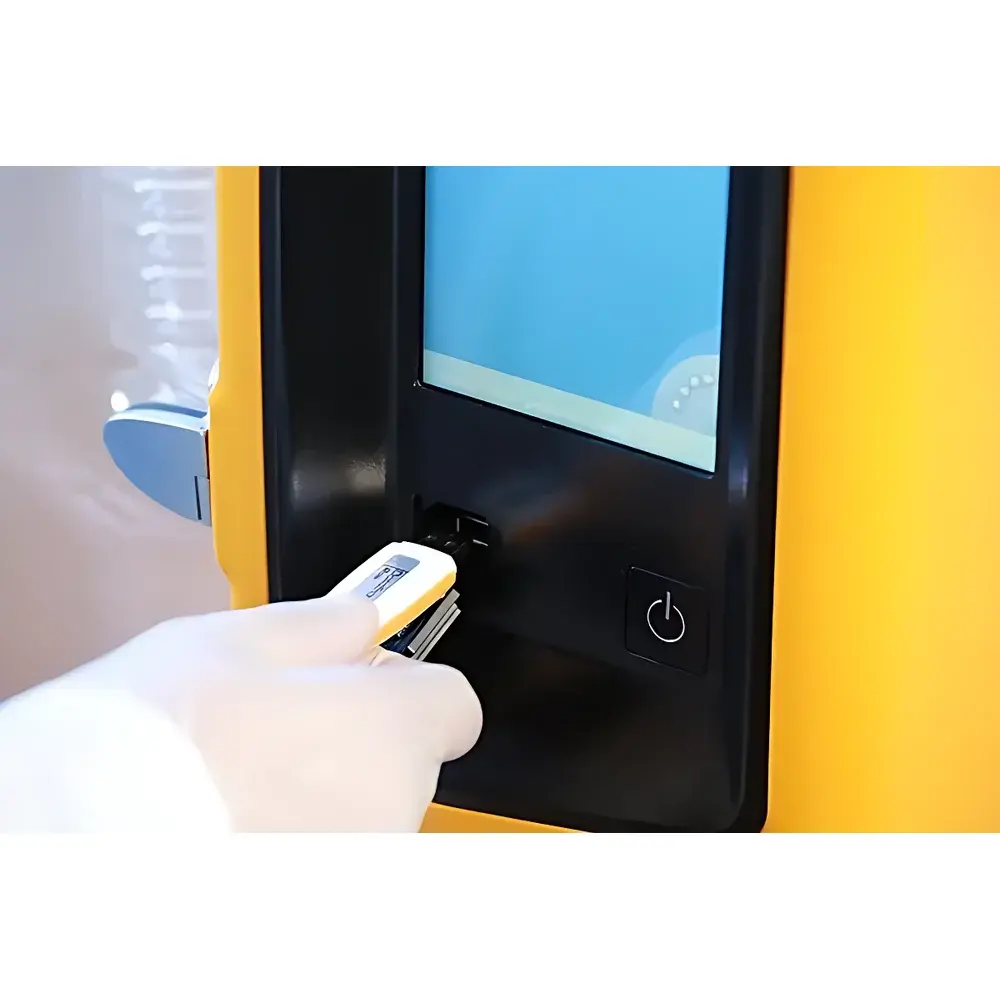
While the Vapodest 300 operates as a stand-alone distillation unit, it is fully compatible with Gerhardt’s LabSoft suite for method storage, result export (CSV, PDF), audit trail generation, and electronic signature implementation. When paired with TitroLine 7700 or other compliant titrators, the combined workflow satisfies 21 CFR Part 11 requirements for electronic records and signatures—including user access control, change logging, and immutable data archiving. Method parameters—including steam ramp profiles, alkali volume, and distillation duration—are stored securely and can be recalled via alphanumeric naming or barcode scanning. All instrument events—including power cycles, calibration actions, and error resets—are timestamped and logged internally for traceability.
Applications
The Vapodest 300 serves as a core nitrogen analysis platform in quality control laboratories across multiple sectors: food and beverage (protein calculation via N × 6.25 factor), agricultural testing (feed protein verification), environmental monitoring (wastewater nitrogen load assessment), and academic research (soil nutrient studies). Its 3.5-minute distillation cycle significantly reduces turnaround time compared to conventional manual systems without compromising accuracy—making it ideal for laboratories processing 20–60 samples per day. The linear response across 0.1–200 mg N enables direct analysis of both low-protein matrices (e.g., drinking water, plant extracts) and high-nitrogen samples (e.g., ammonium sulfate fertilizer, casein standards) without dilution.
FAQ
What regulatory standards does the Vapodest 300 comply with?
It conforms to ISO 8968-1 (milk and milk products), AOAC Official Methods 981.10 and 984.13, DIN 1049 (foodstuffs), and EN ISO 9001:2000 for manufacturing quality assurance.
Can the Vapodest 300 be integrated into an automated Kjeldahl workflow?
Yes—it interfaces seamlessly with Gerhardt digestion units (e.g., Digesdahl 400) and TitroLine titrators to form a complete, traceable Kjeldahl analysis chain supporting GLP/GMP documentation requirements.
Is external cooling water required?
Yes—the system requires a continuous supply of tap or recirculated cooling water at ~3 L/min; optional closed-loop chillers are available for temperature-sensitive environments.
What maintenance intervals are recommended?
Daily visual inspection of seals and tubing; quarterly descaling of the steam boiler; annual calibration verification using certified nitrogen standards—documented in the included maintenance logbook.
Does Gerhardt provide validation documentation for IQ/OQ/PQ?
Yes—factory-issued Installation Qualification (IQ) and Operational Qualification (OQ) protocols are supplied; Performance Qualification (PQ) templates and support are available upon request for site-specific implementation.
Related Products




