
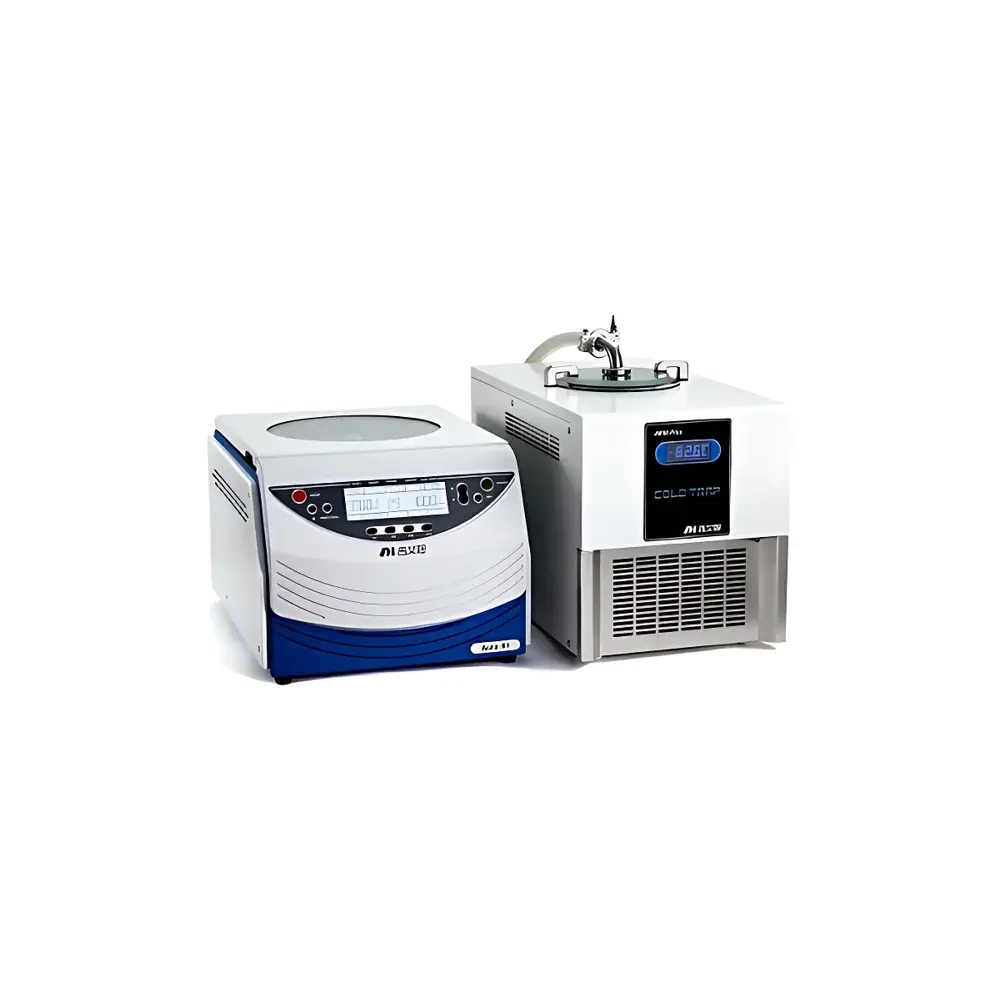
GiAim Auto R1 Vacuum Centrifugal Concentrator
| Brand | GiAim |
|---|---|
| Model | Auto R1 |
| Instrument Type | Vacuum Centrifugal Concentrator |
| Temperature Range | Room Temperature +5°C to +100°C |
| Temperature Control Accuracy | ±1°C |
| Vacuum Control Range | 0.1–100 mbar |
| Vacuum Control Accuracy | ±0.1 mbar |
| Maximum Sample Capacity | 180 × 1.5 mL centrifuge tubes |
| Rotational Speed Range | 800–2000 rpm |
| Max Relative Centrifugal Force (RCF) | 530 × g |
| Timer Range | 0–9999 min |
| Ultimate Vacuum | ≤0.2 mbar |
| Noise Level | ≤55 dB(A) |
| Power Supply | AC 220 V, 50/60 Hz, 10 A |
| Dimensions (L×D×H) | 480 × 370 × 290 mm |
| Weight | 30 kg |
| Chamber Material | 304 Stainless Steel with PTFE-coated components and borosilicate glass viewport |
| Vacuum Release Valve | Imported solenoid-controlled automatic release valve |
| Built-in Delayed Vacuum Initiation | Engages vacuum only after rotor reaches set speed |
| Real-time Centrifugation Imaging | Integrated optical viewing system enabling non-intrusive sample monitoring during operation |
| Pre-stored Programs | 30 user-defined protocols |
| Quick-access Program Keys | 4 dedicated hardware buttons |
| Drive System | Dual-rotor electromagnetic drive architecture |
| Corrosion Resistance | Full chamber and vacuum path engineered for compatibility with chlorinated solvents, acetonitrile, methanol, ethyl acetate, and other common organic media |
Overview
The GiAim Auto R1 Vacuum Centrifugal Concentrator is an integrated sample preparation platform engineered for precise, reproducible solvent removal from biological, pharmaceutical, and analytical chemistry samples. It combines controlled centrifugal force, regulated vacuum pressure, and programmable thermal management to accelerate evaporation while minimizing sample degradation, oxidation, or thermal denaturation. Operating on the principle of vacuum-assisted rotary evaporation under reduced pressure—where lowered ambient pressure decreases the boiling point of solvents—the Auto R1 enables gentle yet efficient concentration of heat-sensitive analytes such as nucleic acids, peptides, metabolites, and small-molecule standards. Its dual-rotor electromagnetic drive ensures stable rotational dynamics across the full speed range (800–2000 rpm), delivering consistent RCF up to 530 × g without mechanical belt wear or vibration-induced tube displacement. The system’s sealed 304 stainless steel chamber, PTFE-coated internal surfaces, and borosilicate glass viewport collectively support long-term exposure to aggressive organic solvents—meeting routine demands in QC labs, proteomics core facilities, and regulated GMP environments.
Key Features
- High-capacity processing: Simultaneous concentration of up to 180 × 1.5 mL microcentrifuge tubes per run—optimized for high-throughput workflows in genomics and biobanking.
- Intelligent vacuum regulation: Built-in electromechanical vacuum control system with 0.1–100 mbar range and ±0.1 mbar precision; includes automated delayed initiation synchronized with rotor acceleration.
- Thermal uniformity: Dual-zone temperature control maintains consistent heating across both ends of the sample chamber, reducing axial thermal gradients and improving reproducibility.
- Real-time process visibility: Integrated optical imaging module allows continuous visual inspection of sample meniscus, condensation behavior, and tube integrity without interrupting rotation or vacuum.
- Corrosion-resilient architecture: All wetted parts—including vacuum valves, chamber walls, and rotor interfaces—are constructed from electropolished 304 stainless steel and coated with chemically inert PTFE; compatible with halogenated solvents, esters, and polar aprotic media.
- User-centric interface: 7-inch capacitive touchscreen with intuitive icon-driven navigation, four dedicated quick-program keys, and storage for 30 customizable protocols with independent vacuum, temperature, speed, and time parameters.
Sample Compatibility & Compliance
The Auto R1 accommodates standard 1.5 mL conical-bottom microcentrifuge tubes (including low-retention variants), PCR strips, and custom-insert racks via its modular rotor system—supporting 16 interchangeable rotor configurations. It complies with IEC 61010-1:2010 for laboratory electrical safety and meets CE marking requirements for electromagnetic compatibility (EMC Directive 2014/30/EU). While not certified to ISO/IEC 17025 as a standalone measurement device, its operational stability, traceable temperature calibration (±1°C), and vacuum repeatability support adherence to GLP documentation practices. When used in conjunction with validated SOPs, the system contributes to data integrity frameworks aligned with FDA 21 CFR Part 11 expectations for electronic records and signatures—particularly when paired with external audit-trail-enabled LIMS integration.
Software & Data Management
The embedded JM-Fast control firmware provides deterministic real-time scheduling of all critical parameters—vacuum ramp rates, thermal equilibration hold times, deceleration profiles, and staged vacuum release sequences. Each protocol stores full execution metadata (start/end timestamps, actual vs. setpoint deviations, vacuum decay curves, and rotor acceleration logs) locally in non-volatile memory. Export options include CSV-formatted runtime reports via USB port, enabling post-run statistical analysis in JMP, Python pandas, or LabWare LIMS. Optional Ethernet connectivity (via add-on module) supports remote status polling and alarm notification via SNMP traps—facilitating integration into centralized lab infrastructure monitoring platforms.
Applications
- Concentration and desalting of DNA/RNA extracts prior to sequencing library preparation.
- Removal of volatile organic solvents (e.g., dichloromethane, ethyl acetate) following liquid–liquid extraction in residue analysis.
- Lyophilization pre-concentration steps in peptide purification workflows.
- Preparative-scale cleanup of HPLC fractions containing thermolabile natural products.
- Routine QC of reference standards in pharmaceutical stability studies where solvent exchange must preserve crystallinity and polymorphic form.
FAQ
Does the Auto R1 support cold trapping or refrigerated condensation?
No—the Auto R1 does not include an integrated cold trap or chilled condenser. Users requiring condensate capture for volatile solvents should connect an external −50°C cold trap upstream of the vacuum pump.
Can the system be validated for use in regulated GMP environments?
Yes—while the instrument itself is not supplied with IQ/OQ documentation, its design supports third-party qualification: temperature sensors are accessible for calibration verification, vacuum transducers output analog signals for external logging, and all timing functions are software-controlled with deterministic latency.
Is rotor balancing required before each run?
Yes—manual symmetry verification remains essential. The Auto R1 does not incorporate active imbalance detection; users must ensure mass distribution symmetry within ±0.5 g across opposing positions.
What maintenance intervals are recommended for the vacuum system?
Inspect vacuum seals and PTFE valve seats every 6 months; replace the inlet filter cartridge quarterly under continuous operation; perform full oil change on the connected vacuum pump per manufacturer specifications (typically every 500 operating hours).
How is data integrity ensured during power interruption?
All active protocol states—including elapsed time, current vacuum level, and rotor speed—are retained in battery-backed RAM. Upon recovery, the system resumes from the last known valid state unless manual abort is initiated.



