
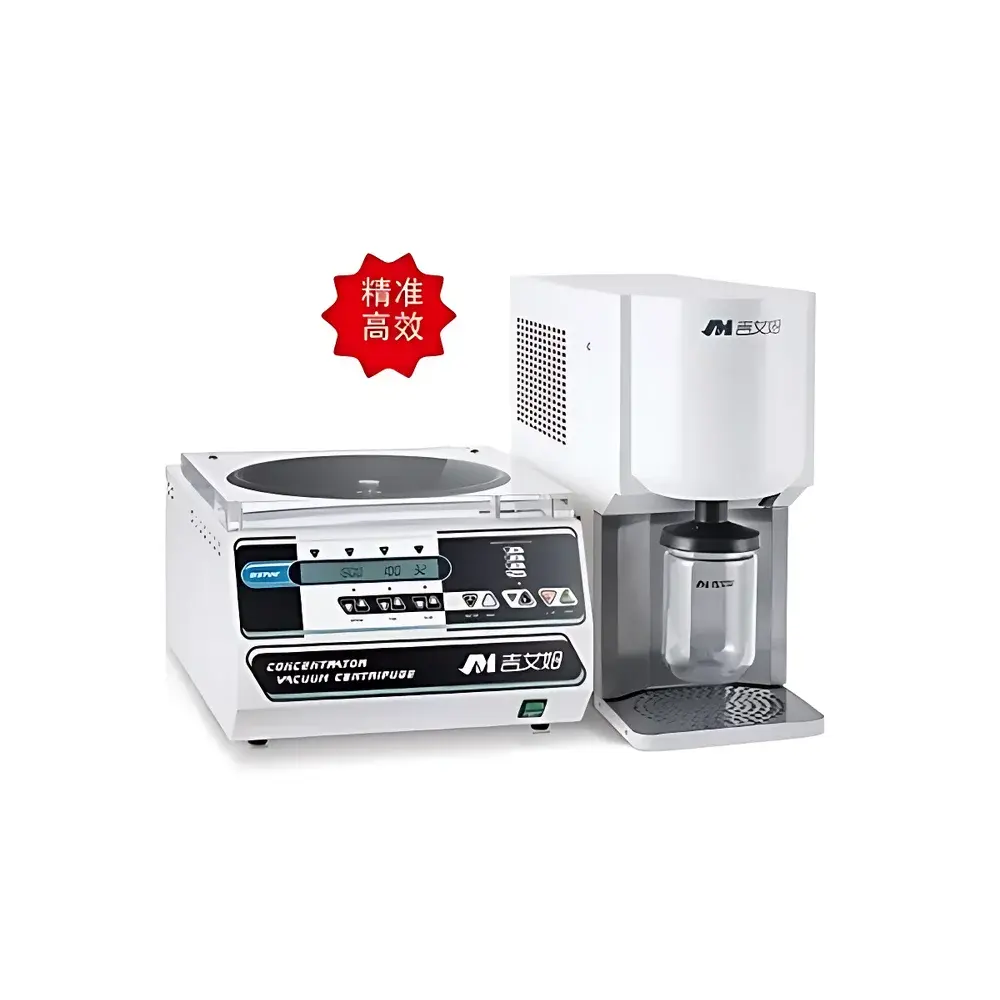
GiAim CV300 Low-Temperature Vacuum Centrifugal Concentrator
| Brand | GiAim |
|---|---|
| Origin | Beijing, China |
| Manufacturer Type | Authorized Distributor |
| Country of Origin | China |
| Model | CV300 |
| Instrument Type | Vacuum Centrifugal Concentrator |
| Temperature Range | Ambient +5°C to 80°C (chamber) |
| Cold Trap | −50°C |
| Sample Capacity | 600 mL |
| Rotational Speed | 300–1800 rpm |
| Max RCF | 430 × g |
| Timer Range | 0–9999 min |
| Ultimate Vacuum | ≤30 Pa |
| Noise Level | ≤60 dB(A) |
| Power Supply | AC 220 V, 50/60 Hz, 10 A |
| Dimensions (L×W×H) | 520 × 360 × 240 mm (main unit) |
| Weight | 56 kg |
| Total Power Consumption | 1200 W |
Overview
The GiAim CV300 Low-Temperature Vacuum Centrifugal Concentrator is an engineered solution for gentle, efficient solvent removal from heat-sensitive biological and chemical samples. It operates on the principle of simultaneous centrifugation, vacuum reduction, and low-temperature condensation—enabling rapid concentration or lyophilization-preparatory drying without thermal degradation. Unlike conventional rotary evaporators or nitrogen blow-down systems, the CV300 maintains sample integrity by minimizing localized overheating and foaming through precisely controlled rotational speed (300–1800 rpm) and dynamic vacuum regulation. Its integrated −50°C cold trap ensures high-efficiency solvent capture—particularly critical for volatile organic solvents (e.g., ethanol, acetone, ethyl acetate) and aqueous buffers containing volatile analytes such as amino acids, nucleotides, or small-molecule pharmaceuticals.
Key Features
- Electromagnetic drive system with brushless AC frequency-conversion induction motor—ensuring silent operation (≤60 dB[A]), zero maintenance, and long-term rotational stability.
- Adjustable rotational speed (300–1800 rpm) and programmable vacuum control to prevent sample bumping or foaming during evaporation—critical for viscous or surfactant-containing solutions.
- Teflon-coated centrifuge chamber and 304 stainless-steel internal piping and rotor—providing corrosion resistance against acidic, basic, and halogenated solvents.
- Compact ergonomic design: 240 mm operational height facilitates easy loading/unloading of microtubes, PCR plates, and conical tubes without bending or strain.
- Direct-condensation architecture: refrigerated condenser coils are positioned inline within the vapor path—maximizing condensation surface area and recovery efficiency (>95% typical for common solvents).
- Rapid cold trap precooling (≤20 minutes to −50°C) with optional auto-defrost function—reducing downtime between runs and ensuring consistent cold trap performance across multi-batch workflows.
Sample Compatibility & Compliance
The CV300 accommodates standard labware including 1.5–2.0 mL microcentrifuge tubes, 15–50 mL conical tubes, deep-well plates, and custom rotors (optional). It supports aqueous, alcoholic, and moderately aggressive organic solvent systems—validated for use in compliance with ISO 17025-accredited laboratories performing residue analysis (e.g., pesticide screening per EN 15662), biomolecule purification (e.g., DNA/RNA cleanup prior to qPCR), and pharmaceutical QC (e.g., API concentration per ICH Q5A guidelines). While not certified for GMP manufacturing environments, its hardware architecture—including traceable temperature logging (via optional RS232/USB interface), non-volatile timer memory, and stable RCF output—supports GLP-aligned documentation requirements and audit readiness.
Software & Data Management
The CV300 features a microprocessor-based control panel with intuitive membrane keypad and dual-line LCD display showing real-time parameters: set/actual temperature, vacuum level (mbar), rotational speed (rpm), remaining time, and cold trap status. All settings—including ramp profiles, hold steps, and end-point actions (e.g., auto-shutdown, alarm activation)—are programmable and retainable after power loss. Optional PC connectivity enables data export (CSV format) for integration into LIMS or ELN platforms. The system logs timestamped event history (start/stop, vacuum breach, temperature deviation >±2°C), satisfying basic 21 CFR Part 11 data integrity expectations when paired with user-access-controlled instrument accounts and electronic signature protocols.
Applications
- Concentration of dilute nucleic acid and protein solutions prior to electrophoresis, mass spectrometry, or HPLC injection.
- Removal of volatile solvents from synthetic reaction mixtures in medicinal chemistry workflows.
- Pre-concentration of environmental water samples for LC-MS/MS detection of emerging contaminants (e.g., PFAS, pharmaceutical metabolites).
- Drying of immunoassay plates following wash steps to stabilize antigen–antibody complexes before fluorescence readout.
- Sample preparation for food safety testing—including mycotoxin extraction (aflatoxin B1, ochratoxin A) and veterinary drug residue analysis (e.g., sulfonamides, tetracyclines).
FAQ
What types of solvents are compatible with the CV300?
The CV300 is validated for use with water, methanol, ethanol, acetonitrile, acetone, ethyl acetate, and chloroform. Strongly oxidizing or highly corrosive solvents (e.g., concentrated nitric acid, bromine, or hydrofluoric acid) are not recommended.
Can the CV300 be used under inert gas conditions?
No—the system is designed for vacuum operation only; it lacks gas inlet ports or pressure-regulated purge capability.
Is the cold trap temperature actively regulated during operation?
Yes—the −50°C setpoint is maintained dynamically via closed-loop PID control of the refrigeration unit, independent of chamber temperature or vacuum load.
Does the CV300 support external temperature monitoring probes?
Not natively; however, third-party PT100 probes can be inserted into sample wells for parallel validation—data must be recorded externally.
What maintenance intervals are recommended?
Cold trap cleaning every 50 operating hours; vacuum pump oil replacement every 300 hours (if using an external diaphragm pump); O-ring inspection every 6 months.



