
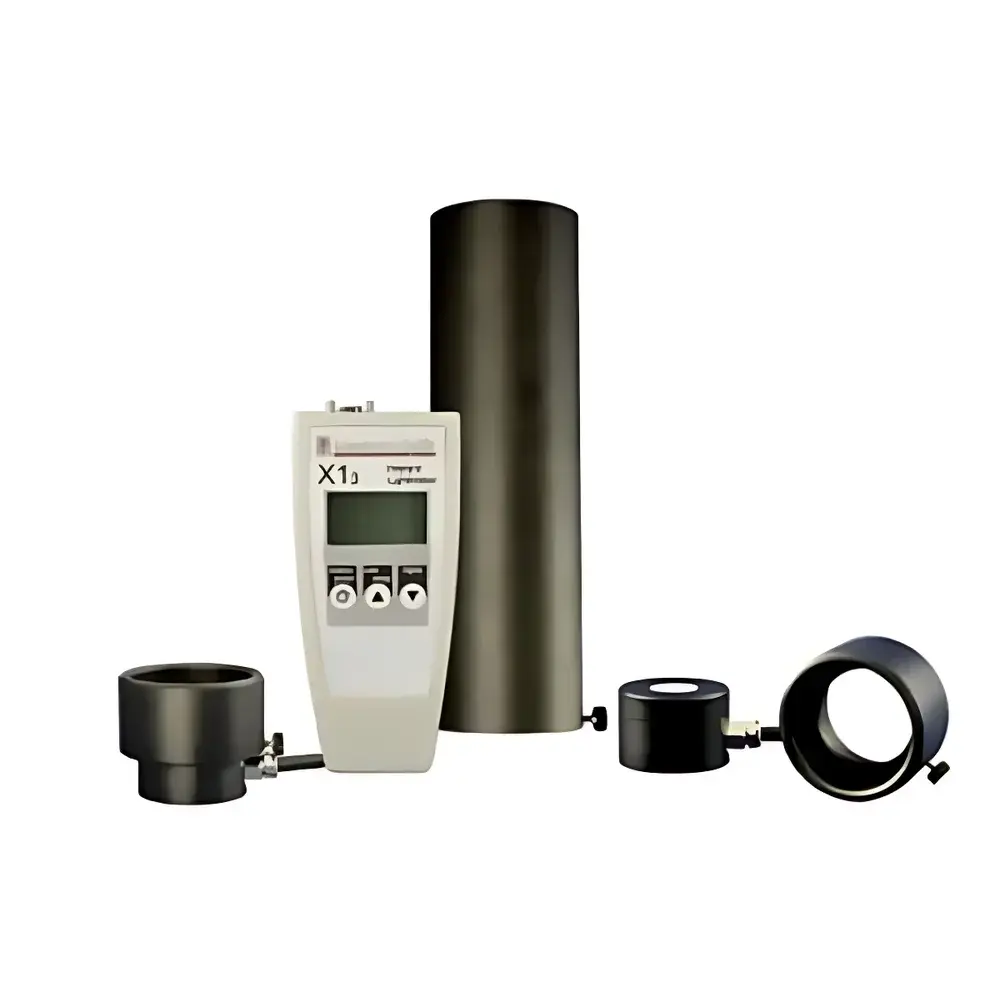
Gigahertz Optik X1-3 UV and Blue Light Hazard Radiometer
| Brand | Gigahertz Optik |
|---|---|
| Origin | Germany |
| Model | X1-3 |
| Detector Compatibility | XD-45-HB (Blue Light Hazard), XD-45-HUV (UV Hazard) |
| Display | 97×32-pixel LCD, 4-line alphanumeric with LED backlight |
| Dynamic Range | 0.1 pA – 200 µA (4-channel amplifier) |
| Resolution | 0.1 pA |
| Power | 2×AA batteries (≈250 h operation, no backlight) or USB bus power |
| Operating Temperature | 5–40 °C |
| Storage Temperature | −10–50 °C |
| Weight | XD-45-HUV detector: 200 g |
| FOV adapter | 50 g |
| Compliance | IEC 62471:2006, EN 62471:2008, IEC TR 62778:2014, EN 14255-1, 2006/25/EC |
Overview
The Gigahertz Optik X1-3 UV and Blue Light Hazard Radiometer is a handheld, field-deployable instrument engineered for quantitative photobiological hazard assessment in accordance with internationally recognized safety standards. It operates on the principle of spectrally weighted radiometry—applying standardized spectral weighting functions (e.g., S(λ) for UV hazard per IEC 62471, B(λ) for blue light hazard per IEC TR 62778) to measured spectral irradiance data—to compute effective radiant exposure values (e.g., E_eff in W/m² for UV, L_B in W/sr·m² for blue light). Unlike laboratory-grade double-monochromator spectroradiometers—which offer high spectral resolution but suffer from limited portability, complexity, and cost—the X1-3 delivers traceable, standards-compliant hazard evaluation using calibrated broadband detectors with multi-cell sensor architecture. Its design targets real-world use cases where rapid, repeatable, and metrologically sound assessments are required at the point of installation: lighting product development labs, occupational safety audits, LED manufacturing QA lines, and workplace lighting validation.
Key Features
- Compact, ergonomic handheld display unit with integrated four-channel low-noise amplifier electronics optimized for multi-sensor detectors
- High-resolution current measurement capability (0.1 pA minimum detectable signal) across six decades of dynamic range (0.1 pA – 200 µA)
- Automatic gain ranging and real-time offset correction ensure stability under varying ambient conditions and detector loading
- Backlit 97×32-pixel graphical LCD with 4-line × 14-character alphanumeric display; configurable LED backlight for low-light environments
- Non-volatile EEPROM storage for user-defined calibration coefficients, measurement modes, and system settings
- Dual-detector support: XD-45-HB for blue light hazard (photobiological retinal injury risk, 300–700 nm, B(λ)-weighted) and XD-45-HUV for ultraviolet hazard (erythema and photokeratitis risk, 200–400 nm, S(λ)-weighted)
- USB interface enables firmware updates, data export (CSV-compatible), and host-controlled operation via optional PC software
- Extended battery life: up to 250 hours on two AA alkaline cells (display backlight disabled); also operable via USB bus power for continuous benchtop use
Sample Compatibility & Compliance
The X1-3 is validated for use with artificial optical radiation sources—including LED lamps, OLED displays, fluorescent tubes, metal halide lamps, and UV-C disinfection systems—as well as natural daylight when equipped with appropriate cosine-corrected diffusers and field-of-view limiters. It meets the metrological requirements specified in IEC 62471:2006 / EN 62471:2008 for lamp and lamp system safety classification (Exempt, Risk Group 1–3), and supports hazard evaluation per IEC TR 62778:2014 for blue light emission characterization. For occupational exposure assessment, it aligns with the action levels and exposure limit values (ELVs) defined in Directive 2006/25/EC and its harmonized standard EN 14255-1. All detector heads undergo individual factory calibration against NIST-traceable reference standards, and calibration certificates include uncertainty budgets compliant with ISO/IEC 17025 requirements. The instrument’s mechanical design and electrical shielding satisfy EMC directive 2014/30/EU and low-voltage directive 2014/35/EU.
Software & Data Management
While the X1-3 operates autonomously with intuitive front-panel menu navigation, its USB interface enables integration into structured quality management workflows. Optional PC software provides remote configuration, real-time data streaming, batch calibration file import/export, and automated report generation compliant with GLP and GMP documentation practices. Measurement data—including timestamp, detector ID, weighting function applied, raw and weighted signal values, and pass/fail status relative to regulatory thresholds—is stored internally with time-stamped metadata. Exported datasets retain full traceability: each record includes detector serial number, calibration date, and applicable standard identifier (e.g., “IEC62471_RG2”). Audit trails are preserved in non-erasable memory, supporting FDA 21 CFR Part 11 compliance when deployed in regulated environments requiring electronic records and signatures.
Applications
- Lamp and luminaire manufacturers performing RG classification per IEC 62471 during R&D and pre-market conformity testing
- Occupational health and safety officers conducting workplace lighting surveys to verify compliance with EU Directive 2006/25/EC ELVs
- LED display module developers assessing blue light hazard potential of new backlight architectures or micro-LED arrays
- Medical device and dental curing light producers validating photobiological safety per ISO 15004-2 and IEC 60601-2-57
- University and government research laboratories performing comparative photobiological risk studies across spectral source families
- Third-party test labs offering accredited photobiological safety services (ISO/IEC 17025 scope extension possible with documented uncertainty analysis)
FAQ
What standards does the X1-3 support for blue light hazard assessment?
The X1-3 implements the B(λ) spectral weighting function defined in IEC TR 62778:2014 and aligns with the measurement methodology described in CIE S 026/E:2019 for blue light hazard evaluation.
Can the X1-3 measure both UV and blue light hazards simultaneously?
No—measurements require sequential detector attachment: XD-45-HUV for UV hazard (200–400 nm) and XD-45-HB for blue light hazard (300–700 nm). Each detector is independently calibrated and optimized for its designated spectral band and weighting function.
Is the X1-3 suitable for outdoor daylight measurements?
Yes, when used with the optional cosine corrector and FOV limiter accessories, the X1-3 meets the angular response requirements of IEC 62471 for broadband hazard assessment under natural illumination conditions.
Does the instrument provide uncertainty estimates for reported hazard values?
Yes—calibration certificates list expanded uncertainties (k=2) for each detector at reference wavelengths and weighting integrals. Total measurement uncertainty for hazard quantities is derived following the GUM (JCGM 100:2008) framework and includes contributions from detector responsivity, amplifier linearity, angular response, and spectral mismatch.
How frequently should the X1-3 be recalibrated?
Gigahertz Optik recommends annual recalibration under normal use conditions; however, recalibration intervals may be extended based on internal verification protocols, usage frequency, and environmental exposure—provided documented evidence of continued metrological performance is maintained.





