
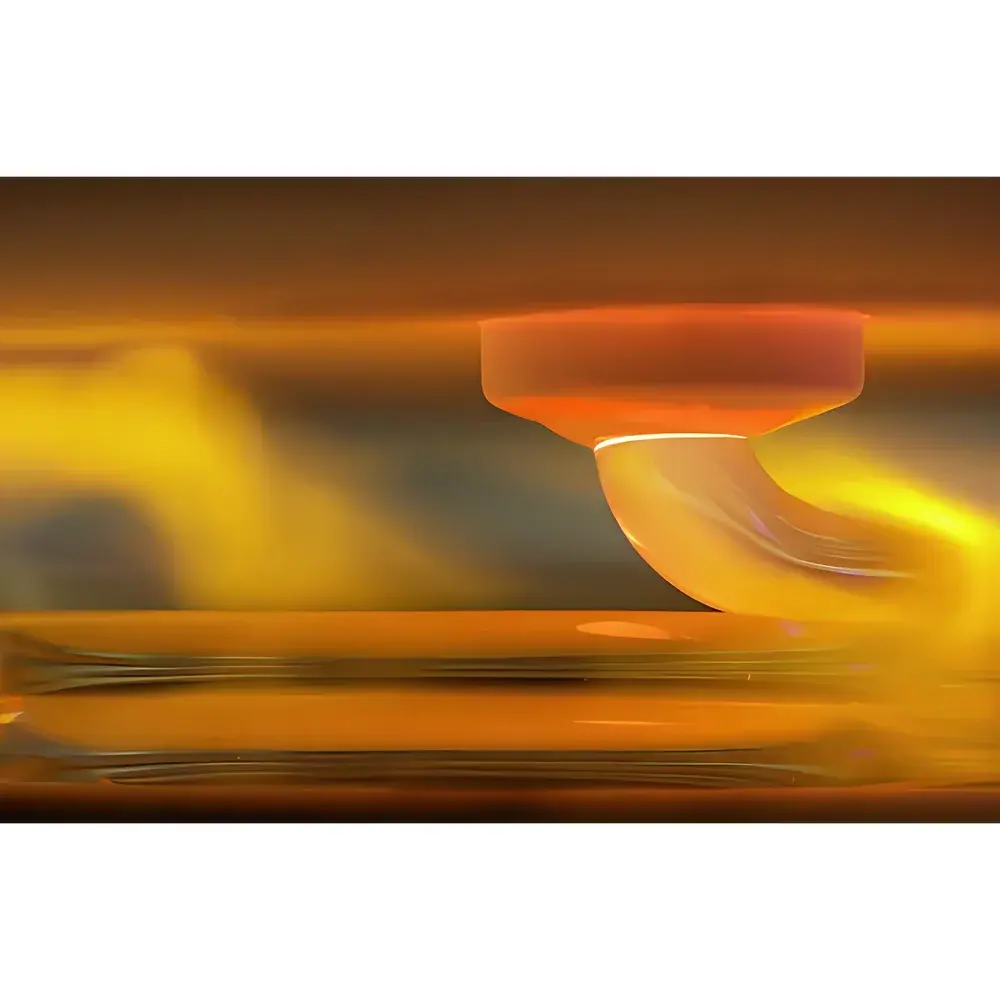
GlassPrint by Yi Xin Technology Desktop Glass 3D Printer
| Brand | Yi Xin Technology |
|---|---|
| Origin | Beijing, China |
| Manufacturer Type | Authorized Distributor |
| Country of Origin | China |
| Model | GlassPrint |
| Max Build Volume | 200 × 200 × 300 mm |
| Printable Material | Fused Silica & Soda-Lime Glass Feedstock (Pre-processed Glass Powder + Binder System) |
| Operating Principle | Extrusion-based Viscous Sintering with In-situ Thermal Consolidation |
Overview
The GlassPrint by Yi Xin Technology is a benchtop additive manufacturing system engineered specifically for the layer-by-layer fabrication of functional glass components via extrusion-based viscous sintering. Unlike conventional polymer or metal 3D printers, this system integrates precision metering, controlled thermal ramping (up to 1200 °C), and programmable dwell profiles to enable direct printing of green-body glass structures followed by debinding and high-temperature sintering in a separate furnace. The process leverages a proprietary glass powder–polymer binder composite feedstock, extruded through a heated nozzle under inert atmosphere conditions to maintain compositional fidelity and minimize thermal degradation. Designed for research laboratories and advanced prototyping facilities, the GlassPrint bridges the gap between digital design and high-performance oxide ceramics—delivering geometric freedom unattainable through traditional glassworking methods such as blowing, casting, or machining.
Key Features
- Integrated dual-zone thermal management: independent heating control for extrusion head (150–300 °C) and build chamber (ambient to 120 °C), ensuring optimal rheology during deposition and minimizing warpage.
- High-resolution XYZ motion system with ±5 µm repeatability and closed-loop stepper control, enabling sub-200 µm feature resolution in green-state geometry.
- Modular feedstock handling: quick-swap cartridge system compatible with standardized glass formulations—including borosilicate, fused silica, and low-thermal-expansion aluminoborosilicate powders (D₅₀ = 5–15 µm).
- Open-parameter G-code interface supporting custom thermal profiles, layer-specific extrusion rates, and multi-material co-deposition sequences (with optional dual-nozzle upgrade).
- CE-compliant safety architecture including gas-tight enclosure, O₂ sensor feedback loop, and emergency thermal cutoff at 1250 °C.
Sample Compatibility & Compliance
The GlassPrint accepts pre-formulated glass-binder composites supplied by Yi Xin Technology or qualified third-party vendors meeting ISO 13320 particle size distribution specifications and ASTM C162–22 binder compatibility criteria. Printed green parts require post-processing in a controlled-atmosphere sintering furnace (not included) per manufacturer-recommended schedules: typical debinding at 400–600 °C (N₂/H₂), followed by densification at 1050–1180 °C (air or dry N₂). Final parts exhibit bulk density ≥98% theoretical, coefficient of thermal expansion (CTE) traceable to raw material datasheets, and surface roughness (Ra) < 2.5 µm after annealing. The system complies with IEC 61000-6-2 (EMC immunity) and IEC 61000-6-4 (EMC emission) standards; full GLP documentation packages—including calibration logs, maintenance records, and audit-ready operational qualification (OQ) protocols—are available upon request.
Software & Data Management
Control is managed via GlassStudio™ v3.2—a Windows-based slicing and machine interface platform supporting STL, 3MF, and STEP import. The software includes physics-informed print simulation modules that predict thermal stress accumulation and estimate shrinkage anisotropy based on input glass composition and layer orientation. All print jobs generate timestamped binary logs containing nozzle temperature history, extrusion pressure traces, axis position data, and ambient O₂ concentration. Export formats include CSV (for statistical process control), HDF5 (for ML training datasets), and PDF reports compliant with FDA 21 CFR Part 11 requirements when paired with optional electronic signature module and networked domain authentication.
Applications
- Optical component prototyping: freeform lenses, microfluidic waveguides, and graded-index substrates requiring precise refractive index control.
- Aerospace thermal management: lightweight, high-temperature-resistant heat exchanger manifolds and sensor housings for turbine environments.
- Bioactive glass scaffolds: patient-specific cranial implants with interconnected porosity (300–600 µm) validated per ISO 13779-2 for in vitro apatite formation.
- Architectural scale modeling: structurally graded façade elements and load-bearing joints fabricated from recycled container glass feedstocks.
- Fundamental materials research: in-situ monitoring of crystallization kinetics during sintering using synchrotron XRD-compatible sample holders.
FAQ
Does the GlassPrint perform full sintering onboard?
No. It prints only the bound green body. Full densification requires a separate high-temperature furnace with controlled ramp/soak profiles.
Can I use my own glass powder?
Yes—if it meets specified particle size distribution, flowability (Hausner ratio < 1.4), and binder compatibility thresholds verified via rheological screening test (provided in user manual Annex B).
Is the system compatible with cleanroom Class 1000 environments?
The base configuration meets ISO 14644-1 Class 8; optional HEPA-filtered recirculation kit upgrades it to Class 7. Full Class 6 integration requires site-specific HVAC coordination.
What post-processing equipment is required?
A programmable muffle furnace (min. 1200 °C), vacuum-assisted debinding oven (optional), and precision metrology tools (e.g., CMM or laser profilometer) for final dimensional validation.
How is calibration maintained across extended operation?
The system performs automated Z-height verification before each job using capacitive probe feedback; annual calibration services include nozzle wear measurement, thermocouple drift assessment, and extrusion rate linearity validation per NIST-traceable standards.



