
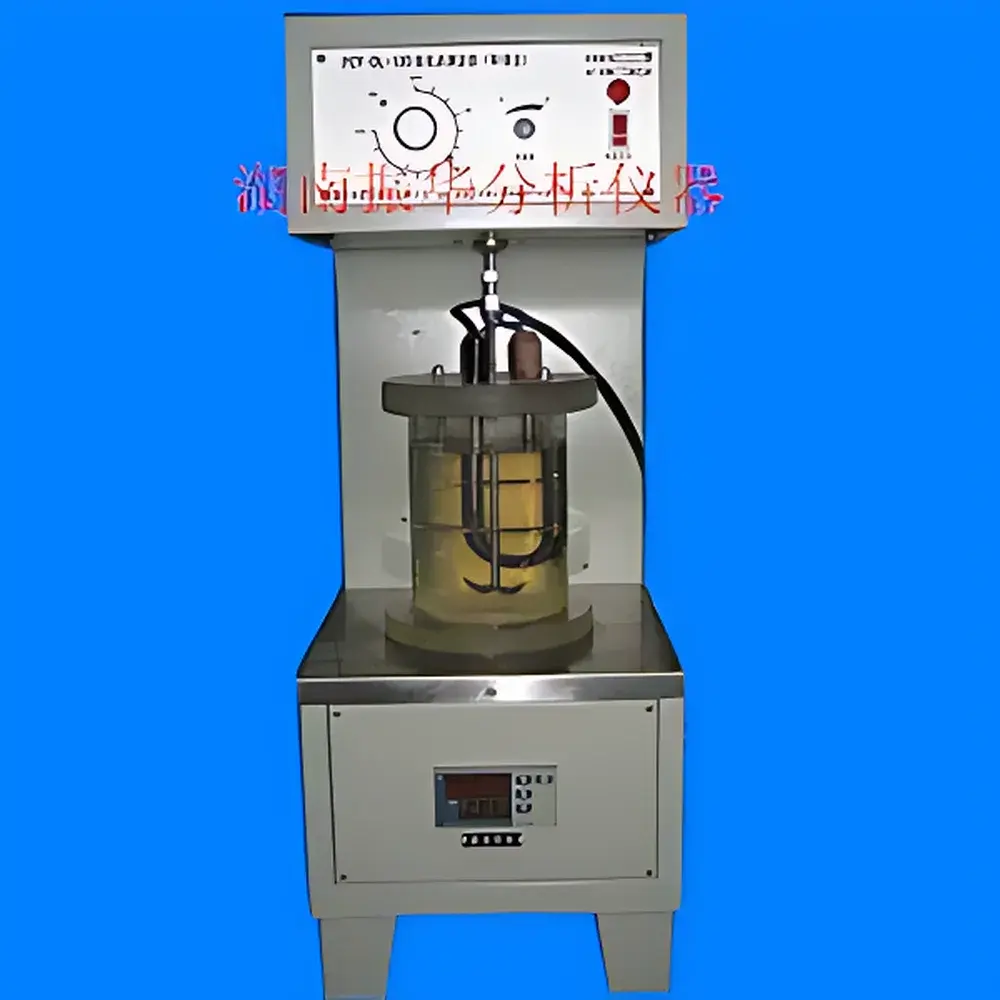
Global Method Softening Point Tester PCY-DL-100
| Origin | Hunan, China |
|---|---|
| Manufacturer Type | Distributor |
| Origin Category | Domestic (China-made) |
| Model | PCY-DL-100 |
| Pricing | Upon Request |
| Test Temperature Range | Up to 80 °C (extendable to 200 °C with alternative heat transfer medium) |
| Heating Method | Electromagnetic heating (2 kW) |
| Stirring | Adjustable-speed electromagnetic stirring |
| Sample Capacity | Dual-sample simultaneous testing |
| Standards Compliance | GB 12007.6–1989, ISO 4625:1980, ASTM D36 / E28, IP 58, DIN 52011, NF T 66-008, EN 1427 |
Overview
The Global Method Softening Point Tester PCY-DL-100 is a precision-engineered thermal analysis instrument designed for the standardized determination of softening point in thermoplastic materials using the classical ring-and-ball method (commonly referred to as the “global method” in international metrological contexts). It operates on the principle of controlled thermal ramping under defined load conditions: a steel ball rests on a sample disc seated in a brass ring; as temperature increases, the softened material yields under gravitational load, and the temperature at which the ball descends a specified distance (typically 25.4 mm) through the ring defines the softening point. This gravimetric–thermal transition measurement is fundamental to quality control and specification compliance for bituminous binders, coal tars, rosin esters, synthetic resins, and polymer-modified asphalt formulations.
Key Features
- Dual independent test stations enabling concurrent analysis of two specimens—enhancing laboratory throughput without compromising repeatability or inter-test comparability.
- Electromagnetic heating system (2 kW nominal power) delivering rapid thermal response, exceptional temperature uniformity across the bath volume, and minimized thermal lag—critical for adherence to strict ramp-rate requirements in ASTM D36 and EN 1427.
- Adjustable electromagnetic stirring mechanism ensuring homogeneous heat distribution throughout the heat transfer medium (e.g., water, glycerol, or silicone oil), eliminating localized hot spots and supporting reproducible thermal gradients per ISO 4625:1980 Clause 6.3.
- Temperature control accuracy ±0.1 °C within the standard operating range (5–80 °C); extended-range operation up to 200 °C achievable using high-boiling-point media, validated per ASTM E28 Annex A1.
- Robust stainless-steel and brass construction compliant with long-term exposure to aggressive organic media; corrosion-resistant bath housing and calibrated ring-and-ball assemblies traceable to national metrology institutes.
Sample Compatibility & Compliance
The PCY-DL-100 accommodates a broad spectrum of thermoplastic and semi-crystalline organic matrices, including penetration-grade and polymer-modified bitumens, coal-tar pitch, colophony derivatives, epoxy resin prepolymers, and thermoplastic road-marking materials. Its mechanical and thermal architecture conforms rigorously to the dimensional, procedural, and instrumentation requirements stipulated in multiple internationally harmonized standards: ASTM D36 (Standard Test Method for Softening Point of Bitumen [Ring-and-Ball Method]), ASTM E28 (Standard Specification for Ring-and-Ball Apparatus), ISO 4625:1980, EN 1427 (Bitumen and Bituminous Binders — Determination of Softening Point — Ring and Ball Method), DIN 52011, IP 58, and GB/T 12007.6–1989. All critical components—including ring dimensions (15.9 mm inner diameter, 6.4 mm height), ball mass (3.5 g ± 0.05 g), and support frame geometry—are manufactured to tolerances aligned with these specifications.
Software & Data Management
While the base configuration operates via analog temperature monitoring and manual endpoint detection, optional digital upgrade modules integrate with PC-based acquisition software supporting real-time temperature logging, automatic softening point calculation (per ASTM D36 Section 8.2), and export of timestamped CSV datasets. Audit-trail functionality—including operator ID, calibration history, ambient condition metadata, and raw thermal curves—is configurable to meet GLP and GMP documentation requirements. Data files comply with 21 CFR Part 11 readiness when deployed with electronic signature-enabled platforms and secure user-role management.
Applications
- Quality assurance laboratories in asphalt production facilities verifying conformance to EN 13108 or AASHTO M226 specifications.
- R&D departments evaluating thermal stability of bio-bitumen alternatives and crumb rubber–modified binders.
- Third-party testing agencies performing accredited softening point determinations for CE marking or DOT certification submissions.
- Petrochemical refineries assessing consistency of distillation residues and heavy-end fractions used in roofing membranes or industrial coatings.
- Academic research groups studying structure–property relationships in thermoreversible polymer networks and supramolecular gels.
FAQ
What heat transfer media are compatible with the PCY-DL-100 for elevated-temperature testing?
Water (up to 80 °C), glycerol (up to 150 °C), and silicone oil (up to 200 °C) are validated media; viscosity and thermal stability must be verified per ASTM D36 Annex A1 prior to use.
Is calibration verification traceable to national standards?
Yes—certified reference thermometers (e.g., platinum resistance thermometers calibrated per ISO/IEC 17025) and NIST-traceable ring-and-ball sets are available as optional accessories.
Can the instrument be integrated into a LIMS environment?
Via optional RS-232/USB interface and vendor-provided API, raw temperature/time data streams can be directed to enterprise LIMS platforms supporting ASTM E1384 or HL7-compliant ingestion protocols.
Does the dual-station design affect thermal cross-talk between samples?
No—the independently heated and stirred bath zones maintain thermal isolation; inter-channel deviation remains < ±0.2 °C under steady-state conditions per internal validation report PCY-DL-100-V2.1.
Are replacement rings and balls supplied with certified dimensional verification?
Yes—each accessory kit includes a certificate of conformance listing measured inner diameter, height, sphericity, and mass, aligned with ISO 4625:1980 Annex B requirements.





