
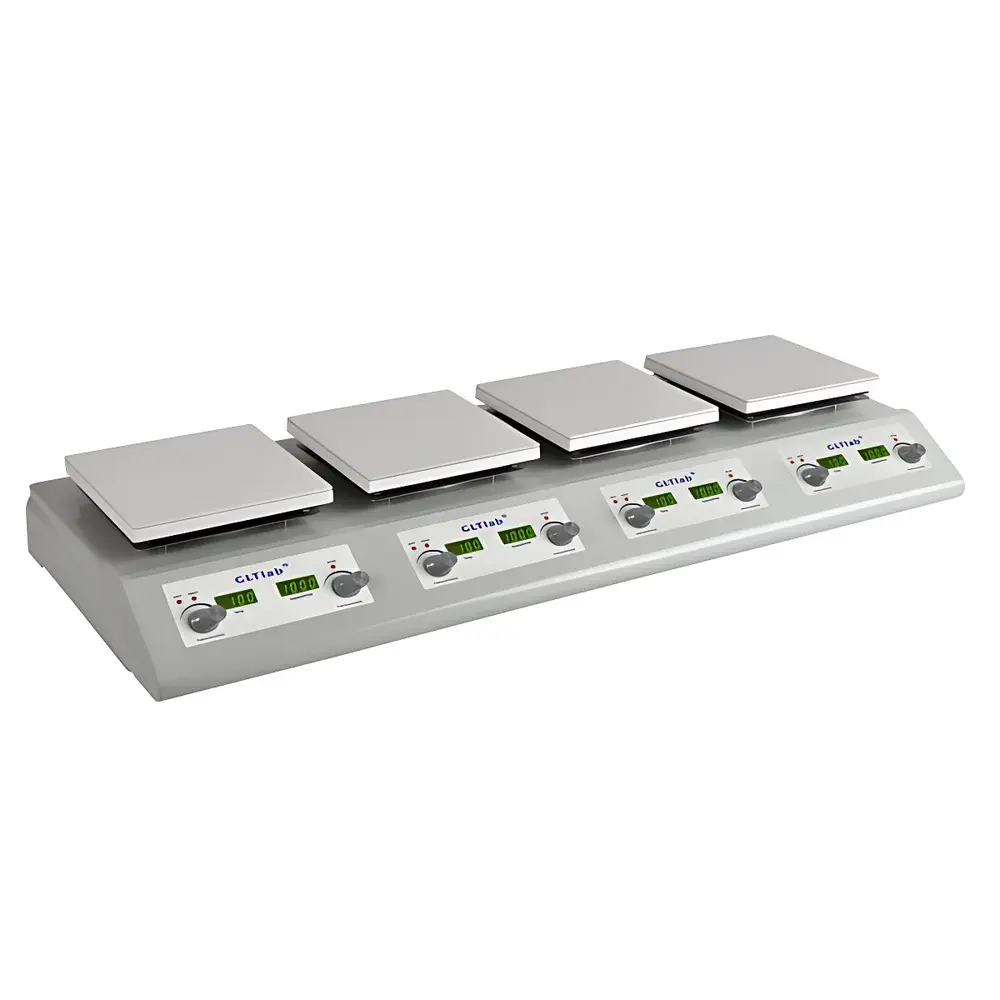
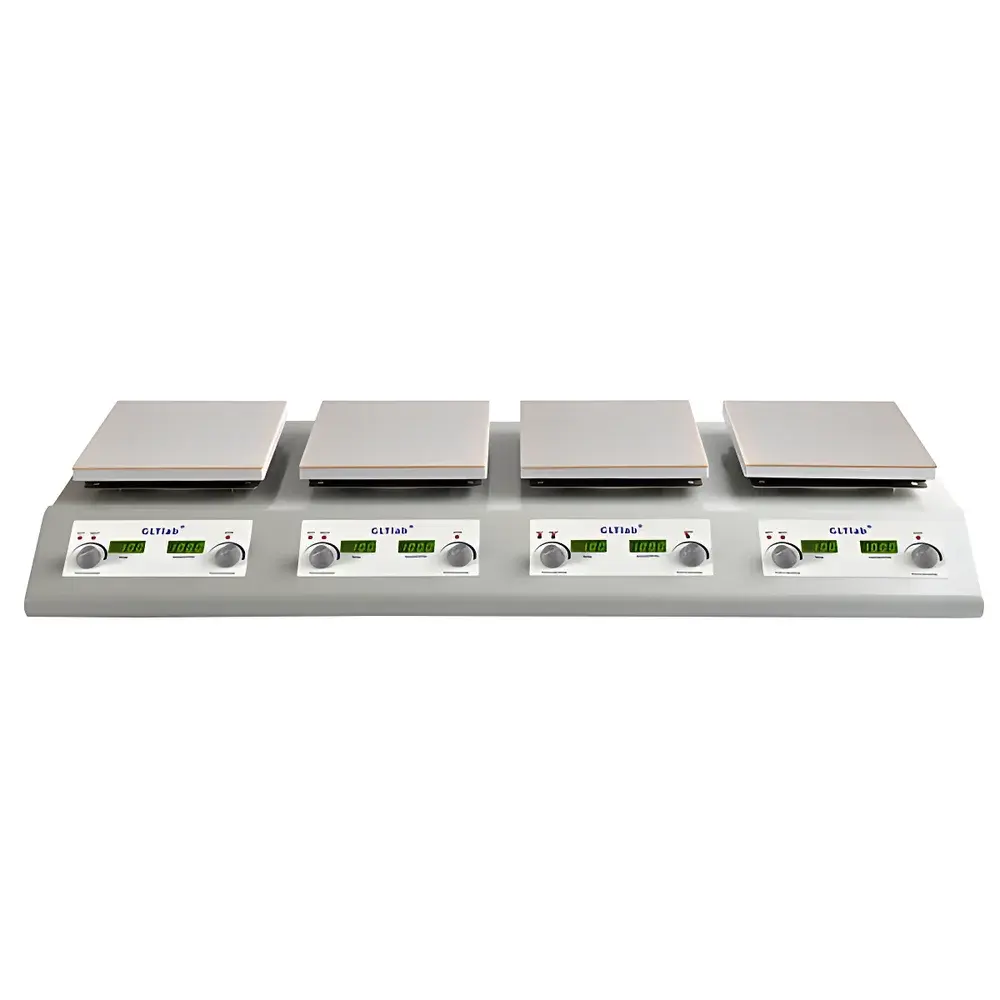
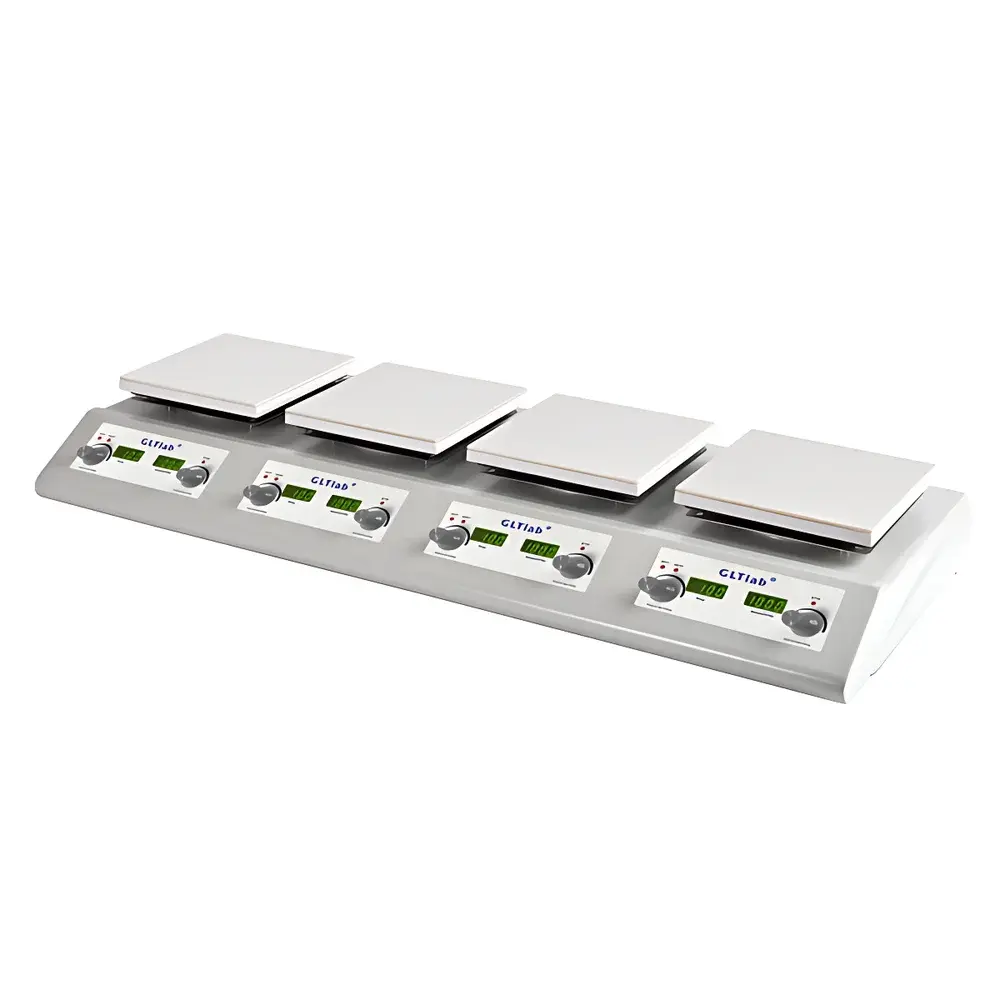
GLTlab SHA-4C Four-Position Ceramic-Plate Magnetic Hotplate Stirrer
| Brand | GLTlab |
|---|---|
| Origin | Guangdong, China |
| Manufacturer Type | Direct Manufacturer |
| Instrument Type | Magnetic Hotplate Stirrer |
| Max Stirring Volume | 10 L × 4 positions |
| Speed Range | 150–1500 rpm |
| Solution Temperature Range | 35–200 °C |
| Plate Surface Temperature Range | 35–550 °C |
| Temperature Setting Resolution (Solution) | 0.1 °C |
| Temperature Stability | ±1 °C |
| PT1000 Sensor Accuracy | ±0.5 °C |
| External Probe Calibration | Yes |
| Panel Material | Ceramic |
| Panel Size per Position | 178 × 178 mm (7") |
| Power | 4000 W |
| Voltage | 200–240 V AC, 50/60 Hz |
| IP Rating | IP21 |
| Operating Ambient | 5–60 °C, ≤80% RH |
Overview
The GLTlab SHA-4C is a precision-engineered four-position magnetic hotplate stirrer designed for parallel thermal and mechanical conditioning of multiple samples in research laboratories, quality control environments, and industrial R&D settings. It operates on the principle of contactless magnetic coupling—where a rotating magnetic field generated beneath a thermally stable ceramic plate induces rotation of PTFE-coated magnetic stir bars immersed in vessels. Simultaneous independent heating and stirring across four stations enables high-throughput experimental workflows without cross-contamination or positional bias. Unlike single-station units, the SHA-4C integrates uniform heat distribution across all four ceramic zones, each equipped with embedded Pt1000 resistance temperature detectors (RTDs) for closed-loop feedback control. Its operational envelope supports aqueous solutions up to 200 °C and dry surface heating up to 550 °C—making it suitable for solvent evaporation, crystallization studies, polymer dissolution, and catalyst activation protocols requiring extended thermal exposure.
Key Features
- Four independently controllable stirring/heating stations with identical thermal and rotational performance specifications
- High-density alumina-ceramic top plate (178 × 178 mm per position) offering exceptional thermal uniformity, chemical inertness, and mechanical durability against thermal shock and acid/base exposure
- Precise digital temperature control with 0.1 °C solution-set resolution and ±0.5 °C accuracy via calibrated Pt1000 external probe input
- Stirring speed adjustable from 150 to 1500 rpm with soft-start ramping to prevent splashing and ensure reproducible mixing kinetics
- LED display interface with intuitive menu navigation, real-time dual-parameter readout (setpoint & actual), and over-temperature safety cutoff
- Robust 4000 W total power architecture delivering rapid thermal response and stable plateau maintenance under full-load conditions (four 10 L vessels)
- IP21-rated enclosure with thermal insulation and passive cooling design ensuring safe operation in ambient lab environments (5–60 °C, ≤80% RH)
Sample Compatibility & Compliance
The SHA-4C accommodates standard laboratory glassware including round-bottom flasks (50 mL to 10 L), beakers, and jacketed reactors. Vessel compatibility extends to borosilicate glass, stainless steel, and PTFE-lined containers—provided magnetic stir bar geometry and size are matched to volume and viscosity requirements. All thermal and rotational parameters comply with IEC 61010-1:2010 for electrical safety in laboratory equipment. The instrument supports traceable calibration workflows through its external Pt1000 probe port and onboard calibration offset adjustment—enabling alignment with ISO/IEC 17025-compliant metrology practices. While not inherently 21 CFR Part 11 compliant, audit-ready operation is achievable when integrated into validated SOPs with manual logbook documentation or third-party electronic lab notebook (ELN) synchronization.
Software & Data Management
The SHA-4C operates as a standalone analog-digital hybrid instrument with no embedded firmware-based data logging. However, its analog output (0–10 V or 4–20 mA optional module) permits integration with programmable logic controllers (PLCs), SCADA systems, or PC-based DAQ platforms such as LabVIEW or MATLAB for time-series acquisition of temperature and speed parameters. Users may configure external data capture at user-defined intervals (e.g., 1 Hz sampling) to generate CSV-formatted logs suitable for statistical process control (SPC) analysis or regulatory submission packages. The front-panel LED interface retains last-set values after power cycling, supporting continuity in multi-shift operations without reconfiguration overhead.
Applications
- Parallel synthesis of metal-organic frameworks (MOFs) requiring identical thermal ramp profiles across reaction vessels
- Accelerated stability testing of pharmaceutical formulations under controlled agitation and elevated temperature (ICH Q1A)
- Dissolution rate profiling of solid dosage forms per USP <711> using synchronized multi-vessel setups
- Preparation of homogeneous nanoparticle dispersions prior to DLS or TEM characterization
- Enzyme kinetic assays where substrate mixing must occur concurrently with precise thermal equilibration
- Calibration verification of reference thermometers and RTD probes using standardized oil baths
FAQ
Can the SHA-4C maintain temperature uniformity across all four positions simultaneously?
Yes—the ceramic plate is engineered with distributed heater traces and individual Pt1000 sensing per zone, achieving ≤±1.0 °C inter-position deviation at steady state (tested with 2 L water loads at 85 °C).
Is external temperature feedback mandatory for accurate solution temperature control?
For solution-specific accuracy (±0.5 °C), insertion of the supplied Pt1000 probe into the vessel is required; surface-mode operation yields ±2.0 °C uncertainty due to thermal lag and vessel wall effects.
What stir bar dimensions are recommended for optimal performance at maximum load (10 L)?
Elliptical stir bars measuring 60–80 mm in length with 12–15 mm diameter and PTFE encapsulation are validated for turbulent flow generation in tall-form vessels under 1500 rpm conditions.
Does the unit support continuous operation beyond 8 hours?
Yes—rated for indefinite duty cycle under nominal load (≤3.2 kW average draw); thermal management includes convection-cooled heatsinks and automatic fan modulation based on internal sensor readings.
Can the SHA-4C be integrated into a GLP-compliant laboratory information management system (LIMS)?
While lacking native network connectivity, analog outputs and deterministic response timing allow hardware-level interfacing with LIMS-compatible DAQ gateways that support audit-trail generation and user-access controls.



