
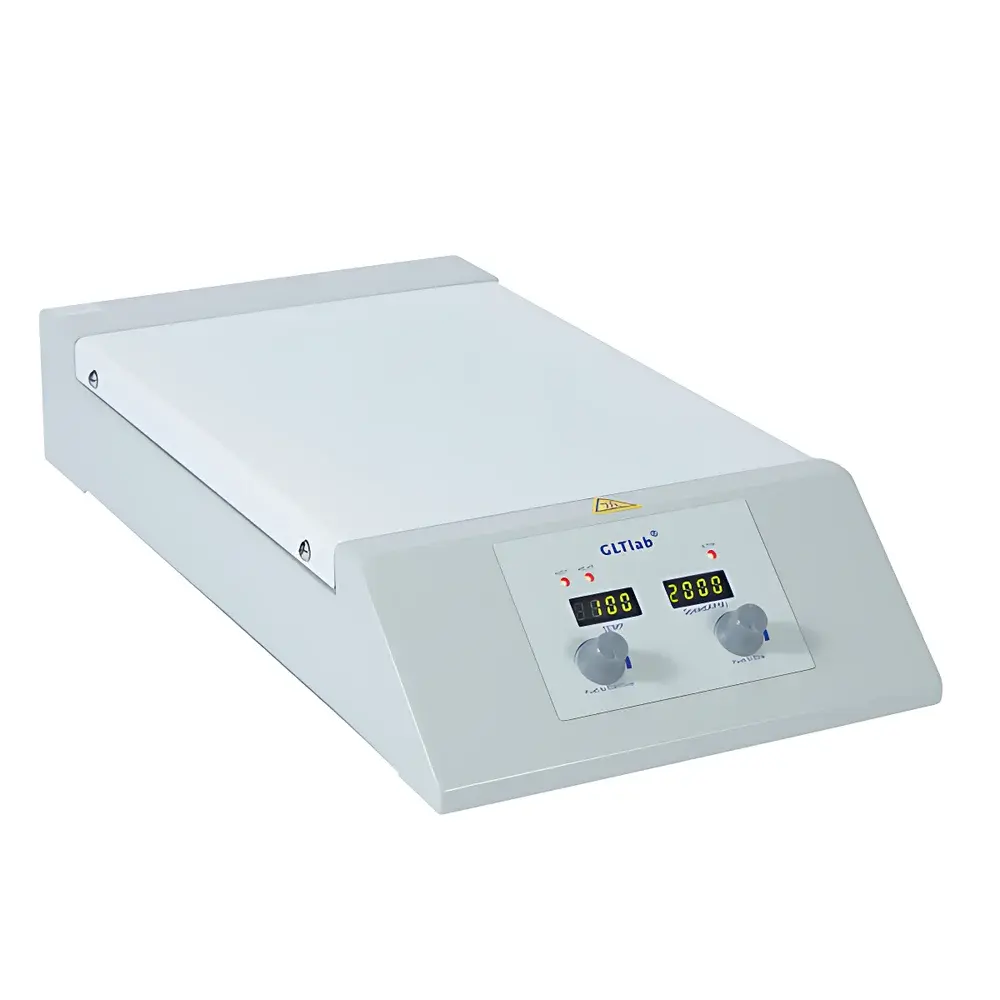
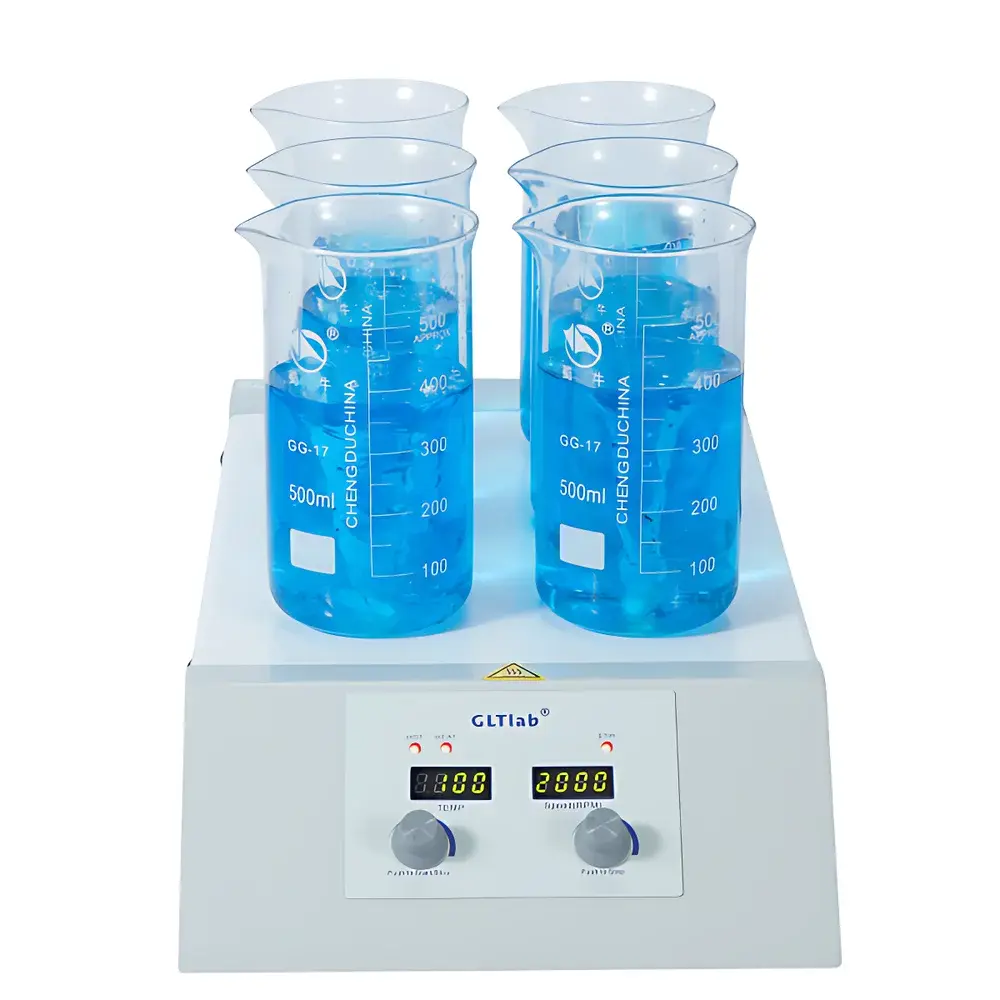
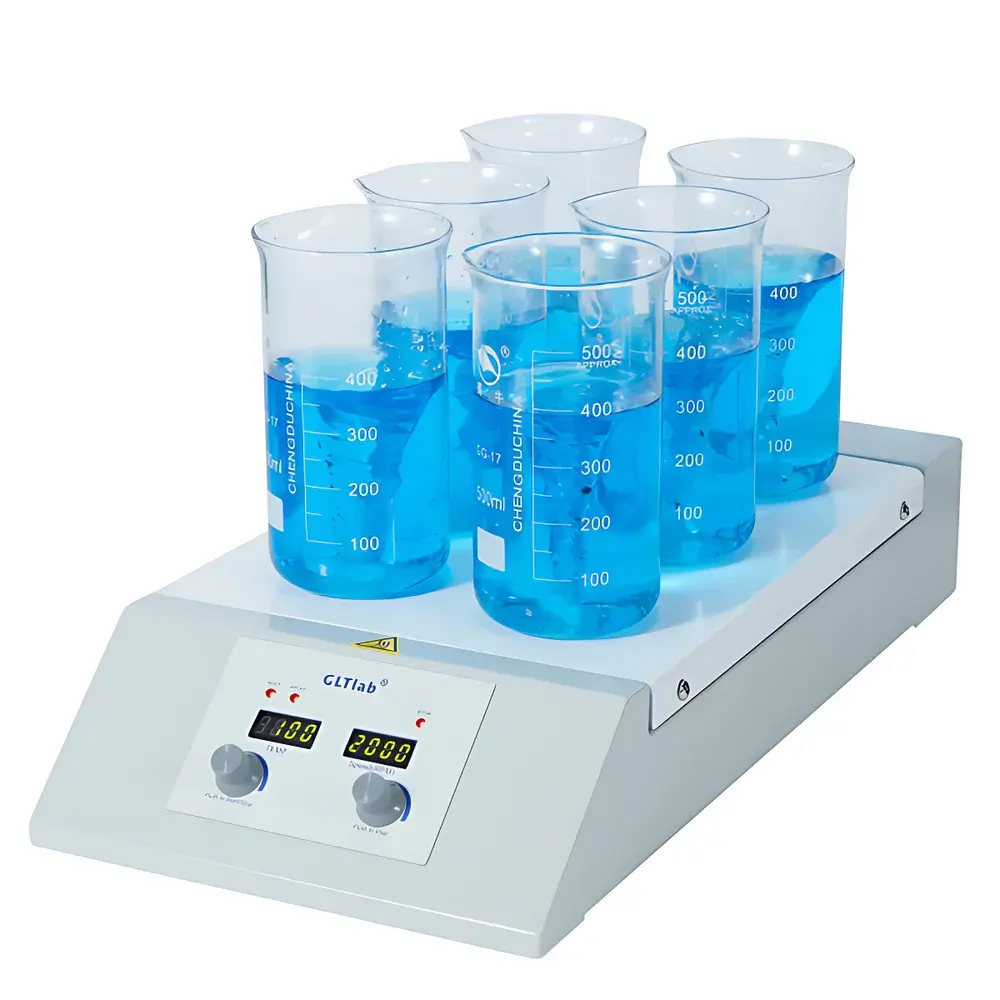
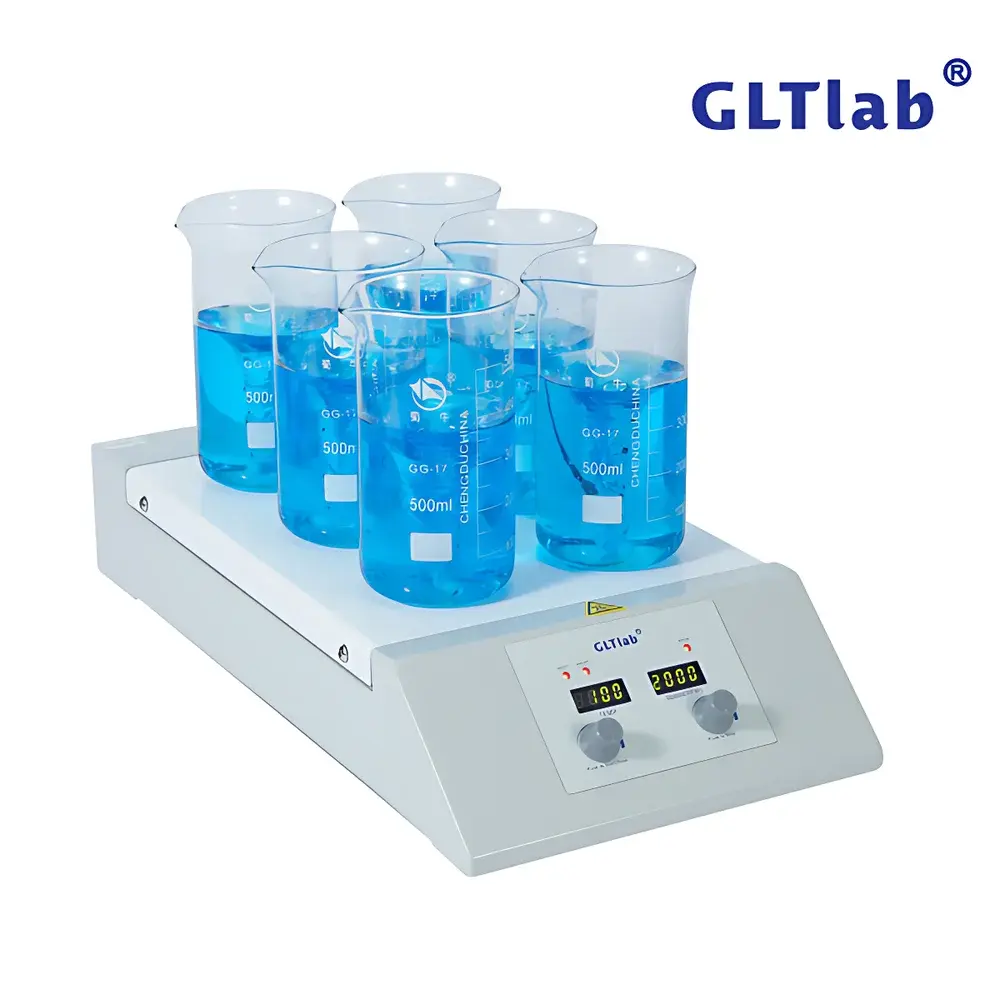
GLTLab SHA-6N Six-Position Programmable Hotplate Magnetic Stirrer
| Brand | GLTLab |
|---|---|
| Model | SHA-6N |
| Origin | Guangdong, China |
| Manufacturer Type | Direct Manufacturer |
| Instrument Type | Magnetic Stirrer |
| Max. Stirring Volume | 2 L × 6 positions |
| Speed Range | 150–2000 rpm |
| Temperature Control Range | Ambient to 120 °C |
| Heating Power | 300 W |
| Panel Material | Ceramic-coated Aluminum |
| Dimensions (L×W×H) | 445 × 245 × 84 mm |
| Weight | 5.8 kg |
| Operating Temperature | 5–40 °C |
| Operating Humidity | ≤80% RH |
| IP Rating | IP42 |
| Voltage | 110/115/230 VAC |
| Frequency | 50/60 Hz |
| Display | Dual LED (speed & temperature) |
| Stirrer Spacing | 100 mm |
| Stir Bar Length Compatibility | 25–35 mm |
| Heating Rate | ~5 °C/min |
| Chemical Resistance | Yes |
| Motor Type | Brushless DC Motor |
| Optional Integration | RS-485 or analog 0–10 V control interface |
Overview
The GLTLab SHA-6N is a six-position programmable hotplate magnetic stirrer engineered for high-throughput laboratory environments requiring simultaneous, independent thermal and mechanical control across multiple samples. Utilizing brushless DC motor technology, the SHA-6N delivers precise rotational actuation via magnetic coupling—eliminating mechanical wear, reducing electromagnetic interference, and ensuring long-term speed stability across all six stations. Each position operates with full parameter independence: individual speed setpoints (150–2000 rpm in 1-rpm increments) and temperature setpoints (ambient to 120 °C) are controlled via dual LED displays and digitally regulated PID algorithms. The unit employs resistive heating embedded beneath a chemically inert ceramic-coated aluminum surface, providing uniform thermal distribution and rapid heat-up kinetics (~5 °C/min average ramp rate). Designed for continuous operation under GLP-compliant workflows, the SHA-6N supports reproducible sample preparation in analytical chemistry, pharmaceutical formulation, polymer synthesis, and quality control laboratories where parallel processing of reagents, buffers, or reaction mixtures is routine.
Key Features
- Six fully independent stirring and heating zones with isolated PID control loops per position
- Brushless DC motors ensure zero maintenance, low acoustic noise (<45 dB(A)), and exceptional speed reproducibility (±1 rpm over 8-hour operation)
- Ceramic-coated aluminum top plate resists corrosion from organic solvents, acids, and bases—validated per ISO 9227 salt spray testing (72 h, no degradation)
- Dual LED display with real-time readout of both speed (rpm) and temperature (°C) for immediate operator verification
- Programmable ramp-hold profiles: users may define multi-step heating/stirring sequences stored in non-volatile memory
- Integrated thermal safety system including overtemperature cutoff (>125 °C), dry-run detection, and audible/visual alert on thermal fault
- Modular I/O architecture supporting optional RS-485 Modbus RTU or 0–10 V analog integration into LIMS or SCADA platforms
Sample Compatibility & Compliance
The SHA-6N accommodates standard laboratory glassware including 50–1000 mL beakers, Erlenmeyer flasks, and cylindrical vessels up to 2 L per station. Stir bar compatibility spans 25–35 mm lengths with diameters from 4–8 mm—optimized for viscosity ranges from 1 to 10,000 mPa·s (water to glycerol-based solutions). All electrical design complies with IEC 61010-1:2010 for laboratory equipment safety, EMC conformity per IEC 61326-1:2021, and RoHS 2015/863/EU material restrictions. The device meets essential requirements for use in ISO/IEC 17025-accredited testing labs and supports audit-ready documentation when operated under defined SOPs.
Software & Data Management
While the SHA-6N operates as a standalone instrument, its optional communication interface enables bidirectional data exchange. When integrated via RS-485, users can log timestamped speed/temperature values at user-defined intervals (1 s to 60 min), store up to 10,000 records locally, and export CSV-formatted datasets for traceability. Firmware supports configurable alarm thresholds and event-triggered logging (e.g., deviation >±2 °C or >±5 rpm for >30 s). Audit trail functionality—including operator ID tagging, parameter change history, and firmware version stamping—is available when deployed with compliant third-party laboratory software adhering to FDA 21 CFR Part 11 requirements.
Applications
- Parallel dissolution testing of solid dosage forms under USP conditions
- Buffer equilibration and pH adjustment across multi-well assay plates
- Catalyst dispersion and nanoparticle synthesis in sealed reactor vessels
- Standardization of calibration standards for ICP-OES and HPLC mobile phase preparation
- Accelerated stability studies requiring consistent thermal-mechanical stress across replicate vials
- Preparation of homogeneous emulsions and suspensions prior to rheological or particle size analysis
FAQ
Is the SHA-6N compatible with corrosive solvents such as concentrated HCl or THF?
Yes—the ceramic-coated aluminum surface exhibits resistance to short-term exposure (<2 h) to common organic solvents and dilute mineral acids; prolonged contact with strong oxidizers (e.g., aqua regia) is not recommended.
Can temperature and speed be logged externally without optional hardware?
No—real-time data export requires installation of the RS-485 or analog control module; front-panel display only shows instantaneous values.
What is the maximum allowable ambient humidity for continuous operation?
The unit is rated for operation at ≤80% relative humidity non-condensing, as verified per IEC 60068-2-30 testing protocols.
Does the SHA-6N support GLP-compliant electronic signatures?
The base unit does not include user authentication or digital signature capability; however, when interfaced with validated LIMS software meeting 21 CFR Part 11, full electronic record integrity can be achieved.
How is thermal uniformity validated across the six positions?
Factory calibration includes IR thermography mapping at 60 °C and 100 °C, confirming ±1.5 °C spatial uniformity across all active zones within 15 minutes of setpoint stabilization.



