

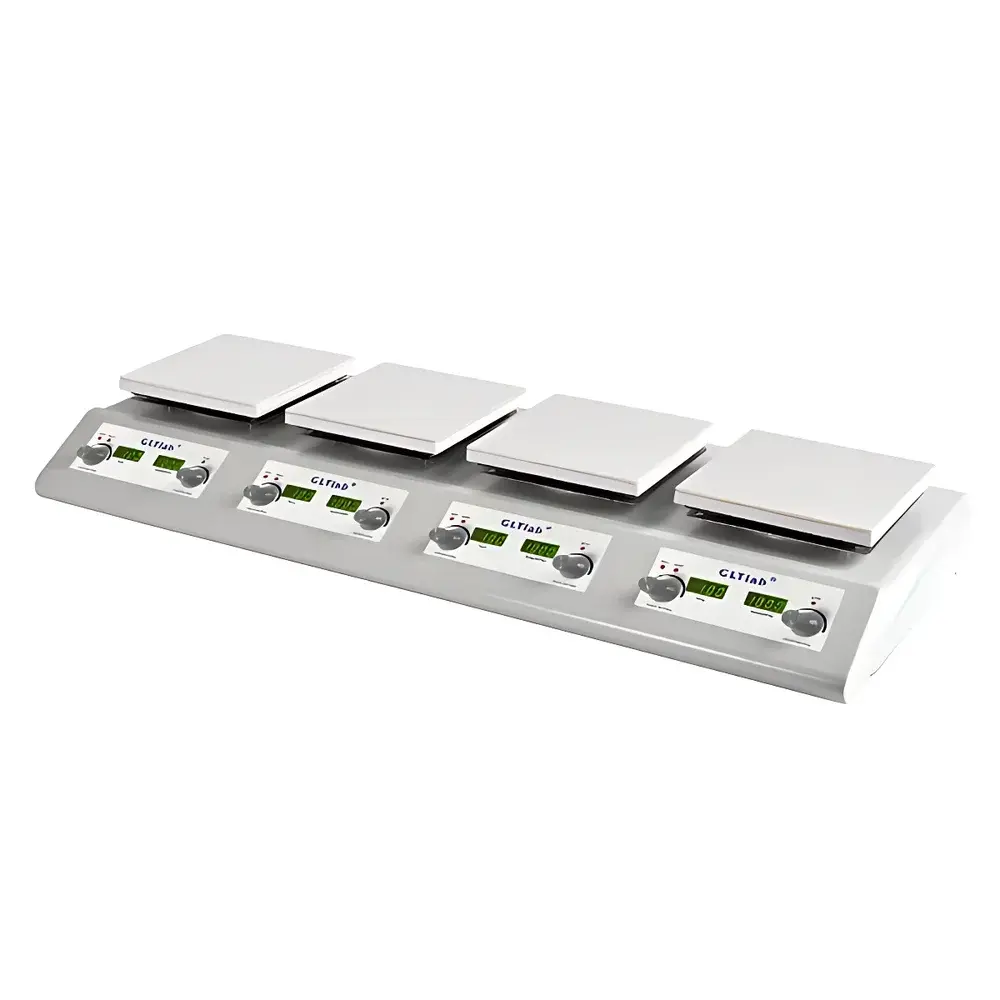
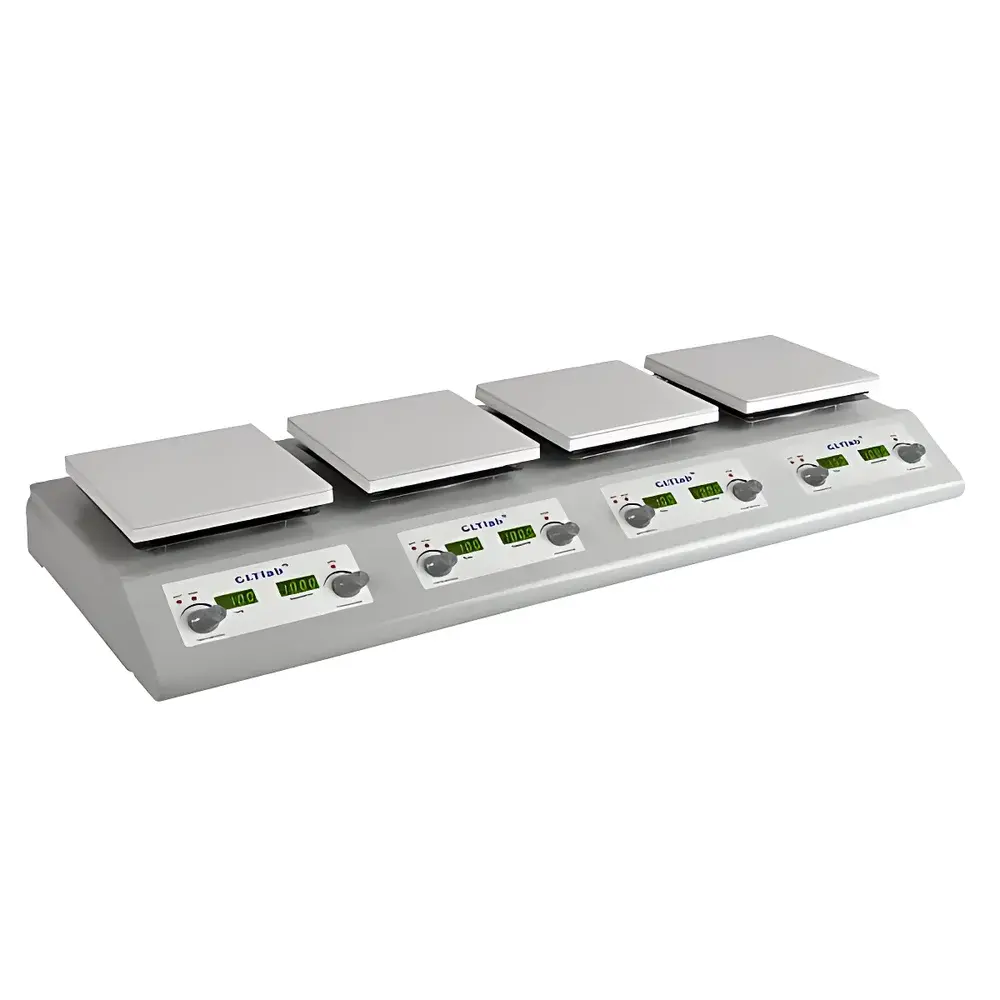
GLTLab SHC-4P Four-Position Ceramic-Plate Heated Magnetic Stirrer
| Brand | GLTLab |
|---|---|
| Origin | Guangdong, China |
| Manufacturer Type | Direct Manufacturer |
| Instrument Type | Heated Magnetic Stirrer |
| Number of Stirring Positions | 4 |
| Max Stirring Volume per Position | 10 L (H₂O) |
| Speed Range | 150–1500 rpm |
| Plate Surface Temperature Range | 35–550 °C |
| Solution Temperature Range | 35–200 °C (average) |
| Temperature Setting Resolution (Plate) | 1 °C |
| Temperature Setting Resolution (Solution, with PT1000 probe) | 0.1 °C |
| Temperature Stability | ±1 °C |
| PT1000 Control Accuracy | ±0.5 °C |
| External Probe Calibration Function | Yes |
| Display | LED |
| Plate Material | Ceramic-Coated Aluminum |
| Plate Dimensions | 160 × 160 mm (6.3 in × 6.3 in) |
| Overall Dimensions (W × D × H) | 760 × 290 × 100 mm |
| Operating Ambient | 5–40 °C, ≤80% RH |
| Protection Rating | IP21 |
| Power Supply | 200–240 V AC, 50/60 Hz |
| Rated Power | 3200 W |
Overview
The GLTLab SHC-4P is a four-position heated magnetic stirrer engineered for parallel sample processing in research laboratories, quality control environments, and industrial R&D settings. It integrates precise conductive heating via a high-emissivity ceramic-coated aluminum plate with independent magnetic stirring across four discrete zones—each capable of simultaneously handling up to 10 L of aqueous or low-viscosity media. Unlike conventional single-station units, the SHC-4P employs a distributed thermal architecture that minimizes inter-zone thermal crosstalk while maintaining uniform surface temperature distribution (±1 °C stability under steady-state conditions). Its operational principle relies on rotating magnetic fields generated by embedded stator coils beneath each heating zone, which drive PTFE-coated magnetic stir bars without mechanical contact—ensuring contamination-free mixing and long-term reliability. Designed for applications requiring both thermal homogenization and kinetic dispersion, the SHC-4P supports protocols aligned with ASTM E2912 (Standard Practice for Laboratory Heating Devices) and ISO/IEC 17025-compliant calibration workflows when used with traceable PT1000 external probes.
Key Features
- Four independent heating and stirring stations with synchronized or asynchronous operation modes
- Ceramic-coated aluminum heating plate (160 × 160 mm per zone) offering rapid thermal response, chemical resistance, and scratch-resistant durability
- Wide plate temperature range (35–550 °C) with 1 °C digital resolution; solution temperature control (35–200 °C) enabled via optional PT1000 external probe with 0.1 °C resolution
- Digital LED interface supporting real-time display of setpoint, actual plate/solution temperature, and rotational speed for each station
- PT1000 sensor integration with user-accessible calibration function—critical for GLP/GMP traceability and audit readiness
- Robust 3200 W total power capacity distributed across four zones, enabling high-volume batch processing without voltage sag or thermal derating
- IP21-rated enclosure suitable for general laboratory use; operating ambient specification complies with IEC 61010-1 safety standards
Sample Compatibility & Compliance
The SHC-4P accommodates standard laboratory glassware including beakers (up to 10 L), Erlenmeyer flasks, and custom reaction vessels placed directly on the ceramic surface. Its non-inductive heating design ensures compatibility with borosilicate glass, quartz, and stainless-steel containers—provided they are flat-bottomed and thermally stable within the specified temperature window. The unit meets CE marking requirements under the EU Low Voltage Directive (2014/35/EU) and Electromagnetic Compatibility Directive (2014/30/EU). For regulated environments, the external PT1000 probe interface supports 21 CFR Part 11–compliant data logging when integrated with validated third-party software platforms. Temperature accuracy (±0.5 °C at 100 °C with calibrated probe) satisfies method requirements in USP , ISO 13485, and pharmaceutical stability testing protocols.
Software & Data Management
While the SHC-4P operates as a standalone instrument with local digital control, its PT1000 input port enables seamless integration with external data acquisition systems—including LabVIEW, MATLAB, or LIMS-compatible SCADA interfaces—via analog 0–5 V or 4–20 mA output (adapter required). All temperature and speed parameters are logged internally with timestamping, and the calibration history for each probe can be exported manually via USB or RS-232 (optional module). Audit trails generated during probe recalibration meet ALCOA+ principles (Attributable, Legible, Contemporaneous, Original, Accurate) when paired with compliant software, facilitating inspection readiness for FDA, EMA, or NMPA audits.
Applications
- Parallel synthesis and optimization of catalytic reactions under controlled thermal and agitation conditions
- Buffer preparation and reagent equilibration in molecular biology workflows (e.g., restriction digests, ligase incubations)
- Accelerated solvent extraction (ASE) pre-conditioning and post-extraction concentration steps
- Quality assurance testing of viscosity modifiers, surfactants, and polymer dispersions
- Educational demonstrations of Arrhenius kinetics, dissolution rate profiling, and heat transfer modeling
- Stability studies per ICH Q1 guidelines requiring multi-vessel thermal cycling with defined ramp rates
FAQ
Can the SHC-4P maintain temperature uniformity across all four positions when operating at maximum load?
Yes—thermal mapping per IEC 60584-2 confirms ≤±1.2 °C inter-zone deviation at 150 °C plate setting with 10 L water loads, provided vessels have consistent geometry and placement.
Is external temperature feedback mandatory for achieving ±0.5 °C accuracy?
Yes; the stated ±0.5 °C PT1000 control accuracy applies only when using a calibrated external probe immersed in the solution. Plate-surface-only mode has ±1 °C stability.
Does the unit support programmable ramp-soak profiles?
No; the SHC-4P provides manual setpoint control only. Programmable thermal profiles require integration with external PID controllers or compatible DAQ systems.
What stir bar sizes are recommended for optimal performance at 1500 rpm?
For 10 L volumes, elliptical PTFE-coated stir bars measuring 60–80 mm in length provide vortex-free mixing with minimal splashing at speeds ≥1200 rpm.
Is the ceramic coating resistant to strong acids or alkalis?
The alumina-based ceramic layer withstands brief exposure to 6 M HCl, 5 M NaOH, and 30% H₂O₂ at ≤80 °C; prolonged contact with concentrated oxidizers is not advised.



