GOM ATOS Q 3D Scanner – High-Precision Optical Coordinate Measuring System (Imported from Germany)
| Brand | GOM (ZEISS Group) |
|---|---|
| Origin | Germany |
| Model | ATOS Q, ATOS Hawk |
| Type | Structured Light Triangulation 3D Scanner |
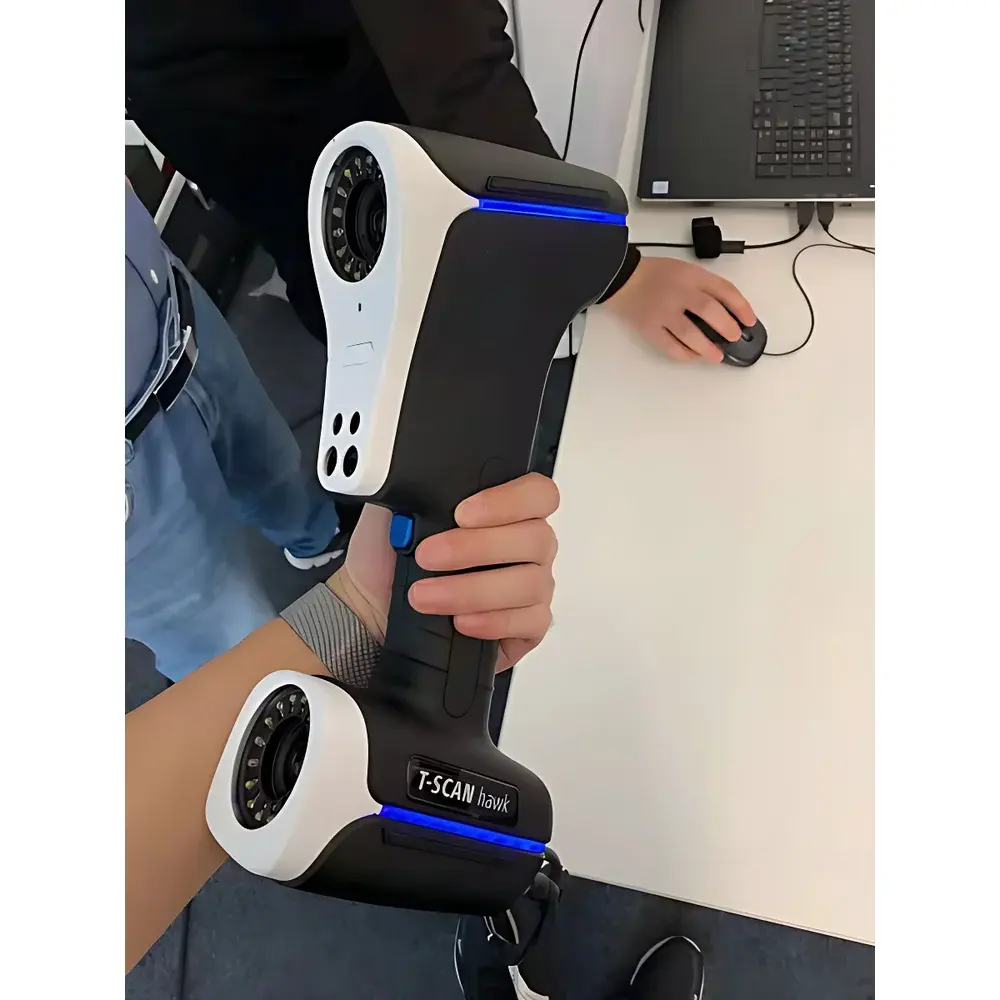
| Weight | 4 kg (sensor head) |
| Compliance | ISO 10360-8, VDI/VDE 2634 Part 2, ASTM E2924 |
| Price Range | USD 42,000 – 70,000 (FOB Germany) |
Overview
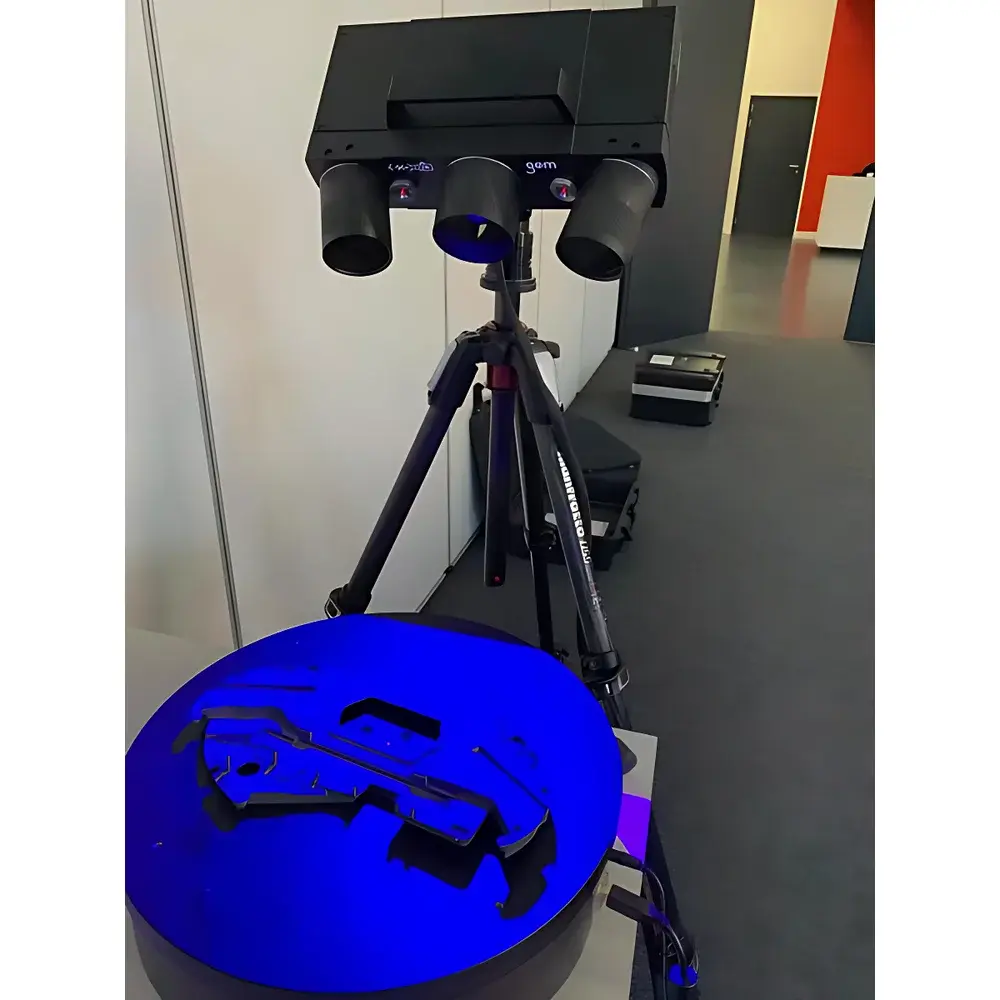
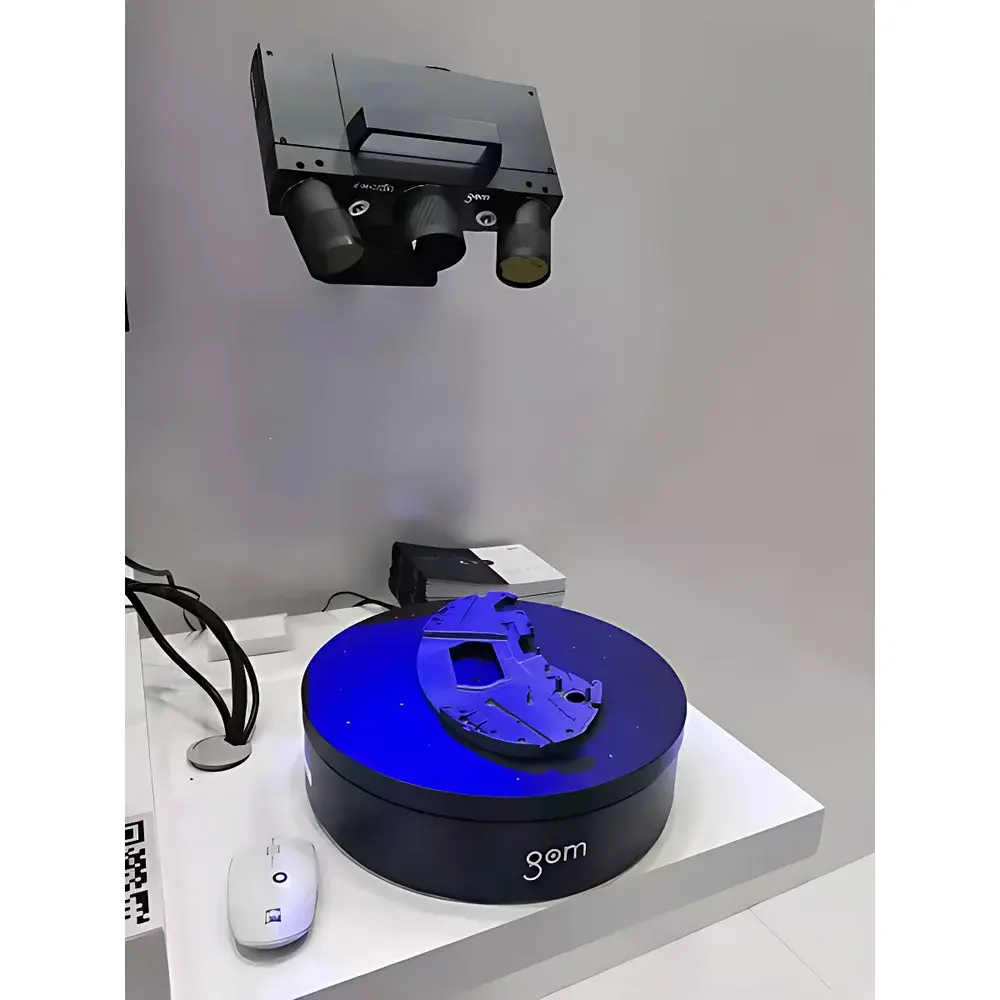
The GOM ATOS Q is a high-accuracy, industrial-grade optical 3D coordinate measuring system developed by GOM GmbH — a Zeiss Group company headquartered in Braunschweig, Germany. It employs advanced structured light triangulation with a proprietary triple-camera sensor architecture (3-in-1 lens-sensor design), enabling simultaneous acquisition of three distinct viewing angles per measurement. This eliminates the need for multiple repositioning steps on complex parts and significantly reduces measurement time without compromising geometric fidelity. Unlike contact-based CMMs or laser line scanners, the ATOS Q delivers non-contact, full-field surface data with sub-micron-level repeatability under controlled environmental conditions. Its core measurement principle relies on precise projection of calibrated fringe patterns onto the object surface, followed by real-time stereo image correlation across synchronized cameras. The system is engineered for metrology-grade applications in R&D labs, production QA/QC environments, and tooling verification workflows where traceable dimensional accuracy and surface topology integrity are critical.
Key Features
- Triple-view structured light sensor: Captures three orthogonal perspectives in a single exposure, minimizing occlusion and improving coverage on highly reflective or freeform surfaces.
- Self-monitoring metrology architecture: Real-time validation of sensor calibration, environmental lighting interference, and motion tracking during scanning — ensuring continuous traceability per measurement point.
- Adaptive ambient light compensation: Integrated photometric sensors detect and compensate for variable ambient illumination, maintaining consistent fringe contrast and reducing operator dependency on darkroom conditions.
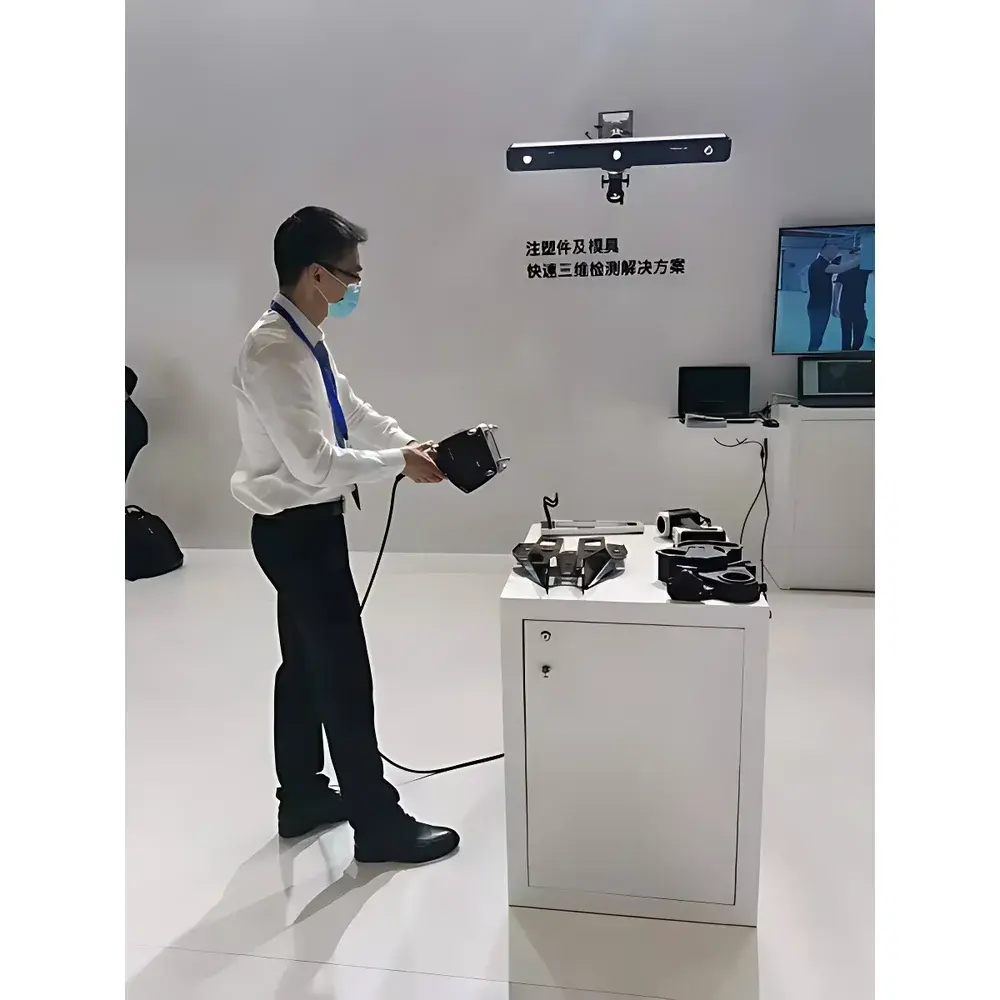
- Modular deployment options: Supports manual handheld operation (4 kg lightweight carbon-fiber sensor head), semi-automated setups with GOM ROT 350 rotary tables, and fully automated integration into ATOS ScanBox 4105 metrology cells.
- Virtual Measuring Room (VMR) compatibility: Enables offline path planning, robot motion simulation, and collision-free trajectory validation prior to physical execution — compliant with ISO/IEC 17025 pre-validation requirements.
- Ruggedized industrial design: IP53-rated enclosure, thermal-stable optical bench, and vibration-damped mounting interfaces ensure long-term stability in shop-floor environments.
Sample Compatibility & Compliance
The ATOS Q accommodates a broad range of industrial components — including sheet metal stampings, injection-molded plastic housings, turbine blades, cast engine blocks, and composite aerospace structures — with typical part sizes ranging from 50 mm to 2,000 mm. Surface finish tolerance extends from matte-painted finishes to polished metals (with optional anti-glare spray or polarization filters). All hardware and software modules comply with ISO 10360-8 (performance verification of optical CMMs), VDI/VDE 2634 Part 2 (optical 3D measuring systems), and ASTM E2924 (standard guide for 3D imaging metrology). Data export formats support ASME Y14.5 GD&T annotation, STEP AP242, and ISO 10303-21 schemas for seamless integration into PLM ecosystems such as Siemens Teamcenter and Dassault ENOVIA.
Software & Data Management
GOM Inspect Professional serves as the native analysis platform, offering certified GD&T evaluation per ISO 1101 and ASME Y14.5–2018 standards. It provides audit-trail functionality aligned with FDA 21 CFR Part 11 requirements, including electronic signatures, version-controlled report generation, and immutable log files for GLP/GMP-regulated industries. Raw point cloud data is stored in vendor-neutral HDF5 containers, supporting third-party import into PolyWorks, Geomagic Control X, or open-source tools via Python API bindings. Calibration certificates are digitally signed and timestamped, with traceability to PTB (Physikalisch-Technische Bundesanstalt) reference standards.
Applications
- First-article inspection and FAI report generation for aerospace Tier-1 suppliers.
- Digital twin creation for die-cast mold validation and wear analysis over production cycles.
- Reverse engineering of legacy parts lacking CAD documentation, with NURBS surface reconstruction capability.
- Deformation analysis in thermal or mechanical load testing (e.g., strain mapping via digital image correlation mode).
- Tooling and fixture verification in automotive body-in-white assembly lines.
- Quality gate monitoring at final assembly stations using pass/fail deviation heatmaps against nominal CAD.
FAQ
Is the ATOS Q certified for use in regulated manufacturing environments?
Yes — it meets ISO 10360-8 verification protocols and supports 21 CFR Part 11-compliant workflows when deployed with GOM Inspect Professional and appropriate IT infrastructure.
Can the system scan highly reflective or black matte surfaces without preparation?
Highly reflective surfaces require standard matte spray application; however, the ATOS Q’s adaptive lighting control and polarization filter option reduce dependency on surface treatment for many metallic finishes.
What level of technical support is available outside Germany?
GOM-certified service engineers operate globally through authorized partners, with remote diagnostics, on-site calibration, and annual performance verification services available under extended warranty agreements.
Does the ATOS Q integrate with robotic arms or automated gantries?
Yes — it supports EtherCAT and PROFINET interfaces for synchronization with KUKA, ABB, and Stäubli robots, and is fully compatible with ATOS ScanBox 4105’s integrated six-axis robotic cell architecture.
How frequently must the system be recalibrated?
Annual calibration is recommended per ISO/IEC 17025 guidelines; however, built-in self-monitoring enables daily verification checks without external artifacts.