
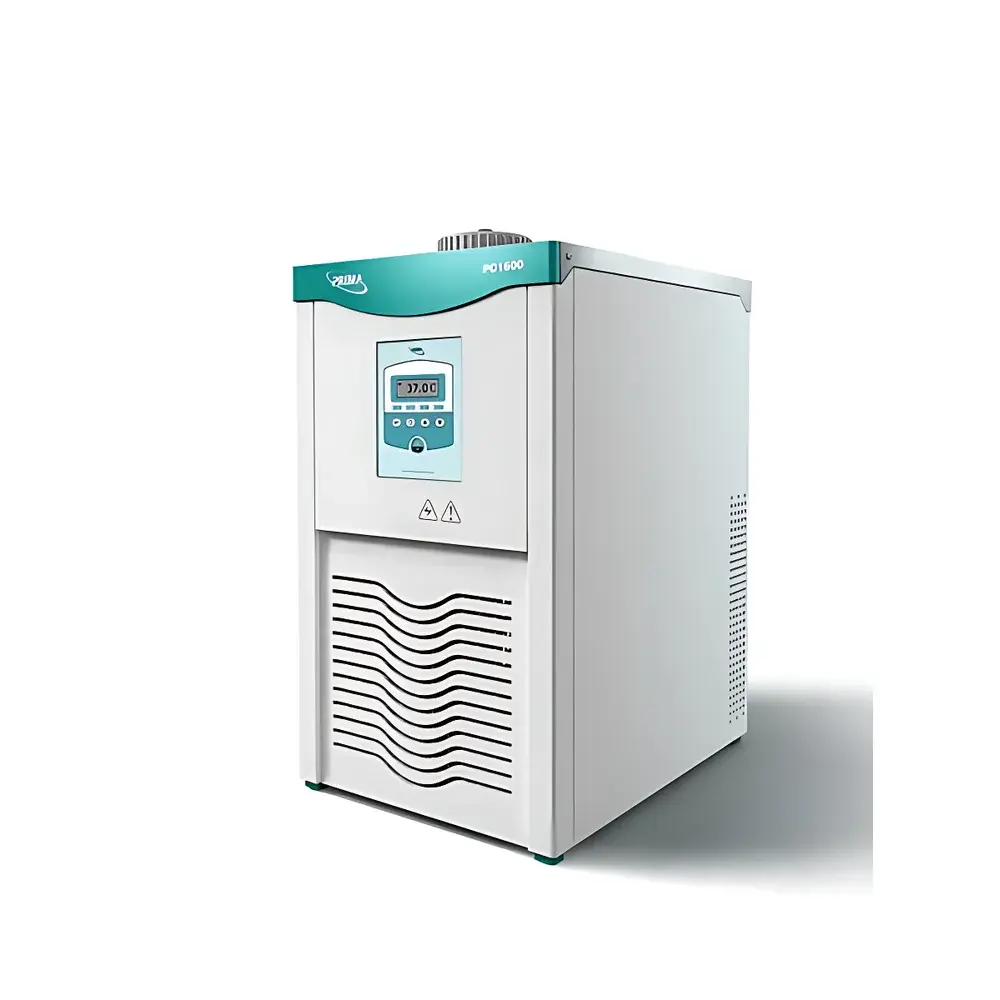
Gop (formerly PRIMA) PC1600 Circulating Chiller
| Brand | Gop (formerly PRIMA) |
|---|---|
| Origin | Imported |
| Model | PC1600 |
| Cooling Method | Water-Cooled |
| Temperature Range | −10 to 40 °C |
| Temperature Stability | ±0.02 °C @ 37 °C |
| Uniformity | ±0.05 °C @ 37 °C |
| Setpoint Resolution | 0.1 °C |
| Display | 4-digit LED |
| Temperature Control | PID with Hot-Gas Bypass |
| Refrigeration Capacity | 1600 W @ 20 °C |
| Pump Max Pressure | 4 bar |
| Pump Flow Rate | 25 L/min |
| Reservoir Volume | 3 L / 5 L (selectable) |
| Pump Type | Hermetically Sealed Magnetic Drive |
| Drain Valve | Integrated Bottom Drain |
| Communication Interface | Optional RS232/RS485 |
| External Sensor Input | Supported |
| Safety Features | Over-Temperature Cut-Off, Low-Level Dry-Run Protection, High-Accuracy Level Detection, Audible Alarm, Overcurrent Protection |
| Power Supply | 230 V, 1.6 kW, 50/60 Hz |
| Dimensions (L×W×H) | 450 × 600 × 800 mm |
| Continuous Operation Mode | Yes |
Overview
The Gop (formerly PRIMA) PC1600 Circulating Chiller is an engineered thermal management solution designed for precision laboratory and analytical instrumentation requiring stable, high-flow, low-temperature coolant delivery. Based on vapor-compression refrigeration with hot-gas bypass modulation and digital PID temperature control, the PC1600 maintains thermal equilibrium across demanding applications where heat load fluctuates dynamically—such as laser systems, electron microscopy, NMR spectrometers, ICP-MS, and high-pressure reactors. Its robust architecture supports continuous operation under full-load conditions, delivering consistent cooling performance at setpoints from −10 °C to +40 °C with a stability of ±0.02 °C at 37 °C and uniformity of ±0.05 °C across the reservoir volume. The system integrates a hermetically sealed magnetic drive circulation pump capable of sustaining 25 L/min flow at up to 4 bar pressure—ensuring reliable thermal coupling with external equipment featuring high hydraulic resistance.
Key Features
- High-precision temperature regulation via dual-stage control: digital PID algorithm combined with hot-gas bypass valve modulation for rapid response and minimal overshoot
- Hermetically sealed magnetic drive pump—zero maintenance, no seal leakage, chemically inert wetted path compatible with deionized water and common coolant mixtures
- Large-capacity dual-reservoir option (3 L or 5 L) with integrated level sensor, transparent sight window, and audible low-level alarm
- 4-digit LED display with 0.1 °C resolution; intuitive menu navigation supporting timer function (1 min to 99 h 59 min)
- Comprehensive safety suite: adjustable over-temperature cut-off, dry-run prevention, overcurrent protection, and acoustic alert for critical fault conditions
- Bottom-mounted drain valve enabling complete fluid evacuation without tilting or disassembly
- Optional communication interfaces (RS232/RS485) for integration into centralized lab monitoring systems or LIMS environments
- External PT100 input support for remote temperature feedback control in closed-loop configurations
Sample Compatibility & Compliance
The PC1600 is compatible with a broad range of laboratory instruments requiring regulated coolant supply—including but not limited to atomic absorption spectrometers, rotary evaporators, rheometers, viscometers, electrophoresis apparatus, and jacketed bioreactors. Its stainless-steel and EPDM-wetted components meet general requirements for use with aqueous coolants and glycol-water mixtures (up to 30% v/v). While not certified to specific ISO/IEC 17025 or GLP validation protocols out-of-the-box, the unit’s deterministic control behavior, audit-ready parameter logging (when equipped with serial interface), and traceable setpoint resolution support compliance with internal SOPs aligned with FDA 21 CFR Part 11 data integrity principles when deployed in regulated QC/QA workflows. All electrical components conform to IEC 61010-1:2010 for laboratory equipment safety.
Software & Data Management
The PC1600 operates autonomously via its embedded microcontroller and does not require proprietary software for basic functionality. When configured with RS232 or RS485, it supports ASCII-based command protocols for remote start/stop, setpoint adjustment, status polling (temperature, flow, error codes), and real-time data streaming. Third-party SCADA platforms or custom Python/LabVIEW scripts can log time-stamped thermal performance metrics for trend analysis or deviation reporting. Optional firmware upgrades may extend data retention depth and timestamp granularity—critical for GLP-aligned environmental monitoring records.
Applications
- Thermal stabilization of high-power lasers and optical cavities requiring sub-0.05 °C spatial uniformity
- Coolant supply for transmission electron microscopes (TEM) and scanning electron microscopes (SEM) with water-cooled condenser lenses or detector housings
- Temperature-controlled circulation in jacketed reaction vessels during exothermic synthesis or cryogenic catalysis
- Heat dissipation for ICP-MS plasma interface cones and RF generator cooling loops
- Stabilization of reference baths in metrology-grade viscometry and rheometry setups per ASTM D445 and ISO 3104
- Continuous cooling of fermentation control units and bioreactor jackets under GMP-compliant process validation frameworks
FAQ
What is the maximum allowable coolant mixture concentration for the PC1600?
The system is rated for aqueous solutions containing up to 30% (v/v) propylene glycol or ethylene glycol; higher concentrations may impair heat transfer efficiency and require recalibration of flow-dependent alarms.
Can the PC1600 be operated in an unventilated cabinet?
No—adequate ambient airflow around the condenser coil is required to maintain rated refrigeration capacity; minimum clearance of 150 mm on all sides is recommended per IEC 61000-3-12 installation guidelines.
Is the pump speed adjustable?
Pump output is fixed at maximum flow (25 L/min); however, flow rate to external devices can be regulated via external valves without affecting internal thermal stability.
Does the unit include a factory calibration certificate?
Standard delivery includes a manufacturer’s verification report referencing NIST-traceable references; formal ISO/IEC 17025 calibration documentation is available upon request and subject to additional lead time and fee.
How often should the coolant be replaced?
Under typical deionized water usage, replacement is recommended every 6 months; frequency increases with ambient humidity, particulate ingress, or glycol additive use—monitor conductivity and visual clarity as primary indicators.



