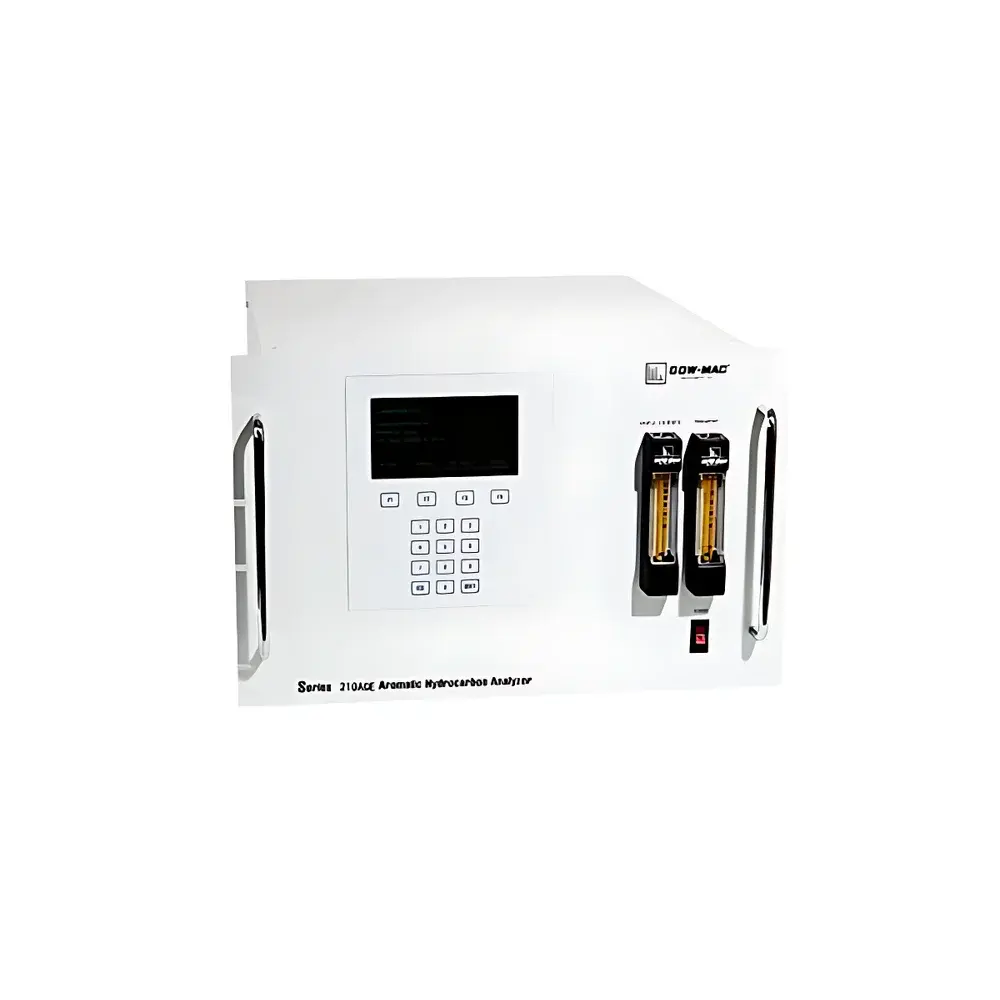
GOW-MAC 210 ACE Trace Acetaldehyde Analyzer
| Brand | GOW-MAC |
|---|---|
| Origin | USA |
| Model | 210 ACE |
| Detection Principle | Hydrogen Flame Ionization Detection (FID) with High-Selectivity Gas Chromatographic Separation |
| Detection Limit | <30 ppb |
| Linear Dynamic Range | >6 orders of magnitude |
| Compliance | ISBT Standard for Acetaldehyde in Beverage-Grade CO₂ |
| Installation | Benchtop or Rack-Mountable |
| Control Interface | Front-panel keypad + optional PC-based software with audit trail capability |
| Data Output | Real-time concentration display, analog output (4–20 mA), digital logging |
Overview
The GOW-MAC 210 ACE Trace Acetaldehyde Analyzer is a dedicated, laboratory- and production-grade gas chromatographic system engineered for the precise, continuous, or intermittent quantification of trace acetaldehyde (CH₃CHO) in high-purity carbon dioxide streams—specifically those used in beverage carbonation. Utilizing a temperature-stabilized capillary column coupled with a highly optimized hydrogen flame ionization detector (FID), the 210 ACE achieves selective separation and sensitive detection of acetaldehyde without interference from common CO₂ impurities such as methanol, ethanol, formaldehyde, acetone, or ethyl acetate. Its measurement principle adheres to the fundamental requirements of gas-phase chromatography: compound partitioning between mobile (carrier gas) and stationary (column coating) phases, followed by ionization and proportional current measurement in the FID. Designed for compliance with the International Society of Beverage Technologists (ISBT) Method for Acetaldehyde in CO₂, the analyzer delivers reproducible results at concentrations well below the ISBT specification limit of 200 ppb (0.2 ppm), with a validated detection limit of <30 ppb and linearity spanning six decades (10⁶).
Key Features
- Hydrogen flame ionization detector (FID) with proprietary burner geometry and optimized jet design for enhanced sensitivity and long-term baseline stability
- Integrated, pre-configured GC column optimized for acetaldehyde resolution in CO₂ matrix—no user column selection or method development required
- Automated sequence control: auto-zero, auto-calibration, flow regulation, sample injection, and peak integration—all executed via front-panel interface or remote command
- Benchtop or 19-inch rack-mount configuration with vibration-dampened chassis and sealed electronics enclosure for industrial environments
- Two-line vacuum fluorescent display (VFD) with tactile membrane keypad—designed for glove-compatible operation in controlled manufacturing areas
- Modular architecture: detector assembly, injection valve, and column oven are field-replaceable as single units with no alignment or calibration tools required
- Optional Ethernet/RS-485 interface supporting Modbus TCP and ASCII protocols for integration into SCADA or MES systems
Sample Compatibility & Compliance
The 210 ACE is validated exclusively for gaseous samples containing ≥99.9% CO₂, with typical inlet pressure range of 20–150 psig and flow rate of 10–50 mL/min (adjustable via integrated mass flow controller). It is not intended for liquid-phase or solvent-based matrices. The analyzer meets the analytical performance criteria defined in ISBT Technical Bulletin TB-017 (2022 Edition) for acetaldehyde determination in food-grade CO₂. Its hardware and firmware architecture support 21 CFR Part 11-compliant data integrity when operated with the optional GOW-MAC DataLink software package—including electronic signatures, audit trails, and user-level access control. All internal calibration standards are traceable to NIST SRM 1861 (Acetaldehyde in Nitrogen) and certified reference gases from ISO/IEC 17025-accredited suppliers.
Software & Data Management
The standard embedded firmware enables fully autonomous operation: users define analysis frequency (e.g., one analysis per hour, per shift, or on-demand), set alarm thresholds (e.g., 50 ppb warning, 150 ppb action), and store up to 30 days of timestamped concentration values in non-volatile memory. Optional GOW-MAC DataLink software provides PC-based instrument control, real-time trending, automated report generation (PDF/CSV), and configurable export to LIMS. All data records include metadata: operator ID, calibration status, column temperature history, FID bias voltage, and raw peak area/integration parameters. Audit logs capture every user-initiated event—including method changes, calibration runs, and alarm acknowledgments—with immutable timestamps and IP address logging where networked.
Applications
- Quality assurance of beverage-grade CO₂ supplied to soft drink, beer, and sparkling water bottlers
- In-process monitoring at CO₂ recovery and purification plants serving the food and beverage industry
- Validation of CO₂ storage tank integrity and pipeline transport systems for acetaldehyde ingress
- Supplier qualification testing per ISO 8573-1 Class 2 purity requirements for compressed gases
- Root-cause investigation during product recalls linked to off-flavor complaints attributed to acetaldehyde taint
- Supporting GLP-compliant stability studies for carbonated pharmaceutical formulations
FAQ
What carrier gas is required for the 210 ACE?
Helium or hydrogen (≥99.999% purity) is recommended as the carrier gas; nitrogen is not supported due to insufficient resolution and extended analysis time.
Can the 210 ACE analyze other aldehydes besides acetaldehyde?
No—the system is factory-optimized and calibrated solely for acetaldehyde in CO₂. Co-elution risks and lack of certified response factors preclude reliable quantification of propionaldehyde, formaldehyde, or butyraldehyde.
Is routine maintenance required beyond detector cleaning?
Yes—monthly replacement of the FID jet and ceramic igniter is recommended; quarterly verification of column retention time and calibration gas response is required for ISO/IEC 17025 compliance.
Does the analyzer require external hydrogen supply?
Yes—a dedicated hydrogen generator or cylinder (CGA-350 fitting) delivering 30–50 mL/min at 30 psig is mandatory for FID operation.
How is calibration performed?
Using certified acetaldehyde-in-nitrogen standard gases (e.g., 100 ppb and 1 ppm); the system supports two-point linear calibration with automatic slope/intercept calculation and drift correction over 72-hour intervals.
Related Products