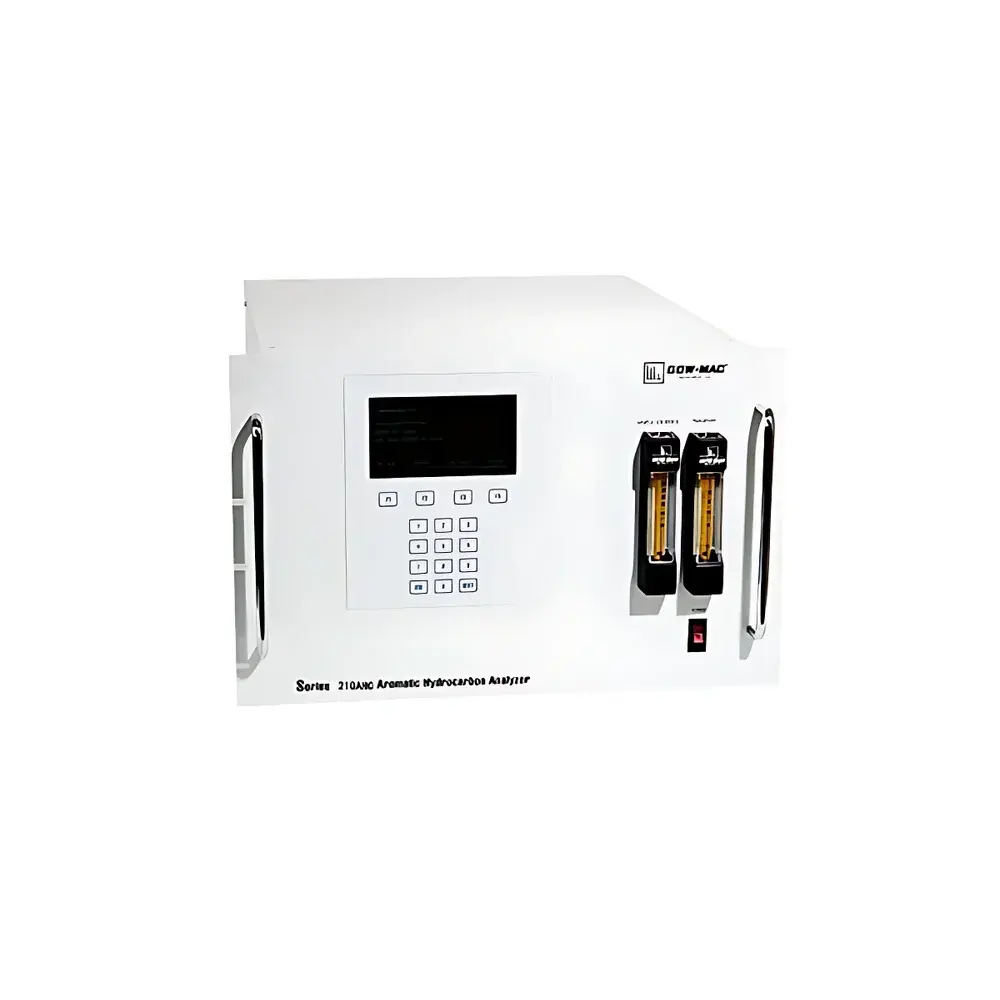
GOW-MAC 210 AHC Trace Aromatic Hydrocarbon Analyzer
| Brand | GOW-MAC |
|---|---|
| Origin | USA |
| Model | GOW-MAC 210 AHC |
| Detection Limit | <30 ppb |
| Carrier Gas Flow Rate | ≈30 cc/min |
| Carrier Gas Pressure | 60 psig |
| Sample Inlet Pressure | 5 psig (max 20 psig) |
| Calibration Gas Pressure | 5 psig (max 20 psig) |
| Operating Temperature | 5–40 °C |
| Power Requirement | 400 W |
| Dimensions (W×H×D) | 42.9×31.1×58.4 cm |
| Net Weight | 23 kg |
| Mounting | 19″ EIA rack (7U) or benchtop |
| Gas Fitting | 1/8″ Swagelok |
| Analog Outputs | six 4–20 mA channels |
| Input Trigger | TTL or dry contact |
| Display | 16×2 character LED-backlit LCD (99.0×24.0 mm active area) |
| User Interface | membrane keypad (non-contact digital input) |
| Linear Range | 5–120 ppb (1×10³ dynamic range) |
| Sample Introduction | dual-solenoid automated valve system with fixed-volume sampling loop |
Overview
The GOW-MAC 210 AHC Trace Aromatic Hydrocarbon Analyzer is a dedicated online gas chromatograph engineered for continuous, unattended quantification of benzene, toluene, ethylbenzene, and xylenes (BTEX) at sub-ppb levels in industrial gas streams. Based on proven packed-column gas chromatography with thermal conductivity detection (TCD), the instrument delivers high reproducibility and long-term stability in demanding process environments. Its design prioritizes robustness, minimal operator intervention, and compliance-ready operation—making it suitable for deployment in carbon dioxide purification systems, beverage-grade CO₂ production facilities, and other critical gas quality assurance applications where trace aromatic contamination must be monitored per ISO 8573-1 Class 1 or USP <643> specifications.
Key Features
- Modular architecture enabling “plug-and-play” replacement of detector assemblies, column ovens, and flow control modules—most field maintenance tasks completed in under 10 minutes with standard hand tools.
- Dual-solenoid automated sample introduction system: one valve selects between calibration gas and process sample; the second implements a fixed-volume sampling loop with upstream solenoid isolation to maximize calibration gas utilization during idle cycles.
- Carrier gas flow regulated by a high-accuracy mass flow controller (≈30 cc/min); carrier supply compatible with cylinder sources, bulk tanks, or portable hydrogen generators—requires stable ambient temperature (±3 °C) for pressure regulator placement.
- Front-panel visual monitoring via analog flow meters; all gas pressures (sample, calibration, carrier) independently adjustable and externally controllable per user-defined process requirements.
- Integrated 19″ EIA rack-mount chassis (7U height) or benchtop configuration; meets IEC 61000-6-2/6-4 EMC immunity and emissions standards; designed for continuous 24/7 operation in non-hazardous industrial zones.
Sample Compatibility & Compliance
The 210 AHC accepts gaseous samples across a wide pressure range (5–20 psig), including CO₂ from cryogenic distillation, fermentation off-gas, or pipeline-sourced industrial gases. It supports direct integration into existing plant DCS via six isolated 4–20 mA analog outputs and TTL/dry-contact trigger inputs. The analyzer complies with fundamental data integrity principles aligned with FDA 21 CFR Part 11 when operated with validated software protocols, and its measurement traceability supports GLP/GMP audit readiness. While not intrinsically safe, its design conforms to ANSI/ISA-12.12.01 for non-incendive equipment in Class I, Division 2 locations when installed per manufacturer guidelines.
Software & Data Management
Operation is managed through a local membrane keypad and two-line LED display—no external PC required for routine start-up, calibration, or alarm acknowledgment. All method parameters—including oven ramp profiles, detector bias settings, and integration thresholds—are stored in non-volatile memory. Optional Ethernet or RS-232 interfaces enable remote configuration and data logging via third-party SCADA or LIMS platforms. Audit trail functionality (timestamped event logs for calibration, maintenance, and parameter changes) is implemented at firmware level to support regulatory review. Raw chromatograms are not stored onboard; however, peak area, retention time, and concentration results are retained for ≥30 days with configurable export intervals.
Applications
Primary deployment domains include beverage-grade CO₂ manufacturing, where BTEX impurities must remain below 10 ppb per International Council of Beverages Associations (ICBA) guidelines; food-grade nitrogen and argon supply chains; and post-combustion flue gas treatment systems requiring aromatic hydrocarbon verification prior to carbon capture. The analyzer also serves as a reference-grade monitor in calibration laboratories supporting ISO/IEC 17025-accredited gas analysis services. Its linear response over 5–120 ppb enables precise trending of low-level contamination events—critical for root-cause analysis in multi-stage purification trains.
FAQ
What detection technology does the 210 AHC employ?
It utilizes thermal conductivity detection (TCD) coupled with stainless-steel packed columns optimized for BTEX separation under isothermal or simple ramp conditions.
Is the instrument certified for hazardous area installation?
No—it is rated for Class I, Division 2 use only when installed with appropriate barrier systems and environmental enclosures per NEC Article 500.
Can the linear range be extended beyond 120 ppb?
Yes, via optional column reconfiguration and detector gain adjustment; however, extended range operation requires revalidation per ASTM D6299 precision criteria.
Does the system support automatic multi-point calibration?
Not natively—the 210 AHC performs single-point span calibration; multi-point routines require external gas standards and manual method loading via keypad interface.
What maintenance intervals are recommended for routine operation?
Column conditioning every 6 months; TCD filament inspection annually; flow path leak checks quarterly; full system performance verification semiannually per GOW-MAC Technical Bulletin TB-210AHC-03.
Related Products