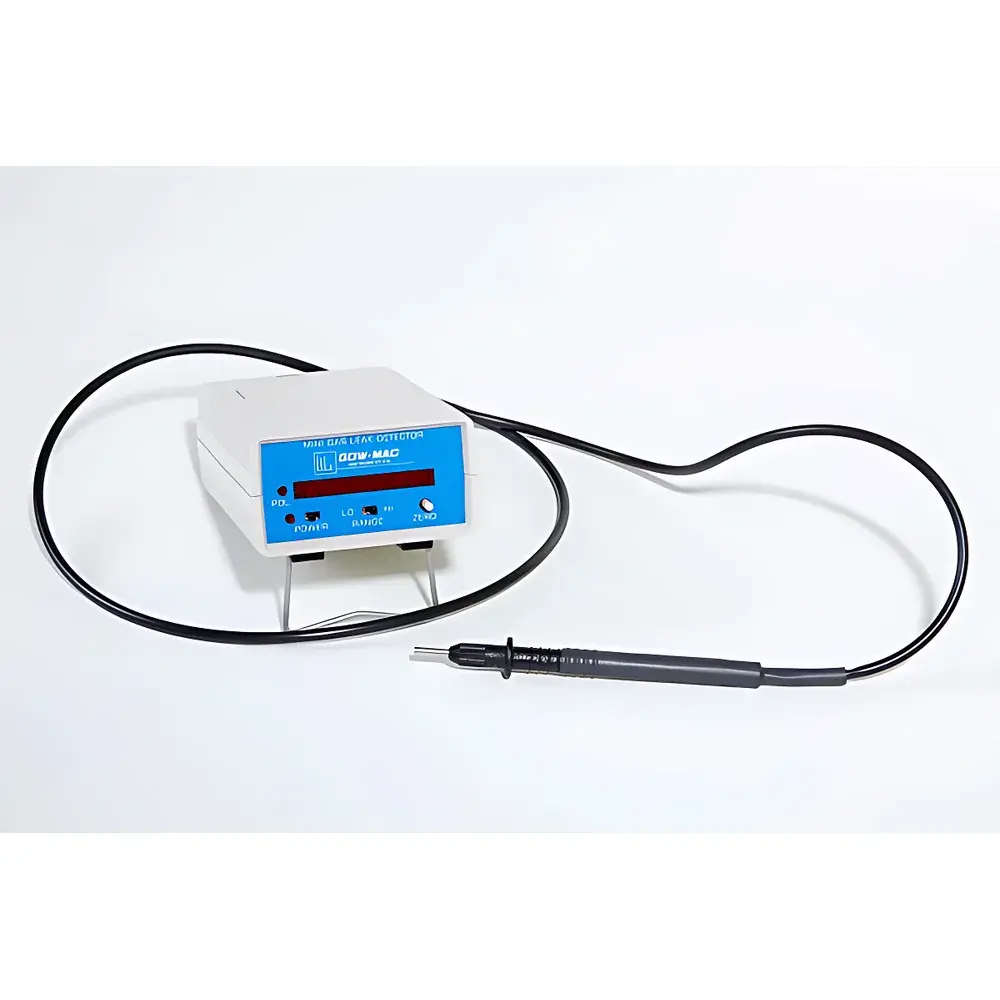
GOW-MAC 21070 Thermal Conductivity-Based Gas Leak Detector
| Brand | GOW-MAC |
|---|---|
| Origin | USA |
| Model | 21070 |
| Detection Principle | Thermal Conductivity Differential Sensing |
| Calibration Traceability | NIST-Traceable Standards |
| Power Supply | 115 V / 230 V AC, 50/60 Hz, 4 W |
| Battery | Rechargeable NiMH, 3.6 V, 1650 mAh |
| Continuous Operation | ~15 hours |
| Charge Time | <60 min to 95% capacity |
| Operating Temperature | 21 °C ± 11 °C (70 °F ± 20 °F) |
| Dimensions | 13.34 × 8.26 × 4.60 cm (L × W × H) |
| Weight | 0.48 kg (instrument only), 0.28 kg (charger) |
| Display | Adjustable-brightness LED bar graph with peak-hold function |
| Pump Type | Diaphragm |
| Sensitivity Range | Low (×1) and High (×100) selectable |
| Response Time Constant & Averaging | User-adjustable |
| Zero Drift Compensation | Manual |
| Audio Alarm | Adjustable threshold and volume |
| Data Retention | Flash memory for user settings |
| Compliance | Designed for industrial leak screening per ASTM E2921 and ISO 10648-2 (qualitative detection) |
Overview
The GOW-MAC 21070 Thermal Conductivity-Based Gas Leak Detector is a precision-engineered, portable instrument designed for rapid, qualitative identification and localization of gaseous leaks in industrial process systems, vacuum chambers, refrigeration circuits, and sealed enclosures. Unlike mass spectrometry or flame ionization methods, the 21070 employs differential thermal conductivity sensing—measuring minute changes in heat transfer between a reference air stream and sampled ambient gas. This principle enables reliable detection of gases with thermal conductivities significantly higher or lower than air (e.g., helium, hydrogen, argon, CO₂, and common refrigerants), without requiring carrier gases or vacuum infrastructure. Its architecture reflects GOW-MAC’s legacy in analytical instrumentation since 1935: robust mechanical design, analog signal stability, and field-deployable calibration integrity. The detector is explicitly intended for non-hazardous leak screening—not for safety-critical combustible gas monitoring—and complies with NIST-traceable calibration protocols per ISO/IEC 17025–aligned procedures.
Key Features
- Thermal conductivity sensor array using matched thermistor bridge configuration for high signal-to-noise ratio and long-term baseline stability
- Dual-range sensitivity selection (×1 low gain and ×100 high gain) optimized for both gross leak screening and fine-tuning near threshold detection limits
- Adjustable LED bar-graph display with user-defined peak-hold duration (1–30 seconds), enabling transient leak capture during dynamic scanning
- Integrated diaphragm pump with consistent flow control across voltage inputs (115 V / 230 V AC), ensuring repeatable sample aspiration independent of line fluctuations
- Rechargeable NiMH battery system (3.6 V, 1650 mAh) supporting up to 15 hours of continuous operation and rapid 60-minute recharge to 95% capacity
- Microprocessor-controlled firmware with flash memory storage for instrument configuration—including zero offset, alarm thresholds, and averaging parameters—preserving settings across power cycles
- Manual zero adjustment with drift compensation capability, critical for maintaining accuracy during extended field use across ambient temperature gradients
- Configurable audio alarm with independent threshold and volume controls, facilitating hands-free operation in noisy industrial environments
Sample Compatibility & Compliance
The GOW-MAC 21070 is validated for qualitative detection of gases exhibiting thermal conductivity deviations from dry air (>±15%). Typical detectable species include helium (He), hydrogen (H₂), argon (Ar), carbon dioxide (CO₂), and chlorofluorocarbon (CFC) and hydrofluorocarbon (HFC) refrigerants. Minimum detectable leak rates are specified under standardized test conditions: 1.0 × 10⁻⁵ cc/sec for He (equivalent to 0.012 ft³/yr), and 1.0 × 10⁻⁴ cc/sec for Ar, CO₂, and most refrigerants (0.110–0.123 ft³/yr). All factory calibrations are traceable to NIST Standard Reference Materials (SRMs) and documented per ISO/IEC 17025 requirements. The instrument does not meet UL 913, IEC 60079, or ATEX certification criteria and must not be deployed in classified hazardous locations. It conforms to ASTM E2921 (Standard Practice for Qualitative Leak Detection Using Thermal Conductivity Sensors) and supports GLP-aligned documentation when used with external logbooks or LIMS-integrated reporting workflows.
Software & Data Management
The 21070 operates as a standalone hardware platform with no embedded operating system or wired/wireless connectivity. All operational parameters—including sensitivity range, peak-hold time, alarm setpoint, and zero offset—are stored in non-volatile flash memory and retained after power-down. While it lacks real-time data logging or PC interface capabilities, its analog output stability and repeatable response characteristics make it suitable for integration into third-party SCADA or PLC-based monitoring loops via optional analog voltage output modules (sold separately). For audit readiness, users are advised to maintain manual calibration logs referencing the included NIST-traceable certificate (provided with each unit), and to perform periodic verification using certified leak standards per ISO 10648-2 Annex B guidelines.
Applications
- Pre-commissioning leak verification of HVAC/R systems, including evaporator coils, condenser manifolds, and brazed joints
- Routine maintenance screening of semiconductor process tooling, gloveboxes, and inert gas purged enclosures
- Quality assurance testing of hermetically sealed medical devices, pharmaceutical packaging, and MEMS sensors
- Troubleshooting vacuum integrity in electron microscopy chambers, thin-film deposition systems, and analytical spectrometers
- Educational laboratory demonstrations of gas transport phenomena and thermal property differentials
FAQ
Can the GOW-MAC 21070 detect combustible gases such as methane or propane?
No. The instrument is not intrinsically safe and lacks explosion-proof certification. It is unsuitable for detecting flammable or toxic gases in potentially hazardous atmospheres.
Is helium required as a tracer gas for operation?
No tracer gas is needed—the 21070 detects naturally occurring or process-relevant gas leaks by comparing thermal conductivity against ambient air. Helium is commonly used in industry due to its high thermal conductivity and inertness, but the detector responds to any gas with sufficient thermal contrast.
How often must the unit be recalibrated?
Annual recalibration against NIST-traceable standards is recommended for compliance with ISO 9001 and internal QA protocols. Field zeroing should be performed before each use session.
Does the device support data export or computer connectivity?
No. The 21070 is an analog-dominant, microprocessor-assisted instrument with no USB, Bluetooth, or Ethernet interface. Data recording requires manual entry or external analog signal capture.
What accessories are included with standard shipment?
Each unit ships with a universal AC adapter (115/230 V), rechargeable NiMH battery pack, and carrying case (Part No. 59-050). NIST-traceable calibration certificate and operator manual are provided digitally and in print.
Related Products