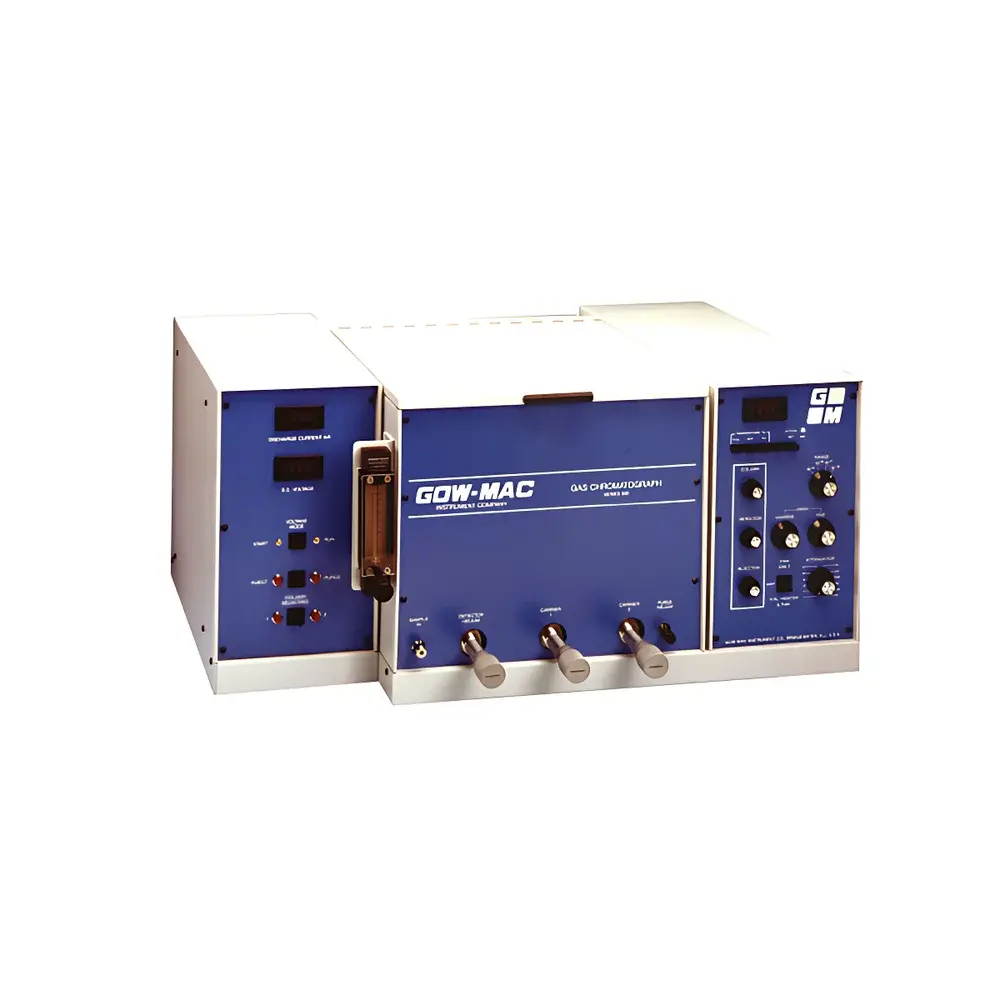
GOW-MAC 592 Dedicated Online Gas Chromatograph
| Brand | GOW-MAC |
|---|---|
| Origin | USA |
| Model | 592 |
| Detector Type | Discharge Ionization Detector (DID) |
| Detection Range | 1 ppb to <0.5% (v/v) |
| Carrier Gas | Ultra-High-Purity Helium |
| Installation Options | Benchtop or 19″ Rack-Mounted |
| Construction Options | Stainless Steel or Corrosion-Resistant Wet-Coated Surfaces |
| Compliance | Designed for ASTM D7613, ISO 8573-5, and semiconductor-grade gas purity monitoring |
Overview
The GOW-MAC 592 Dedicated Online Gas Chromatograph is an engineered analytical platform designed for continuous, high-sensitivity trace impurity analysis in ultra-pure industrial gases. Built upon GOW-MAC’s legacy of precision gas analysis since 1935, the 592 system implements gas chromatographic separation coupled with a helium-based Discharge Ionization Detector (DID) — a non-radioactive, universal, concentration-sensitive detection method. Unlike traditional radioactive detectors (e.g., Ni-63 ECD), the DID generates ionizing radiation via controlled helium plasma discharge, producing energetic UV photons and metastable helium atoms capable of ionizing all compounds except helium itself. This principle enables quantitative detection across six orders of magnitude — from sub-ppb (parts-per-quadrillion-level achievable with optimized configuration) to high-percent concentrations — without detector saturation or source decay. The instrument operates as a fixed-configuration, application-specific analyzer, optimized for routine monitoring of electronic-grade gases (e.g., N₂, Ar, O₂, H₂, CO₂, SF₆), bulk industrial gases, and specialty process streams where regulatory compliance and long-term baseline stability are critical.
Key Features
- Discharge Ionization Detector (DID): Non-radioactive, maintenance-free detection with inherent immunity to source aging; housed in a continuously helium-purged enclosure to minimize ambient contamination and suppress background noise.
- Ultra-High-Purity Gas Handling Architecture: All wetted surfaces available in electropolished stainless steel or corrosion-resistant wet-coated variants (e.g., SilcoNert® or Sulfinert®) to prevent adsorption, catalytic decomposition, or surface-induced memory effects — essential for reactive species such as HCl, NH₃, or HF.
- Robust Flow Control System: Precision bellows-sealed metering valves and helium-purged sample injection valves ensure reproducible, contamination-free introduction of sample gas — eliminating carryover and drift during extended unattended operation.
- Modular Configuration Flexibility: Pre-configured column sets and valve manifolds tailored to specific gas matrices (e.g., He matrix analysis for H₂, O₂, N₂, CH₄; Ar matrix for CO, CO₂, hydrocarbons); each configuration validated with retention time locking and peak identification libraries.
- Industrial Mounting Options: Fully compatible with both benchtop laboratory deployment and 19″ rack integration into distributed control systems (DCS) or centralized process analyser shelters, with IP54-rated enclosures available for harsh environments.
Sample Compatibility & Compliance
The GOW-MAC 592 is validated for use with inert, reactive, and corrosive gas matrices including but not limited to helium, nitrogen, argon, hydrogen, oxygen, carbon dioxide, sulfur hexafluoride, and silane derivatives. Its corrosion-resistant flow path options meet material compatibility requirements defined in SEMI F57 (for semiconductor process gases) and ISO 8573-5 (for purity class 1–2 compressed air and gases). When operated with certified UHP helium carrier gas (≥99.9999% purity, ≤10 ppt H₂O, ≤10 ppt total hydrocarbons), the system supports measurement uncertainty budgets compliant with ISO/IEC 17025–accredited laboratories. Data integrity features align with FDA 21 CFR Part 11 expectations when integrated with validated LIMS or SCADA interfaces — including electronic signature support, audit trail logging, and user-access-controlled method parameters.
Software & Data Management
The 592 operates via embedded firmware with configurable acquisition parameters (oven ramp rates, valve timing sequences, detector gain, integration thresholds). Raw chromatograms and calibrated concentration reports are exported in ASCII or CSV format for third-party data historians (e.g., OSIsoft PI, Emerson DeltaV). Optional GOW-MAC ChromaView™ software provides real-time peak tracking, alarm thresholding, trend visualization, and automated report generation per ISO 10723 or ASTM D7613 Annex A1. All method files include metadata stamping (operator ID, calibration date, column lot number), and raw signal buffers retain ≥72 hours of continuous waveform data for forensic review — satisfying GLP/GMP traceability requirements.
Applications
- Electronics Manufacturing: Monitoring dopant gases (PH₃, B₂H₆, AsH₃), etchants (ClF₃, WF₆), and purge gases (N₂, Ar) for ASTM E2132-compliant purity certification.
- Petrochemical Refining: Quantifying sulfur compounds (H₂S, COS, mercaptans) and light hydrocarbons in hydrogen reformate streams.
- Pharmaceutical Excipient Production: Verifying residual solvents (acetone, methanol, ethyl acetate) in medical-grade nitrogen or compressed air per USP <1207> and EP 2.2.43.
- Hydrogen Fuel Infrastructure: Detecting CO, CO₂, and total hydrocarbons in PEM electrolyzer output per SAE J2719 and ISO 14687-2 specifications.
- Research & Development Labs: Method development for novel gas mixtures requiring sub-ppb resolution without radioactive licensing constraints.
FAQ
Is the DID detector truly non-radioactive and license-free?
Yes. The DID uses only electrical discharge in helium — no isotopic sources. It requires no NRC or national radiation safety permits for installation or operation.
Can the GOW-MAC 592 analyze corrosive gases like HCl or Cl₂?
Yes — when specified with wet-coated flow paths (e.g., SilcoNert®-treated stainless steel) and chemically resistant column phases (e.g., porous polymer PLOT columns). Contact factory for application-specific validation data.
What carrier gas purity is required to achieve stated detection limits?
UHP helium with total hydrocarbon content ≤10 ppt and moisture ≤10 ppt is mandatory. GOW-MAC recommends integration with in-line gas purifiers (e.g., heated metal getters) for sustained ppb-level performance.
Does the system support remote diagnostics or predictive maintenance alerts?
Via optional Ethernet interface and Modbus TCP protocol, real-time status flags (oven temperature deviation, detector voltage drift, pressure fault) can be routed to plant-wide asset management systems.
Is method transfer possible between different GOW-MAC 592 units?
Yes. Retention time locking, standardized column dimensions (e.g., 0.53 mm ID, 15 m length), and identical valve timing logic enable direct method portability across instruments within the same configuration family.
Related Products