
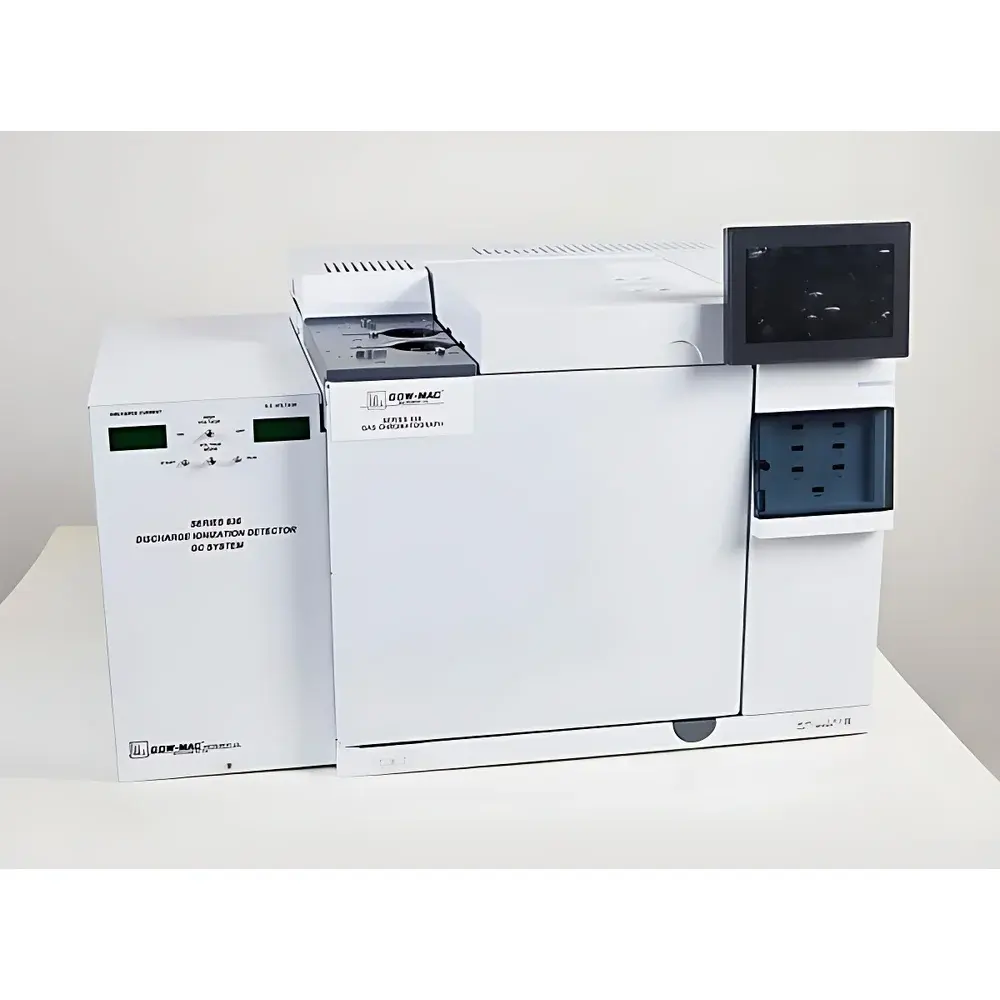
GOW-MAC 836 Series Gas Chromatograph
| Brand | GOW-MAC |
|---|---|
| Origin | USA |
| Model | GOW-MAC 836 Series |
| Instrument Type | Laboratory Gas Chromatograph |
| Column Configuration | Up to 8 Valves & 10 Columns |
| Oven Temperature Range | Ambient +4°C to 450°C |
| Max Ramp Rate | 120°C/min |
| Cooling Time | 450°C to 50°C in ≤4 min |
| Temperature Resolution | 0.1°C |
| Oven Program Steps | 20–21 ramps |
| Detector Capacity | Up to 3 Independent, Thermally Controlled Detectors |
| Detector Options | DID, TCD, FID, PID, FPD, NPD |
| Flow Control | Electronic Pressure Control (EPC) |
| Dimensions | 58 cm × 54 cm × 56 cm |
| Detection Limits | 5 ppb (CH₄, DID), 20 ppb (CH₄, FID), 2×10⁻⁹ g/mL (CₙHₘ, TCD), 1×10⁻¹² g (C₆H₆, PID), 50 ppb avg. (FPD), 10 ppb avg. (NPD) |
| Response Times | <0.5 s (DID, TCD, PID), 1 ms (FID) |
| Linear Dynamic Ranges | 10⁴–10⁷ (detector-dependent, log-log scale) |
Overview
The GOW-MAC 836 Series Gas Chromatograph is a high-performance, multi-dimensional laboratory gas chromatograph engineered for precision analysis of volatile and semi-volatile organic compounds across diverse sample matrices. Designed and manufactured in the United States since GOW-MAC’s founding in 1935, this system leverages decades of detector innovation and robust GC architecture to deliver exceptional sensitivity, method reproducibility, and analytical flexibility. Its core operational principle relies on differential partitioning of analytes between a mobile gas phase (helium, hydrogen, or nitrogen) and stationary phases coated inside capillary or packed columns. Separation efficiency is enhanced through precise thermal programming of the column oven and independent temperature control of up to three detectors—enabling simultaneous or sequential detection with orthogonal selectivity.
Key Features
- Multi-dimensional configuration support: Up to eight programmable valves and ten columns allow for comprehensive heart-cutting, column switching, and back-flushing applications—ideal for complex mixture resolution (e.g., petrochemical streams, environmental extracts, or flavor/aroma profiling).
- Thermally isolated, independently controlled detector compartments: Each detector (DID, TCD, FID, PID, FPD, or NPD) operates at its optimal temperature without cross-interference, supporting concurrent detection modes within a single run.
- High-fidelity oven system: Temperature range from ambient +4°C to 450°C with 0.1°C setpoint resolution; programmable ramp rates up to 120°C/min; rapid cooling (<4 minutes from 450°C to 50°C) enabled by optimized air circulation and thermal mass management.
- Electronic Pressure Control (EPC): Delivers stable, repeatable carrier gas flow and pressure profiles across methods—critical for retention time stability, quantitative accuracy, and compliance with ISO 17025 and ASTM D3606/D5186 validation requirements.
- Modular hardware architecture: Designed for long-term serviceability and field-upgradability—including detector swaps, valve manifold expansions, and data system integration—reducing total cost of ownership over instrument lifetime.
Sample Compatibility & Compliance
The GOW-MAC 836 Series accommodates a broad spectrum of sample introduction techniques—including split/splitless injection, on-column, PTV, and gas-tight syringe—compatible with liquid, gaseous, and headspace-derived samples. It supports both fused-silica capillary columns (0.1–0.53 mm ID) and stainless-steel or glass packed columns (up to 6 m). Regulatory alignment includes design features essential for GLP and GMP environments: audit-trail-capable software (when paired with compliant acquisition platforms), EPC traceability per USP , and detector response linearity verified per ICH Q2(R2) guidelines. The system meets mechanical and electrical safety standards per UL 61010-1 and CE marking directives (2014/30/EU, 2014/35/EU).
Software & Data Management
While the 836 Series operates via front-panel controls and analog/digital I/O, it is fully compatible with third-party chromatography data systems (CDS) compliant with ASTM E1947 and ASTM E2524 standards—including Thermo Chromeleon, Agilent OpenLab CDS, and Waters Empower. All detector signals are output as calibrated voltage or current (4–20 mA or 0–10 V), enabling seamless integration into LIMS and ELN workflows. When configured with optional digital interface modules, the system supports full remote monitoring, method transfer, and electronic signature functionality aligned with FDA 21 CFR Part 11 requirements—including user access control, event logging, and immutable data archiving.
Applications
- Environmental testing: EPA Method 8021B (halogenated hydrocarbons), 8260D (VOCs), and 8015M (petroleum hydrocarbons) analysis using FID/TCD/DID combinations.
- Petrochemical QA/QC: SimDist (ASTM D2887), hydrocarbon type analysis (ASTM D5186), and sulfur speciation (FPD/NPD) in refinery streams.
- Pharmaceutical residual solvents: USP and ICH Q3C-compliant quantification of Class 2 and 3 solvents via headspace-GC/FID.
- Food & flavor chemistry: Quantitative profiling of terpenes, esters, and aldehydes in essential oils and fermented products using multi-column heart-cutting and PID/FID dual detection.
- Industrial hygiene: OSHA and NIOSH method implementation (e.g., NIOSH 1501, 1600) for workplace air contaminant monitoring.
FAQ
What detector configurations are supported on the GOW-MAC 836 Series?
The system supports up to three independently temperature-controlled detectors simultaneously. Common configurations include FID+TCD for hydrocarbon/oxygenate analysis, DID+FID for ultra-trace methane in inert gases, or FPD+NPD for selective sulfur/nitrogen compound detection.
Is the column oven programmable for complex temperature gradients?
Yes—the oven accepts up to 21 temperature ramps and holds, with 0.1°C resolution and ramp rates adjustable from 0.1°C/min to 120°C/min. Gradient reproducibility is maintained within ±0.2°C across repeated runs.
Does the system comply with regulatory data integrity requirements?
When integrated with validated CDS software and appropriate network security protocols, the 836 Series supports ALCOA+ principles (Attributable, Legible, Contemporaneous, Original, Accurate, Complete, Consistent, Enduring, Available) and meets technical prerequisites for FDA 21 CFR Part 11 and EU Annex 11 compliance.
Can the GOW-MAC 836 be used for method development involving column switching?
Yes—its modular valve manifold supports up to eight electrically actuated, temperature-stabilized valves, enabling automated multidimensional GC (MDGC) configurations such as heart-cutting, comprehensive two-dimensional GC (GC×GC) precursor setups, and parallel column analysis.
What maintenance intervals are recommended for detector performance verification?
Detector baseline noise, sensitivity, and linearity should be verified at least weekly for regulated environments, or per internal SOPs. GOW-MAC recommends annual calibration of EPC modules and biannual inspection of oven insulation and detector filaments—documentation templates are provided in the Instrument Qualification Package (IQP).






