
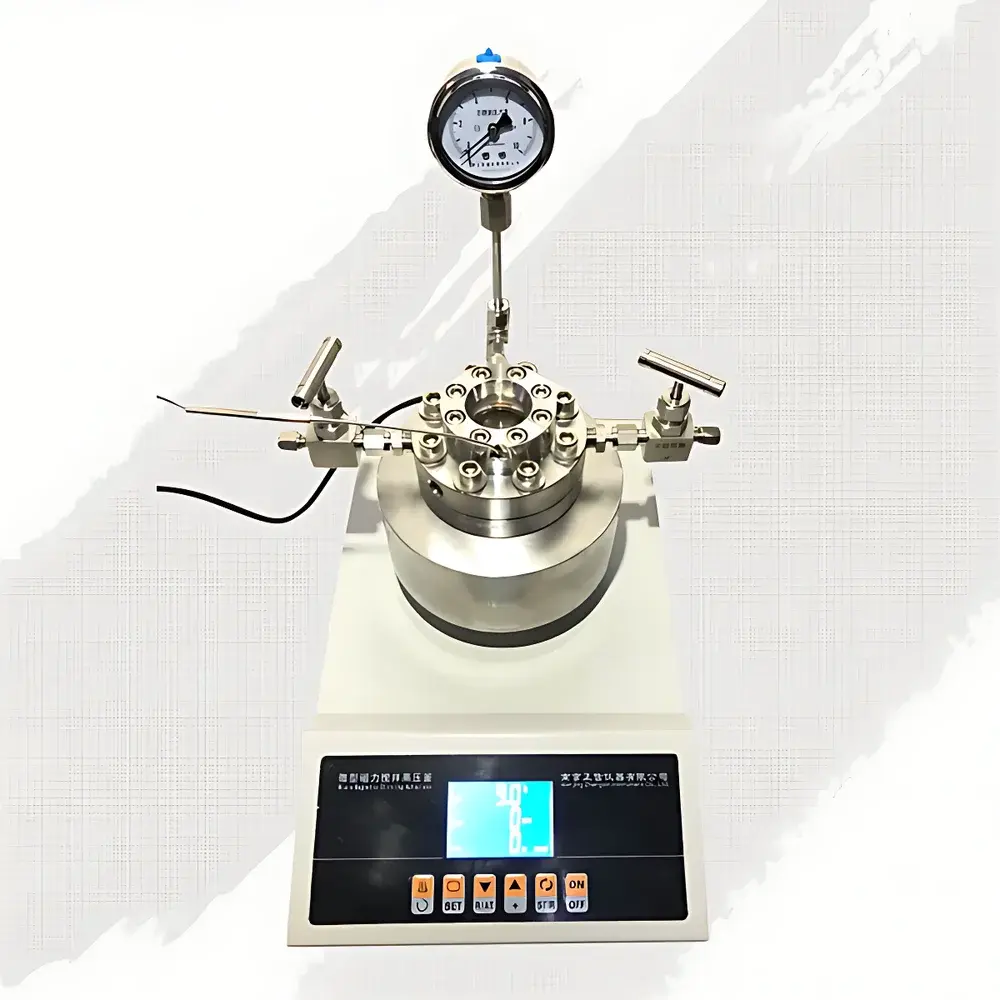
GPSK-100ML Photochemical High-Pressure Reactor (ZXYIQI Brand)
| Brand | ZXYIQI |
|---|---|
| Origin | Jiangsu, China |
| Manufacturer Type | Authorized Distributor |
| Country of Origin | China |
| Model | GPSK |
| Capacity | 100 mL |
| Vessel Material | Stainless Steel (304/316L standard) |
| Operating Pressure Range | Up to 40 MPa |
| Vacuum Level | ≤ –0.1 MPa |
| Temperature Range | 0–400 °C |
| Heating Method | Embedded Modular Heater |
| Control System | PID Dual-Loop Temperature Control |
| Stirring Speed | 0–1000 rpm |
| Sealing | Hybrid Soft/Hard Seal (Alloy Face + Elastomer Gasket) |
| Safety Features | Overpressure Rupture Disc (Hastelloy), Overtemperature/Overtime Alarm, Acoustic & Visual Alert |
| Window Material | Sapphire (Standard), Optional Quartz or Tempered Glass |
| Window Position | Top-Mounted or Side-Mounted |
| Stirring Type | Magnetic Suspension Drive |
| Internal Lining Options | PTFE, Quartz, PPL, or Steel-Lined |
| Power Supply | 220 V / 110 V AC |
Overview
The GPSK-100ML Photochemical High-Pressure Reactor is a purpose-engineered laboratory-scale reaction system designed for controlled photochemical transformations under elevated pressure and temperature conditions. It integrates high-intensity optical access with robust pressure containment—enabling quantitative studies of photocatalytic mechanisms in gas-phase and liquid-phase heterogeneous systems. The reactor operates on the principle of simultaneous photon irradiation (via external or internal light sources, including UV–vis LEDs or xenon arc lamps) and pressurized reaction environments, facilitating kinetic investigations of light-driven redox processes such as CO₂ photoreduction to CH₃OH or CH₄, NOₓ abatement, and formaldehyde mineralization. Its monolithic stainless steel (standard 304 or optional 316L/310S/Hastelloy/Ti) construction ensures structural integrity at pressures up to 40 MPa and temperatures up to 400 °C, while its sapphire viewport (≥15 mm thickness, Vickers hardness >2000 HV) maintains optical clarity and chemical inertness under aggressive catalytic media.
Key Features
- Hybrid sealing architecture combining elastomeric soft gaskets and precision-machined alloy face seals for leak-tight performance across thermal and pressure cycles.
- Dual-loop PID temperature control with K-type thermocouple feedback (±1 °C accuracy), preventing thermal overshoot during ramp-and-hold protocols.
- Magnetic suspension stirring system using SmCo permanent magnets and brushless DC motor—eliminating shaft penetration and enabling continuous operation at 0–1000 rpm without seal degradation.
- Modular heating design allows rapid thermal coupling/decoupling between reactor body and heater block—reducing thermal inertia and improving reproducibility in kinetic experiments.
- Integrated overpressure protection via replaceable Hastelloy C-276 rupture disc, calibrated to activate within ±3% tolerance of set burst pressure.
- Top- or side-mounted sapphire viewport (optional quartz for UV-C transmission) with AR-coating compatibility—supporting in situ spectroscopic monitoring (e.g., Raman, UV-Vis absorption).
Sample Compatibility & Compliance
The GPSK-100ML accommodates heterogeneous photocatalysts (e.g., TiO₂, g-C₃N₄, MOFs), slurry-phase suspensions, supercritical CO₂ mixtures, and corrosive reagents (e.g., HF-containing electrolytes when lined with PTFE or PPL). All wetted components comply with ASTM A240/A276 standards for austenitic stainless steels. Optional linings (quartz, PTFE, PPL) extend compatibility to hydrofluoric acid, molten alkalis, and strong oxidants. The reactor meets ASME BPVC Section VIII Div. 1 design requirements for Class I pressure vessels and supports GLP-compliant documentation through optional data-logging modules with timestamped event records (alarm triggers, pressure spikes, temperature deviations).
Software & Data Management
While the base unit features an embedded LCD interface with real-time display of temperature, pressure, stirring speed, and elapsed time, optional RS485/Modbus RTU connectivity enables integration into LabVIEW™, MATLAB™, or custom SCADA platforms. Data logging (1 Hz sampling) can be configured to record up to 10,000 points per session, with CSV export supporting post-acquisition analysis of Arrhenius parameters, quantum yield calculations, and pressure-dependent rate constants. Audit-trail functionality—including operator ID tagging and parameter-change history—is available upon request to satisfy FDA 21 CFR Part 11 requirements for regulated laboratories.
Applications
- Photocatalytic CO₂ hydrogenation to methanol and methane under syngas-relevant partial pressures (1–10 MPa).
- In situ mechanistic studies of plasmonic nanoparticle-assisted N₂ fixation under visible-light excitation.
- High-pressure photo-Fenton oxidation of recalcitrant organics (e.g., pharmaceuticals, PFAS precursors) in aqueous media.
- Stability testing of perovskite-based photocathodes in contact with corrosive electrolytes under operational bias and illumination.
- Accelerated aging of photocatalytic coatings under combined UV irradiance and thermal cycling (ISO 4892-2).
FAQ
What light sources are compatible with the GPSK-100ML reactor?
Standard configurations accept collimated LED arrays (365–450 nm), 300 W xenon arc lamps with liquid light guides, or fiber-coupled lasers (up to 5 W CW). Custom port adapters support UV-C (254 nm) quartz windows.
Can the reactor be used for electrochemical-photochemical hybrid reactions?
Yes—optional feedthroughs accommodate Pt, Ag/AgCl, or graphite electrodes rated to 400 °C and 40 MPa; electrical insulation meets IEC 61000-4-5 surge immunity standards.
Is third-party calibration certification available?
Factory calibration certificates (traceable to NIM, China) are included; ISO/IEC 17025-accredited calibration by TÜV SÜD or SGS may be arranged pre-shipment.
What maintenance intervals are recommended for the magnetic drive and rupture disc?
Magnetic coupling requires no scheduled maintenance; rupture discs must be replaced after each activation event or every 12 months under continuous operation, per ASME guidelines.
Does the system support automated gas dosing and composition analysis?
Gas inlet/outlet ports conform to Swagelok® SS-400 series; optional integration with mass flow controllers (MFCs) and online GC-TCD/FID is supported via analog I/O expansion module.



