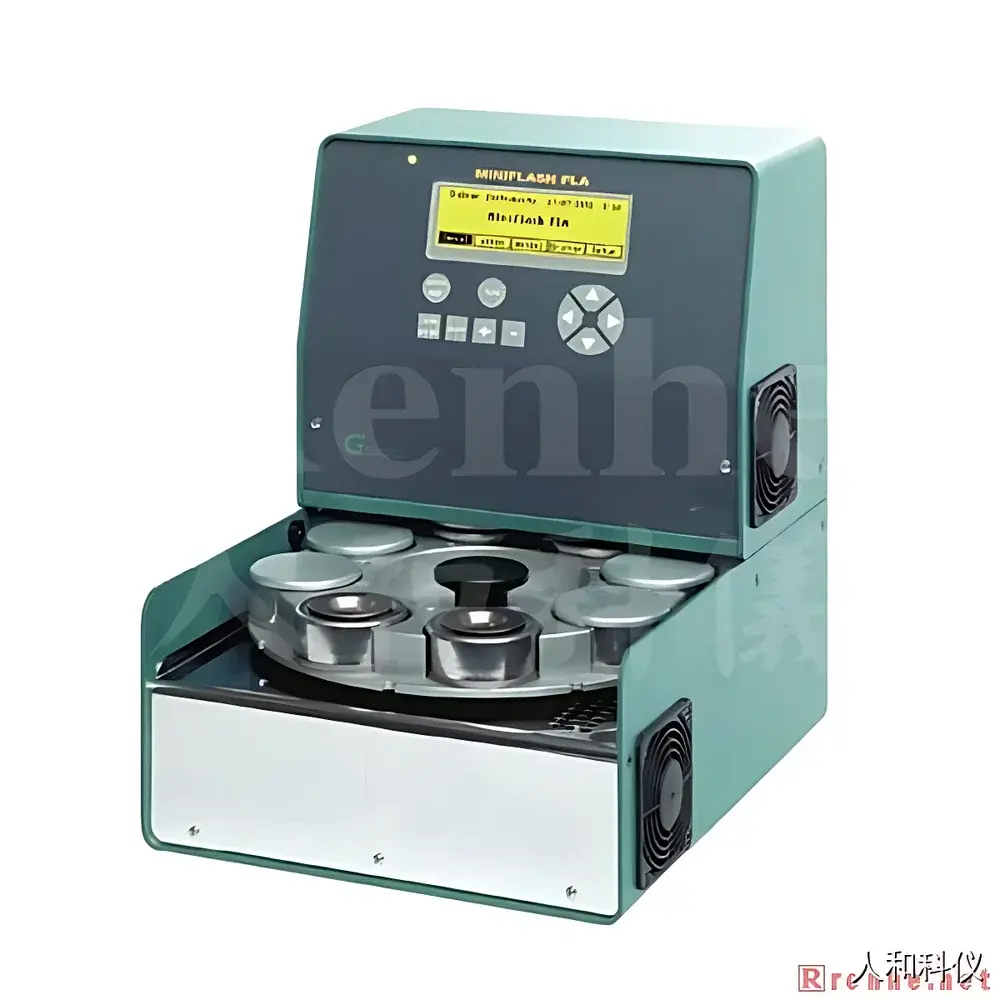
Grabner MiniFlash FLA 8-Position Automatic Flash Point Sampler
| Brand | Grabner |
|---|---|
| Origin | Austria |
| Model | MiniFlash FLA |
| Detection Method | Closed-Cup |
| Operation Mode | Fully Automatic |
| Compliant Standards | ASTM D6450 (SH/T 0768) & D7094 |
| Temperature Range | 0 to 200 °C |
| Dimensions (W×H×D) | 312 × 402 × 390 mm |
| Weight | 20 kg |
Overview
The Grabner MiniFlash FLA is an 8-position fully automatic sample handler engineered for seamless integration with the MiniFlash series of closed-cup flash point analyzers. Designed around the Peltier-controlled heating and high-sensitivity flame detection architecture of the MiniFlash platform, the FLA unit enables unattended, standardized flash point determination in strict accordance with ASTM D6450 (equivalent to SH/T 0768) and ASTM D7094 methodologies. Its operation relies on precise thermal ramping, automated sample aspiration, and reproducible cup sealing—ensuring thermodynamic equilibrium prior to ignition source exposure. The system eliminates manual pipetting, cup loading, and instrument repositioning, reducing operator intervention to initial setup and final data review. With a temperature control range spanning 0 to 200 °C and compatibility with low-volume (2 mL) samples, the FLA supports both quantitative flash point measurement and pass/fail GO/NOGO screening across diverse petroleum, chemical, pharmaceutical, and industrial waste matrices.
Key Features
- Fully automated 8-position sample carousel with barcode-ready vial support and integrated lid detection
- Throughput capacity up to 80 samples per 24-hour cycle under continuous operation
- Mean cycle time ≤45 minutes for a full 8-sample batch, including thermal equilibration, injection, and post-test purge
- Precise 2 mL sample volume handling via positive-displacement syringe pump, minimizing carryover and cross-contamination
- Integrated Peltier-based temperature control synchronized with MiniFlash main unit for traceable thermal profiling
- Modular mechanical design compliant with ISO/IEC 17025 laboratory infrastructure requirements; CE-marked per EU Machinery Directive 2006/42/EC
Sample Compatibility & Compliance
The MiniFlash FLA accommodates standard 10–15 mL glass or metal sample vials with screw caps or crimp seals. It handles viscous residues (e.g., used engine oils, asphalt cutbacks), volatile distillates (jet fuel, diesel), aqueous-organic mixtures (pharmaceutical intermediates), and heterogeneous suspensions (filter cakes, sludge emulsions) without modification. All measurements adhere to internationally recognized closed-cup protocols: ASTM D6450 (for low-flash liquids, including ethanol/IPA solutions) and ASTM D7094 (for high-boiling, viscous, or thermally unstable samples). Data output meets GLP documentation requirements—including audit trails, user authentication logs, and timestamped method parameters—as validated under FDA 21 CFR Part 11-compliant software configurations (when paired with MiniFlash Control Software v5.3+).
Software & Data Management
When operated with Grabner’s MiniFlash Control Software, the FLA module enables method-driven scheduling, multi-step temperature ramp programming (e.g., for fuel dilution curve generation), and real-time status monitoring via Ethernet or USB 2.0 interface. Raw thermal curves, ignition event timestamps, and pass/fail flags are stored in vendor-neutral CSV and XML formats. The software supports customizable report templates aligned with internal QA checklists or external regulatory submissions (e.g., UN TDG Class 3 hazard classification, ADR/RID transport compliance). Audit trail functionality records all user actions—including method edits, calibration events, and result overrides—with immutable digital signatures where enabled.
Applications
- Petroleum & Lubricants: Detection of low-flash contaminants in jet fuel (ASTM D1655), diesel (EN 590), and crankcase oils; quantification of diesel/gasoline dilution in used engine oil via programmable flash point depression curves
- Pharmaceutical Manufacturing: Flash point verification of ethanol-, isopropanol-, or glycerol-containing drug substances and excipients per ICH Q5C stability guidelines
- Hazardous Materials Transport: Pre-shipment screening per UN Manual of Tests and Criteria, Part III, Section 32.3 (closed-cup flash point for Class 3 flammable liquids)
- Coatings & Inks: Safety assessment of solvent-borne paints, varnishes, and printing inks during R&D and batch release
- Waste Characterization: Classification of unknown liquid hydrocarbon streams or filter cake leachates under EPA SW-846 Method 1020B or ISO 3679
- Maintenance Diagnostics: Early detection of fuel ingress into lubricating oils—where ≥1% diesel dilution typically reduces flash point by 15–30 °C, signaling imminent mechanical risk
FAQ
Is the MiniFlash FLA compatible with legacy MiniFlash instruments?
Yes—the FLA interfaces with all MiniFlash models released since 2012 (including MiniFlash FP, MiniFlash CC, and MiniFlash Smart) via standardized RS-232 or Ethernet communication protocols.
Can the FLA perform GO/NOGO testing at user-defined flash point thresholds?
Yes—threshold-based pass/fail logic can be embedded directly into assay methods, enabling rapid compliance checks against transport or storage limits (e.g., “fail if flash point < 60 °C”).
Does the system require routine calibration with certified reference materials?
Per ISO 2719 and ASTM E502, annual verification using NIST-traceable standards (e.g., n-decane, n-dodecane) is recommended; Grabner provides certified calibration kits with uncertainty budgets.
What maintenance is required for long-term reliability?
Daily wiping of the sample probe and cup interface; quarterly inspection of Peltier module thermal paste; biannual replacement of the silicone O-ring seal kit (part no. FLA-SEAL-KIT).
How is sample carryover mitigated between runs?
Each vial position includes dedicated rinse cycles using solvent-compatible purge gas (compressed air or nitrogen); syringe and needle assemblies are cleaned in situ with two-stage solvent flushes pre- and post-injection.