
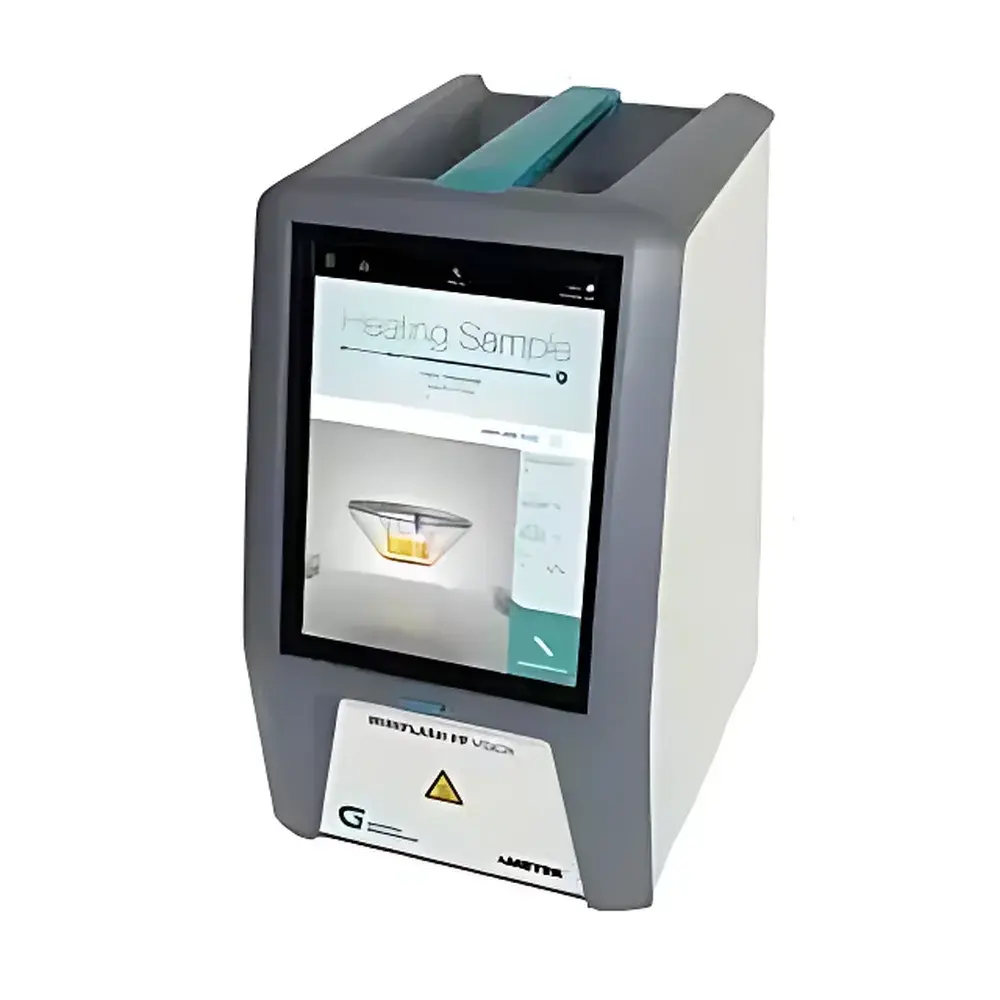
GRABNER MINIFLASH FP Vision Closed-Cup Flash Point Analyzer
| Brand | GRABNER |
|---|---|
| Origin | Austria |
| Model | MINIFLASH FP Vision |
| Detection Method | Closed-Cup (ASTM D6450/D7094) |
| Temperature Range | 0–120 °C (standard), down to –25 °C with external chiller |
| Temp. Stability | ±0.05 °C |
| Sample Volume | 1–2 mL |
| Throughput | Up to 12 samples/hour |
| Interfaces | 4× USB, 2× LAN |
| Power | 100–240 V AC, 50/60 Hz, max. 180 W |
| Dimensions | 253 × 368 × 277 mm |
| Weight | 10.2–11.2 kg |
Overview
The GRABNER MINIFLASH FP Vision is a fully automated, closed-cup flash point analyzer engineered for precision, safety, and regulatory compliance in demanding industrial and quality control laboratories. It operates on the principle of equilibrium-based closed-cup testing—specifically implementing the ASTM D6450 and D7094 methodologies—which rely on controlled heating, vapor-phase ignition detection via high-sensitivity optical flame recognition, and real-time thermal profiling. Unlike traditional Pensky-Martens (ASTM D93) or Tagliabue (ASTM D56) instruments, the FP Vision eliminates open flames, manual ignition, and large sample volumes, instead using a micro-volume (1–2 mL), continuously sealed test chamber with integrated Peltier thermoelectric heating and cooling. This architecture ensures repeatable flash point determination across volatile, viscous, and contaminated hydrocarbon streams—including fuels, lubricants, solvents, fragrances, coatings, and used oils—while meeting stringent occupational safety and environmental requirements.
Key Features
- Optical flame detection with real-time video recording of ignition events—enabling combustion analysis for trace contaminant assessment
- Peltier-based rapid thermal cycling: achieves sub-1-minute cooling between tests without external chillers (0–120 °C range); optional water-cooled operation extends range to –25 °C
- Automated ignition system with self-cleaning cycle—removes carbonaceous residues from electrodes to maintain long-term accuracy
- Patented continuous closed-cup design: zero open flame, no vented fumes, and active air compensation to suppress explosive atmospheres and odor release
- 10-inch full-color capacitive touchscreen with context-aware visual navigation—no operator training required
- Integrated sample chamber auto-lid mechanism prevents spillage, ensures reproducible headspace geometry, and enhances operator safety
- GLP-compliant user management and audit trail via Cockpit™ software (SQC edition), supporting ASTM D6299 performance monitoring and 21 CFR Part 11 readiness
Sample Compatibility & Compliance
The MINIFLASH FP Vision accommodates diverse sample matrices: low-flash liquids (e.g., ethanol blends, acetone, ethyl acetate), high-viscosity oils (e.g., engine oils, gear lubes), multi-component mixtures (e.g., biodiesel blends, reformulated gasoline), and thermally unstable formulations (e.g., fragrance concentrates, polymerizable monomers). Its method library includes pre-validated protocols aligned with ASTM D6450 (adopted as SH/T 0768 in China), ASTM D7094, ISO 3679/3680, IP 523/524, and EN 15292. Validation studies confirm statistical equivalence to ASTM D93 (Pensky-Martens) per ASTM Flash Point Committee statement, and strong correlation with ISO 2719, DIN 51758, IP 34, JIS K2265, ISO 13736, and IP 170. The instrument is formally approved by the U.S. Department of Transportation (DOT), U.S. Environmental Protection Agency (EPA) under RCRA, U.S. Navy, and NATO for fuel and lubricant certification—and listed in multiple ASTM standard annexes governing aviation turbine fuel, marine distillates, and transformer oil specifications.
Software & Data Management
Cockpit™ is GRABNER’s centralized laboratory informatics platform, enabling remote configuration, real-time monitoring, and secure data aggregation across distributed MINIFLASH Vision instruments. The Cockpit™ SQC module implements ASTM D6299-based control charts for bias, precision, and stability tracking—supporting routine QC verification and GLP/GMP audit preparedness. All test logs include timestamped metadata (operator ID, method version, ambient conditions, calibration status), digital signatures, and immutable storage. Data export supports CSV, PDF, and LIMS-compatible XML formats. USB and dual-LAN interfaces allow seamless integration into enterprise networks, electronic lab notebooks (ELN), and chromatography data systems (CDS). On-device digital manuals are searchable, version-controlled, and exportable—ensuring consistent procedural adherence across shifts and sites.
Applications
- Petroleum refining & distribution: rapid flash point screening of crude cuts, naphthas, jet fuels (Jet A-1, JP-8), and diesel blends per ASTM D93/D6450 equivalency requirements
- Chemical manufacturing: safety classification of intermediates, solvents, and monomers under GHS/CLP and OSHA HCS frameworks
- Power generation: transformer oil condition monitoring—including fuel dilution detection and oxidation stability assessment
- Fragrance & flavor R&D: flash point verification of highly volatile aroma compounds where conventional methods fail due to evaporation loss
- Coatings & inks: formulation QC for solvent-borne systems with narrow flash point tolerances and complex volatility profiles
- Regulatory compliance labs: accredited testing per ISO/IEC 17025, supporting UN TDG, IMDG Code, and IATA Dangerous Goods Regulations submissions
FAQ
Does the MINIFLASH FP Vision comply with ASTM D93 equivalency requirements?
Yes—the ASTM Flash Point Committee has confirmed that D7094 results show no statistically significant difference from D93 Method A, enabling direct substitution in most regulatory and contractual contexts.
Can it test high-viscosity or residue-containing samples?
Yes—its optimized cup geometry, Peltier thermal control, and automated electrode cleaning enable reliable flash point determination for used engine oils, bitumen cutbacks, and heavy fuel oils.
Is remote diagnostics and firmware updates supported?
Yes—via Cockpit™ Cloud Connect, users can initiate secure remote support sessions, schedule over-the-air updates, and monitor instrument health metrics in real time.
What safety certifications does the instrument hold?
It carries CE marking (ATEX Category 2G, IECEx), UL 61010-1 listing, and formal approvals from U.S. DOT, EPA, U.S. Navy, and NATO for field-deployable hazardous materials testing.
How is method validation performed for non-standard applications?
Users may define custom ramp rates, hold times, ignition thresholds, and pass/fail criteria; all methods are stored with full version history, parameter lockout, and electronic signature capability.
Related Products







