
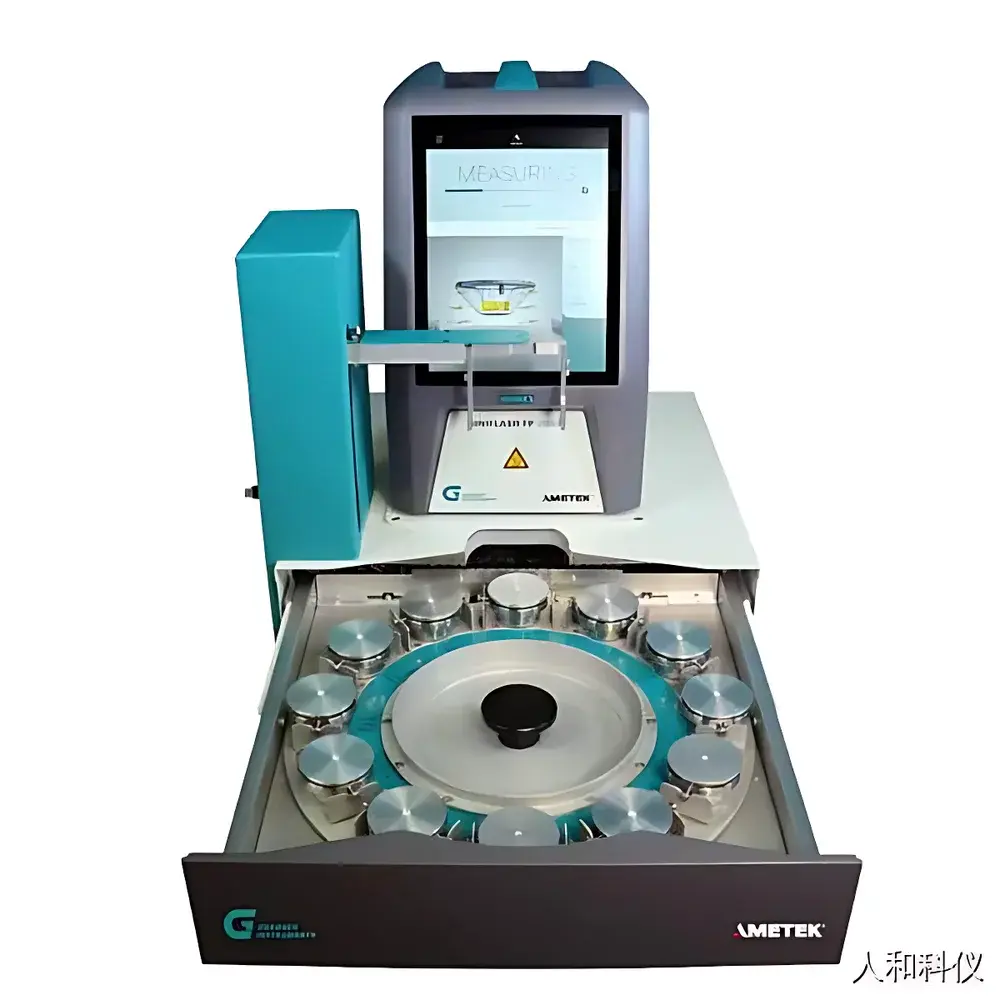
Grabner MINIFLASH FPA VISION 12-Position Automatic Sample Handler for Flash Point Testing
| Brand | Grabner |
|---|---|
| Origin | Austria |
| Model | MINIFLASH FPA VISION |
| Detection Method | Closed-Cup |
| Operation Mode | Fully Automatic |
| Power Supply | 100–264 VAC, 45–63 Hz, Max. 50 W |
| Dimensions (W×H×D) | 435 × 425 × 415 mm |
| Height with FP(H) VISION mounted | 530 mm |
| Weight | 15.9 kg (turntable: 2.2 kg |
| fully loaded turntable | 4.2 kg) |
| Cooling | External liquid cooling interface |
| Compliance | CE-marked per EN standards for laboratory instruments |
| Software Platform | VISION Platform with Cockpit™ PC software |
| Interface | Dedicated hardware interface to MINIFLASH FP/H VISION analyzers |
Overview
The Grabner MINIFLASH FPA VISION is a purpose-built 12-position automatic sample handler engineered exclusively for integration with the MINIFLASH FP(H) VISION series of closed-cup flash point analyzers. Designed and manufactured in Austria, this module implements ASTM D93, ISO 2719, IP 34, and EN ISO 3679-compliant flash point determination using the Pensky-Martens closed-cup principle. Its core function is to automate sequential sample introduction, cup loading, temperature ramping coordination, ignition sequence triggering, and post-test cleaning—enabling unattended operation across wide thermal ranges from –25 °C to +400 °C. Unlike standalone autosamplers, the FPA VISION is not a generic peripheral but a mechanically and electronically synchronized subsystem, sharing real-time thermal status, pressure compensation data, and ignition timing signals with the host analyzer via proprietary low-latency hardware interface. This tight coupling ensures measurement integrity under dynamic thermal gradients and eliminates inter-device synchronization latency—a critical requirement for reproducible flash point detection per GLP and ISO/IEC 17025-accredited laboratories.
Key Features
- 12-Position High-Density Sample Carousel: Increases sample throughput capacity by 50% compared to predecessor models, supporting continuous batch analysis without manual intervention.
- Ultra-Compact Footprint: Occupies only 0.18 m²—optimized for space-constrained QC labs while maintaining full compliance with IEC 61000-6-3 EMC and EN 61010-1 safety requirements.
- Modular Plug-and-Play Integration: Installs or detaches in under 30 seconds without tools; compatible with both MINIFLASH FP VISION (low-flash) and FPH VISION (high-flash) variants via identical mechanical docking and signal bus architecture.
- Industrial-Grade Construction: Housed in electrostatically coated steel chassis; uses sealed industrial-grade stepper motors, reinforced ceramic-bearing turntable, and conformally coated PCBs rated for continuous operation at ambient temperatures up to 40 °C.
- Active Chamber Cooling Interface: Supports external recirculating chiller connection (e.g., Huber CC-K20) to maintain sample carousel ambient below 25 °C during extended high-temperature testing—preventing premature volatilization and thermal drift in volatile fractions.
- Switch-Mode Power Architecture: Integrated 50 W external power supply delivers stable, low-noise DC rails, minimizing electromagnetic interference with sensitive flame-detection photodiodes and thermocouple amplifiers.
Sample Compatibility & Compliance
The FPA VISION accommodates standard 30–50 mL Pensky-Martens test cups (ASTM D93-compliant geometry), including stainless-steel, aluminum, and disposable polymer variants. It supports all petroleum distillates, biofuels (FAME, HVO), solvents, lubricants, and formulated chemical intermediates within the instrument’s validated flash point range. All motion control firmware adheres to IEC 62061 SIL1 functional safety requirements for laboratory automation. The system is CE-marked under Directive 2014/30/EU (EMC) and 2014/35/EU (LVD), and conforms to EN 61326-1:2013 for measuring/control lab equipment. Data audit trails generated via Cockpit™ software comply with FDA 21 CFR Part 11 requirements when configured with electronic signatures and role-based access control.
Software & Data Management
Operation is fully orchestrated through the VISION platform’s Cockpit™ PC software—designed for Industry 4.0-ready laboratories. Users define test sequences (e.g., “Crude Cut Series”, “Jet Fuel QC Batch”) with customizable hold times, ramp rates, and pass/fail criteria. The software auto-synchronizes method parameters with the FP(H) VISION unit and triggers sample positioning, cup sealing, and ignition logic without operator input. All raw sensor timestamps, thermocouple readings, flame detection events, and pass/fail decisions are logged with nanosecond-resolution hardware clocks. Export formats include CSV, PDF reports (with digital signature), and direct SQL database push to LIMS via ODBC. Remote monitoring, multi-site fleet management, and over-the-air firmware updates are supported via TLS 1.2-encrypted Ethernet or optional Wi-Fi module.
Applications
The FPA VISION is deployed in refinery QC labs for rapid screening of naphtha, kerosene, diesel, and residual fuel oils; in petrochemical R&D for evaluating novel solvent blends and hydrogenated bio-oils; in aviation fuel certification labs performing ASTM D1655 Annex A5 testing; and in regulatory compliance facilities conducting UN GHS Category 1–4 flammability classification per CLP Regulation (EC) No 1272/2008. Its modular design also enables deployment in mobile field labs—where quick disassembly allows separate transport of analyzer and autosampler—and in contract testing organizations requiring concurrent validation of multiple flash point methods on shared hardware infrastructure.
FAQ
Is the FPA VISION compatible with legacy MINIFLASH FP models?
No. It is exclusively designed for the VISION-series analyzers (FP VISION and FPH VISION) and requires firmware version ≥3.2.0.
Does the autosampler require calibration independent of the main analyzer?
No. Positional accuracy is factory-trimmed via laser interferometry and maintained through closed-loop stepper motor control; no user calibration is required.
Can the cooling interface support dry ice or Peltier-based chillers?
Only liquid-recirculating chillers with 6–10 °C outlet temperature and ≥0.5 L/min flow rate are validated; Peltier systems lack sufficient thermal mass stability for sustained operation.
What happens if a sample cup is misaligned or missing during rotation?
Integrated capacitive cup presence sensors and optical position verification halt movement and generate an error log entry before initiating any thermal cycle.
Is remote firmware update capability available without local PC access?
Yes—when connected to enterprise networks with static IP assignment and firewall port forwarding enabled, updates can be pushed via Grabner’s secure cloud portal.






